Why Champions League Uses Neutral Venues: Fan Guide
The Champions League final is always played at a neutral venue. That is not a preference or a tradition — it is written directly into UEFA’s competition regulations, which states that the final is contested as a single match at a pre-selected neutral ground. Beyond the final, UEFA can also move group-stage or knockout ties to neutral locations when safety, logistics, or stadium fitness make a home fixture unworkable.
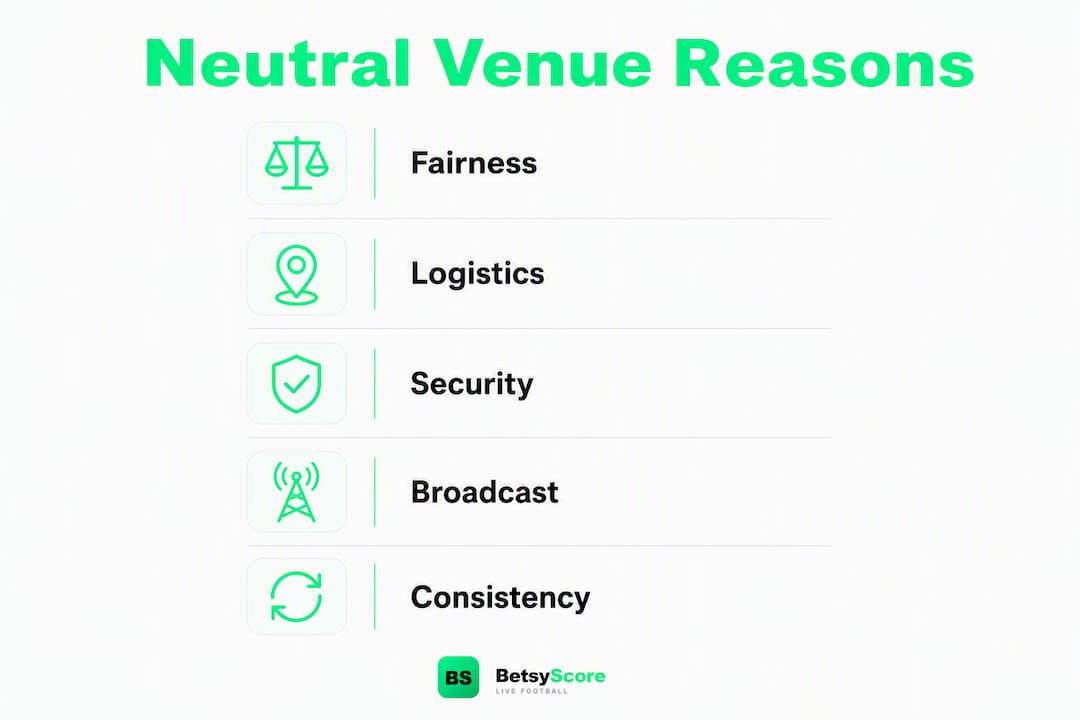
The core reasons UEFA relies on neutral venues:
- Sporting fairness: A one-off final cannot give either finalist a home-crowd advantage.
- Safety and public order: Policing capacity, city infrastructure, and cross-border travel limits can make a home fixture unsafe or impractical.
- Operational logistics: Stadium capacity, transport links, broadcast infrastructure, and hospitality requirements must meet UEFA’s minimum standards.
- Commercial and ticketing control: Neutral finals let UEFA manage ticket allocation, sponsorship inventory, and broadcast rights without interference from a home club’s commercial interests.
The sections below break down each of these reasons in detail, covering how host stadiums are selected, what “neutral venue” actually means for competition rules, and the real-world cases where UEFA has moved matches.
Table of Contents
- Why does the Champions League use neutral venues for the final?
- How does UEFA select and prepare a host stadium?
- Why do security and logistics sometimes force matches to neutral venues?
- What does “neutral venue” actually mean for rules and administration?
- Notable examples of neutral and relocated venues
- Key Takeaways
- Why neutral venues matter more than most fans realize
- Useful sources
- FAQ
Why does the Champions League use neutral venues for the final?
The simplest answer is fairness. A Champions League final is a single match with no second leg, no away-goals tiebreaker, and no chance to recover from a hostile environment. If the final were held at one finalist’s home ground, that club would arrive with familiar turf, a partisan crowd, and no travel disruption. The other finalist would face the opposite. UEFA’s regulations eliminate that asymmetry by mandating a pre-selected neutral stadium chosen years in advance.
The commercial logic reinforces the sporting one. A neutral final is a controlled environment where UEFA, not a home club, manages ticket allocation, hospitality packages, and broadcast positioning. A portion of tickets at a Champions League final are allocated to each finalist’s supporters, with the remainder distributed to UEFA sponsors, national associations, and commercial partners. That split is only possible when no club has a territorial claim on the stadium.
Consistency matters to broadcasters and sponsors too. A fixed, pre-announced neutral venue allows global media partners to plan production infrastructure, satellite uplinks, and on-site studios months in advance. Moving the final to a home ground at short notice would disrupt contracts worth hundreds of millions of dollars.
Pro Tip: Home advantage in football is real across a full season, but its effect in a single high-stakes final is harder to isolate. Research on football momentum shows that crowd noise and familiarity influence in-game momentum, which is precisely why UEFA removes those variables for the most important match of the club calendar.
How does UEFA select and prepare a host stadium?
UEFA announces host cities for Champions League finals several years in advance, following a formal bidding process. National associations and city authorities submit bids, and UEFA evaluates them against a detailed set of criteria before awarding hosting rights.
The key stadium and city requirements include:
- Capacity: — The venue must meet UEFA’s minimum seat threshold for a final, typically a large national or club stadium, as specified by UEFA regulations.
- Transport and airport access: UEFA regulations require that the host city be reachable by direct international flights and/or charter services within an acceptable travel window. Smaller cities without major international airports are effectively ineligible.
Once a bid is awarded, UEFA’s administration conducts operational checks in the years leading up to the final. Local authorities must formally confirm policing and public-order arrangements. If those confirmations are not received, UEFA retains the authority to reconsider the host assignment.
The role of UEFA rankings in seeding and competition structure also feeds into venue planning: higher-ranked associations tend to have more stadiums that already meet UEFA’s technical standards, which is why finals cluster in Western Europe.

Why do security and logistics sometimes force matches to neutral venues?
Fairness explains the final. For group-stage and knockout ties, the triggers are almost always operational. UEFA’s regulations give the administration authority to move a match when a home stadium is judged unfit, when city infrastructure cannot support the fixture, or when policing resources are unavailable.
City-based fixture congestion is one of the most common pressure points. UEFA rules prevent multiple major ties from being staged in the same city on the same night. When two clubs from the same city are drawn to play home legs simultaneously, the lower-ranked club is typically required to find an alternative venue outside the city. That effectively converts a home leg into a neutral fixture, with the home club bearing all staging costs under Article 26 of the Champions League regulations.
When fixture congestion, travel bans, or policing limits make a home venue unworkable, UEFA’s regulations give the administration the authority to select a neutral stadium in another association’s territory if no acceptable local alternative exists.
The COVID-19 pandemic produced the starkest recent examples. In February 2021, UEFA moved Manchester City’s last-16 first leg against Borussia Mönchengladbach to Budapest because Germany had imposed travel restrictions on arrivals from Britain. Liverpool’s tie against RB Leipzig was similarly relocated to Budapest. Chelsea’s quarter-final against Porto was moved to Seville for the same reason. In each case, the home club was responsible for finding an alternative; when no acceptable local option existed, UEFA stepped in and selected the neutral site.
The practical lesson: neutral venues for non-final matches are rarely about sporting fairness. They are the least disruptive way to keep the competition on schedule when the original venue becomes unworkable.
What does “neutral venue” actually mean for rules and administration?
Moving a match to a neutral ground does not reset the competition’s administrative structure. Home and away designations remain in place for regulatory purposes, regardless of where the match is physically played.
| Administrative element | Effect at a neutral venue |
|---|---|
| Home/away designation | Unchanged; the club listed as “home” retains that status for competition rules |
| Staging costs | The home club bears the costs of the relocated match under UEFA regulations |
| Away goals (when applicable) | Goals scored at a neutral venue count as away goals when the administrative designation is “away” |
| Ticket allocation | UEFA manages the split; finals use a controlled allocation with no home-club priority |
| Transport requirements | Clubs must have access to direct international or charter flights to the host city |
One nuance worth noting: a final can technically take place in a finalist’s home city and still be classified as a neutral venue. UEFA’s ticket allocation controls and administrative oversight preserve neutrality even in that scenario. The 2019 Champions League final at Wanda Metropolitano in Madrid is a useful reference point: neither finalist was a Spanish club, so the stadium’s location was incidental. But even when a finalist’s city hosts the final, UEFA’s 50/50 ticket split and full administrative control mean the match retains its neutral status.
Pro Tip: If a match you planned to attend gets relocated, check the official UEFA website and the relevant club’s communications first. Ticket validity, transport logistics, and hospitality arrangements all change with the venue. Betsyscore’s live coverage updates venue and lineup information in real time, so it is a practical first stop when news breaks.
Notable examples of neutral and relocated venues
The history of the Champions League includes several cases where the neutral-venue principle was applied in ways fans did not expect.
Old Trafford, 2003: The 2003 Champions League final was held at Old Trafford in Manchester. Neither finalist, AC Milan nor Juventus, was an English club, making it a straightforward neutral assignment. It remains one of the most cited examples of a prestigious club stadium used as a neutral final venue.
COVID-era relocations, 2020–2021: The pandemic produced the most widespread use of neutral venues in the competition’s modern history. Matches were relocated to Budapest, Seville, and Bucharest as travel restrictions made home fixtures impossible. In several cases, both legs of a knockout tie were played at neutral grounds, with administrative home/away designations preserved throughout.
The 2020–21 season demonstrated that UEFA’s neutral-venue framework is not just a fairness mechanism for finals — it is the operational backbone that keeps the competition running when external conditions make home fixtures unworkable.
London congestion cases: When two London clubs have been drawn to play home legs on the same night, UEFA’s city-congestion rules have required the lower-ranked club to relocate. Chelsea have faced this scenario in the Champions League last 16, with the club required to identify an alternative stadium outside London or risk UEFA selecting one. Clubs can sometimes avoid relocation by reversing the leg order, playing the first leg at home and the second away, provided they notify UEFA before the draw.
For a broader look at the clubs that have navigated these rules across multiple finals, Betsyscore’s Champions League winners page covers the full title history.
Key Takeaways
The Champions League uses neutral venues to protect sporting fairness, guarantee operational safety, and maintain UEFA’s control over the commercial and administrative framework of its flagship competition.
| Point | Details |
|---|---|
| Finals are always neutral | UEFA regulations mandate a single match at a pre-selected neutral stadium, with no home-club advantage. |
| Non-final relocations are logistics-driven | City congestion, policing limits, and travel restrictions are the most common triggers for moving knockout ties. |
| Administrative designations remain | Home/away status and related rules (including away goals when applicable) are preserved even at neutral venues. |
| Home club pays staging costs | Under Article 26 of the Champions League regulations, the home club bears costs when a match is relocated. |
| Transport access is a hard requirement | UEFA requires direct international or charter flight access to any approved host city. |
Why neutral venues matter more than most fans realize
The neutral-venue rule is often treated as a footnote, something that applies to the final and gets forgotten the rest of the season. The COVID relocations changed that perception. Suddenly, fans who had booked travel to Budapest expecting a home fixture for their club found themselves in a genuinely neutral environment, with no home crowd, no familiar stadium, and no logistical advantage for either side.
What that period revealed is that UEFA’s neutral-venue framework is not a ceremonial gesture toward fairness. It is a functional contingency system, built into the regulations precisely because the Champions League operates across dozens of countries with different travel rules, policing capacities, and infrastructure standards. The final gets the most attention, but the same regulatory machinery that governs the final is what kept the 2020–21 knockout rounds running when national governments were closing borders.
For fans planning to attend a Champions League match, the practical implication is straightforward: venue confirmations should always be treated as provisional until UEFA’s administration has signed off on operational checks. Club announcements and UEFA’s official communications are the authoritative sources. Betsyscore’s Champions League predictions and live coverage also reflect venue updates as they are confirmed, which is useful when news moves quickly.
Useful sources
The following primary documents and reports are the most reliable references for understanding Champions League venue rules and relocations.
- UEFA Champions League Regulations, Article 25 (Stadium announcements) — The official regulation governing how home stadiums are designated and when exceptions apply.
- AP News: UEFA moves Man City game to Hungary — Contemporaneous reporting on the COVID-era relocation of the Mönchengladbach vs. Manchester City tie.
- AP News: Chelsea vs. Porto moved to Seville — Reports on the quarter-final relocation driven by UK travel restrictions.
For live venue confirmations, lineup updates, and real-time match data, Betsyscore covers all Champions League fixtures with scores, predictions, and instant stats updated throughout each match.
FAQ
Is the Champions League final always at a neutral venue?
Yes. UEFA regulations state that the final is played as a single match at a neutral venue selected by UEFA in advance, with no home-club designation for either finalist.
Why can’t Anfield host international or Champions League final matches?
Anfield can host Champions League group-stage and knockout ties as Liverpool’s home ground. It cannot host a final unless UEFA selects it as a neutral venue for a specific edition, which requires the full bidding and approval process — Liverpool’s presence in the competition would complicate that designation.
Do away goals still count when a match is moved to a neutral venue?
Yes. UEFA preserves administrative home/away designations when a match is relocated, so goals scored by the administratively “away” side count as away goals under the rules that applied at the time.
Why can’t Inter Miami play in the Champions League?
Inter Miami competes in Major League Soccer, which is governed by CONCACAF, not UEFA. The Champions League is a UEFA club competition open only to clubs affiliated with UEFA member associations in Europe. Inter Miami would need to be a European club to qualify.
How does UEFA decide which city hosts the Champions League final?
UEFA runs a formal bidding process in which national associations and city authorities submit applications. Bids are evaluated against criteria including stadium capacity, international airport access, hospitality infrastructure, broadcast facilities, and confirmed policing arrangements. Host cities are typically announced several years before the final takes place.