Role of UEFA Rankings in the Champions League

UEFA rankings are a points-based system that determines how many clubs from each country qualify for the Champions League and at what stage they enter the competition. Known formally as UEFA club coefficients and association coefficients, these rankings shape everything from direct league phase access to draw seeding. The role of UEFA rankings in the Champions League is not a minor administrative detail. It is the structural backbone that decides which clubs face qualifying rounds and which walk straight into the main event.
How are UEFA club and association coefficients calculated?
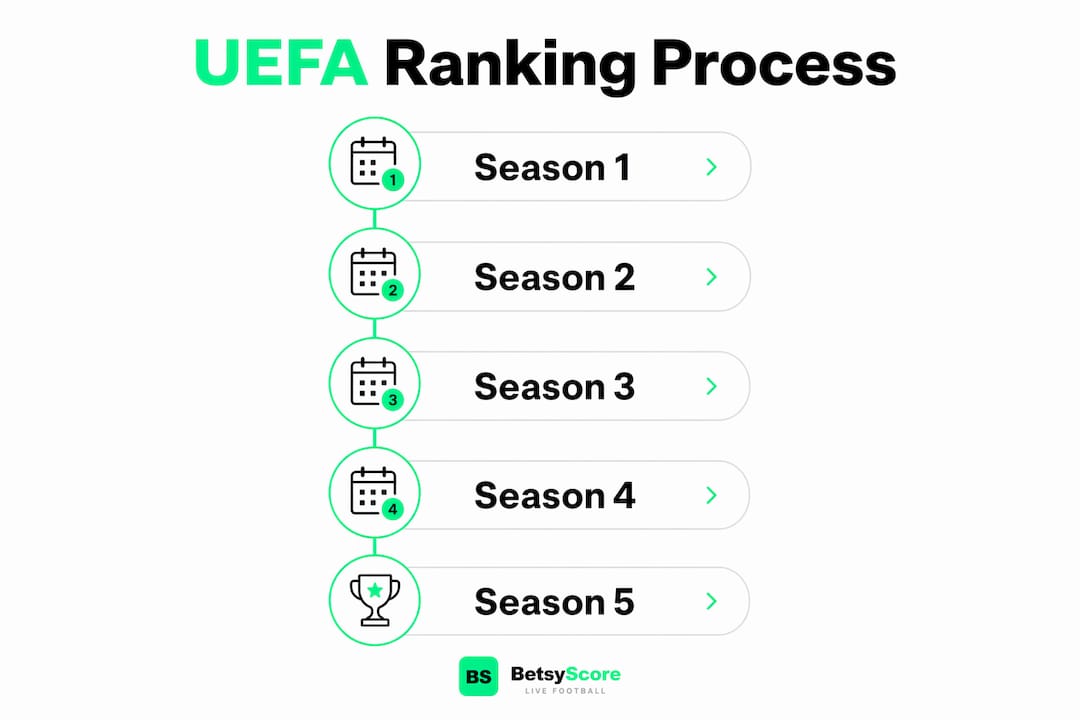
UEFA coefficients are built from club results across five seasons of UEFA competition. Points accumulate based on match outcomes and progression milestones. According to UEFA’s official rankings framework, points are awarded for wins, draws, advancing through rounds, and qualifying for specific competition stages. Those points aggregate over five seasons to form a club’s coefficient score.

The association coefficient works differently. It takes the average coefficient of all clubs from one country that competed in UEFA competitions during the same five-year window. That average then ranks associations against each other across Europe. A country with several clubs consistently reaching the knockout stages will rank higher than one with only one or two clubs making deep runs.
Here is how the points structure works in practice:
- Win in a group or league phase match: 2 points
- Draw in a group or league phase match: 1 point
- Qualifying round win: 1 point (split between two legs)
- Advancing to the round of 16, quarterfinals, semifinals, or final: bonus points at each stage
- Winning the competition: additional coefficient bonus
One critical timing detail: UEFA association coefficients use multi-season data with roughly a two-season lag, meaning 2024/25 rankings affect 2026/27 access allocations. That lag reflects UEFA’s preference for stable, predictable qualification structures rather than volatile year-to-year swings.
How do UEFA rankings affect Champions League qualification stages?
Association rankings directly control how many clubs each country sends to the Champions League and whether those clubs enter the league phase directly or must survive qualifying rounds. Higher-ranked associations receive more direct league phase places. Lower-ranked associations receive fewer direct spots and must send clubs through preliminary qualifying rounds.
The practical consequences are significant:
- Top-ranked associations (England, Spain, Germany, Italy, France) typically receive four or five direct league phase places each.
- Mid-ranked associations receive two or three direct places, with additional clubs entering at the playoff or qualifying round stage.
- Lower-ranked associations may receive only one direct place, with other clubs starting as early as the first qualifying round.
UEFA coefficients determine which clubs enter directly into the league phase versus qualifying rounds, and also govern access list adjustments when vacancies arise. When the reigning Champions League titleholder qualifies domestically, the vacant spot does not simply disappear. Instead, it is filled by the club with the highest coefficient among those on the champions path, which can shift entry round assignments for multiple clubs.
A real example: Shakhtar Donetsk earned an automatic league phase place for 2026/27 thanks to their club coefficient, after rebalancing triggered by a titleholder vacancy. That is a club bypassing qualifying rounds entirely because of their coefficient standing, not their domestic league finish.
Pro Tip: If you follow clubs from smaller leagues, check their association’s coefficient ranking each season. A rise of even two or three positions can mean the difference between entering at the first qualifying round and entering at the playoff round.
What are European Performance Spots and how do they work?
European Performance Spots are one of the most significant recent additions to the Champions League access system. UEFA awards these spots to the two associations with the best collective club performance in the previous season, measured by their association coefficient. Each winning association receives one extra league phase place for a club that would not otherwise qualify directly.
The mechanism works as follows:
- UEFA calculates each association’s coefficient at the end of the season.
- The two associations with the highest coefficients receive a European Performance Spot for the following season.
- The spot goes to the next-best domestic league finisher behind those clubs that already secured direct Champions League qualification.
- That club enters the league phase directly, skipping all qualifying rounds.
The 2026/27 season provides the clearest illustration. England and Spain finished as the top two associations in 2025/26 coefficients. Liverpool and Real Betis secured the European Performance Spots for their respective countries, both finishing fifth in their domestic leagues. Without this mechanism, neither club would have qualified directly for the league phase.
European Performance Spots convert an association’s collective strength into a practical qualification advantage for an additional club. A fifth-place Premier League finish is not normally a Champions League ticket. With a Performance Spot, it is.
Pro Tip: The Performance Spot always goes to the club ranked next-best domestically after those who already qualified. If a top-four club declines or is ineligible, the spot moves down the table accordingly.
How do UEFA rankings influence Champions League seedings and draws?
The Champions League seeding process uses club coefficients to sort teams into four pots before the draw. Pot 1 contains the clubs with the highest coefficients, including the reigning Champions League and Europa League holders. Pots 2, 3, and 4 follow in descending coefficient order.
The impact of seeding on a club’s path through the competition is direct:
- Pot 1 clubs avoid each other in the early draw and face lower-seeded opponents in the opening matches.
- Pot 4 clubs face the toughest possible early schedule, often drawing multiple Pot 1 opponents.
- Association coefficient indirectly influences seeding because clubs from stronger associations tend to accumulate higher individual coefficients through deeper runs in European competition.
The Champions League seeding process uses these coefficient rankings to balance the competition structure. A club that has consistently reached the semifinals over five seasons will carry a higher coefficient than one that exits at the round of 16 every year. That difference shows up directly in which pot they occupy.
One nuance worth noting: association coefficient indirectly shapes seeding because clubs from top-ranked leagues play more UEFA matches and therefore have more opportunities to accumulate points. A club from a lower-ranked association faces fewer European fixtures and builds its coefficient more slowly, even if it wins every match it plays.
Common misconceptions about UEFA rankings and match outcomes
UEFA rankings do not predict or influence what happens on the pitch. This is the most persistent misunderstanding among fans. A club’s quality, tactics, and squad determine on-pitch success, entirely separate from coefficient rankings. A high coefficient reflects past performance across five seasons. It says nothing about current form, injuries, or managerial decisions.
“Coefficient rankings serve dual roles: they govern competition entry logistics and influence draw seeding but do not dictate competitive strength on the pitch.” — UEFA Champions League Regulations
The confusion arises because high-coefficient clubs are often genuinely strong clubs. Real Madrid, Manchester City, and Bayern Munich consistently hold top coefficients and consistently perform well in the competition. But the coefficient did not cause the performance. The performance caused the coefficient. A club can hold a high coefficient while going through a poor run of form, and a low-coefficient club can outperform expectations entirely.
Rankings affect access and draws. Squad depth, management quality, and current form determine results. Fans who treat a high coefficient as a guarantee of deep tournament runs will be disappointed regularly.
Key takeaways
UEFA rankings determine Champions League access, entry stages, and draw seedings through a five-season points system that rewards consistent European performance at both the club and association level.
| Point | Details |
|---|---|
| Coefficients govern access | Association rankings set how many clubs each country sends directly to the league phase. |
| Five-season calculation | Club coefficients accumulate over five UEFA competition seasons, with a roughly two-season lag on access allocations. |
| European Performance Spots | The two top-ranked associations each season earn an extra league phase place for their next-best domestic club. |
| Seeding uses club coefficients | Higher club coefficients place teams in better pots, reducing early exposure to the strongest opponents. |
| Rankings do not predict results | Coefficients reflect past performance and shape logistics. They do not determine on-pitch outcomes. |
Why the coefficient system matters more than most fans realize
The coefficient system is one of the most consequential structures in European football, and most fans only notice it when their club misses out on a direct qualification spot. What gets overlooked is how the system quietly rewards consistency over single-season brilliance.
A club that reaches the Champions League quarterfinals four years in a row builds a coefficient that protects it from qualifying rounds for years afterward. That protection has real financial value. Qualifying rounds carry elimination risk before the main competition even begins. A single bad two-legged tie can cost a club ten of millions in broadcast and prize money. The coefficient is, in practical terms, an insurance policy built from sustained European performance.
The European Performance Spot mechanism adds another layer that I find genuinely underappreciated. It means a fifth-place Premier League finish can now be worth as much as a top-four finish in a weaker league, purely because England’s clubs collectively outperformed other associations. That is a structural shift in how UEFA rewards league strength, and it has real implications for how clubs in top leagues approach their domestic seasons.
What enthusiasts often miss is that the coefficient system creates incentives that extend well beyond the Champions League itself. Clubs in the UEFA Europa League and UEFA Europa Conference League also contribute to their association’s coefficient. A strong run in the Europa League by a mid-table club can lift the entire country’s ranking, potentially earning a Performance Spot that benefits a completely different club the following season.
— Aria
Betsyscore keeps you close to every Champions League development
Following UEFA rankings and Champions League qualification in real time takes more than checking a table once a week. Betsyscore covers the Champions League and more than 200 competitions worldwide with live scores that refresh every few seconds, detailed player profiles, and tournament leaderboards that update as matches progress.

Betsyscore’s AI-powered match predictions factor in expected goals, recent form, and head-to-head records to give you win-probability percentages before every match. You can follow live Champions League action with momentum tracking that shows which side is on top minute by minute. For fans who want to stay across qualification developments, coefficient standings, and match results across all UEFA competitions, Betsyscore delivers the data in one clean, fast platform.
FAQ
What are UEFA club coefficients?
UEFA club coefficients are points totals built from a club’s results in UEFA competitions over five seasons. Points are awarded for wins, draws, and progression through rounds, and the total determines seeding and access allocations.
How do UEFA rankings affect Champions League qualification?
Association rankings set how many clubs each country sends directly to the league phase versus qualifying rounds. Higher-ranked associations receive more direct places, reducing elimination risk for their clubs.
What is a European Performance Spot?
A European Performance Spot is an extra Champions League league phase place awarded to the next-best domestic club in the two associations with the highest coefficients from the previous season. Liverpool and Real Betis both received these spots for 2026/27 after finishing fifth in their respective leagues.
Do UEFA rankings determine Champions League seedings?
Yes. Club coefficients directly determine which seeding pot a team occupies in the Champions League draw. Pot 1 goes to the highest-coefficient clubs, giving them the most favorable early matchups.
Can a low-ranked club still win the Champions League?
Yes. UEFA rankings affect access and draw seedings, not match outcomes. A club’s squad quality, form, and tactics determine results on the pitch, independent of its coefficient standing.