The Role of a Defensive Midfielder: A Tactical Guide
A defensive midfielder protects the back line, disrupts opposition attacks, initiates build-up play, and controls the tempo of the match. This position sits between the defensive line and the central midfield, functioning as the team’s first line of recovery and its primary pass-recycling hub.
The four baseline functions every defensive midfielder must perform:
- Screening: Occupying passing lanes in front of the center-backs to prevent opponents from playing through the middle.
- Interceptions and tackling: Winning the ball back through anticipation, positioning, and direct challenges.
- Circulation and pass initiation: Receiving from defenders under pressure and distributing quickly to restart attacks.
- Tempo control: Slowing or accelerating the team’s rhythm depending on the match situation.
Total Football Analysis identifies three primary archetypes within the position: the destroyer, the deep-lying playmaker (regista), and the single pivot/all-rounder. Each archetype prioritizes these four functions differently, which is why two players can both be labeled “defensive midfielders” while performing almost entirely different tactical jobs.
Key Takeaways
The defensive midfielder’s role spans four core functions: screening, interceptions, circulation, and tempo control, with archetype selection determining which function takes priority.
| Point | Details |
|---|---|
| Four baseline functions | Every DM must screen, intercept, circulate the ball, and control tempo regardless of archetype. |
| Seven distinct archetypes | Holding, destroyer, regista, half-back, segundo volante, deep number 8, and all-rounder each suit different systems. |
| Single vs. double pivot | Single pivot demands an all-rounder; double pivot allows complementary pairings like destroyer plus playmaker. |
| Key evaluation metrics | Interceptions per 90, pass completion in own half, progressive passes, and duels won reveal archetype and quality. |
| Live data for DM analysis | Betsyscore’s live stats track these metrics in real time across 200+ competitions. |
Table of Contents
- Why the defensive midfielder role has become essential in modern football
- The main defensive-midfielder archetypes and how they differ
- Single pivot versus double pivot: which structure fits your team?
- Where a defensive midfielder positions on the pitch and what they do in-game
- The skills and attributes that define an effective defensive midfielder
- How coaches choose the right defensive-midfielder archetype
- How elite defensive midfielders measurably affect match outcomes
- Common tactical challenges and how defensive midfielders adapt
- How defensive midfielders communicate to maintain team shape
- Training drills that improve defensive midfielder skills
- Betsyscore’s perspective on the modern defensive midfielder
- Sources
- FAQ
Why the defensive midfielder role has become essential in modern football
The position has changed substantially over the past three decades. In the 1980s and early 1990s, the typical holding midfielder was a single-function destroyer: physical, aggressive, and focused almost entirely on breaking up play. Claude Makélélé’s influence at Real Madrid and Chelsea in the early 2000s shifted that perception. His ability to screen the back four, recycle possession economically, and maintain positional discipline showed coaches that the position could anchor an entire system without requiring a creative profile.
The next evolution came with Sergio Busquets at Barcelona, who added a deep-lying playmaker dimension to the role. Busquets could drop between center-backs, receive in tight spaces, and distribute with precision, turning the defensive midfielder into a genuine architect of possession. That model has since become the standard at elite clubs.
Several tactical forces drove this evolution:
- Faster passing cycles demanded a midfielder who could receive and release under pressure in under two seconds.
- Positional play systems required a player who could form a back three in possession and revert to a single pivot out of possession.
- High-press environments needed a DM who could bypass the press with long switches or carry the ball forward when space opened.
ESPN’s analysis of transfer valuations confirms that clubs now treat the position as decisive for title and European success, with market values rising across multiple transfer cycles as clubs that lacked a trusted DM spent several windows trying to fix the problem.
The main defensive-midfielder archetypes and how they differ
Tactical analysis identifies several distinct archetypes within the broader defensive midfielder category. Understanding them helps fans recognize what a coach is asking for and helps players identify which profile fits their own game.
-
Holding midfielder / anchor: Sits statically in front of the back four, rarely ventures forward, and focuses on positional screening. Requires exceptional positional awareness and the ability to read the game two or three passes ahead. Claude Makélélé is the archetype’s defining example.
-
Destroyer: Prioritizes winning duels, making tackles, and disrupting opposition rhythm through aggressive pressing and physical confrontation. Gennaro Gattuso and Patrick Vieira represent this profile. FootnoteFC notes that pure destroyers are increasingly rare at the top level because teams also demand technical contribution.
-
Deep-lying playmaker (regista): Receives deep, distributes with range and precision, and dictates tempo from a withdrawn position. Andrea Pirlo is the canonical example. This archetype requires excellent vision, a strong passing range, and the composure to operate under pressure.
-
Half-back: Drops between the center-backs during build-up to create a temporary back three, giving the team numerical superiority against a high press. Guide to Football explains that this movement is common in possession-based systems where the full-backs push high.
-
Segundo volante: A box-to-box variant that combines defensive screening with forward runs into the penalty area. Common in South American tactical systems and in teams that use a double pivot where one midfielder holds while the other advances.
-
Deep number 8: Operates slightly higher than a traditional DM but still performs screening duties. Bridges the gap between a classic holding midfielder and a central midfielder, often used in a 4-3-3 where the single pivot needs mobility.
-
Single pivot / all-rounder: The most demanding profile. One player covers all four baseline functions: screening, interceptions, circulation, and tempo control. Busquets at Barcelona and Casemiro at Real Madrid exemplify this archetype.
Two players can share the “defensive midfielder” label while performing almost entirely different jobs. A destroyer and a regista both occupy the same zone on the pitch, but their decision-making, movement, and technical demands diverge sharply. Guide to Football’s role breakdown captures this breadth well, noting that the position encompasses screening, winning tackles, starting attacks, dropping into the back line, and breaking forward.
Single pivot versus double pivot: which structure fits your team?
The number of defensive midfielders a team deploys changes the individual player’s responsibilities significantly.
Single pivot places one DM in front of the back four. That player must cover the entire central zone alone, which demands exceptional mobility, positional discipline, and the ability to read play quickly. It suits possession-based teams that keep the ball and limit transitions, or teams with a high defensive line where the DM acts as the last line before the center-backs.
Double pivot pairs two midfielders in the defensive zone, allowing complementary profiles. One can hold while the other advances, or both can screen simultaneously against a team that attacks through the center.
Pros and cons of each structure:
- Single pivot — advantages: Creates an extra outfield player higher up the pitch; gives the team more attacking options; suits a regista or all-rounder who can manage space alone.
- Single pivot — disadvantages: Leaves the DM exposed against teams that overload the center; demands elite physical output across 90 minutes; a single injury or yellow card disrupts the entire structure.
- Double pivot — advantages: Provides better central coverage; allows a destroyer-and-playmaker pairing; reduces individual workload and improves press resistance.
- Double pivot — disadvantages: Reduces attacking numbers in midfield; can make the team predictable in build-up; requires strong communication between the two players to avoid positional duplication.
Archetype fit matters here. A single pivot almost always needs a player with strong passing range because the team relies on that one player to start attacks. A double pivot can accommodate a destroyer alongside a regista, with each covering the other’s weakness. Guide to Football’s positioning guide notes that in double-pivot systems, the DM who drops between center-backs during build-up is typically the more technical of the two.
Where a defensive midfielder positions on the pitch and what they do in-game
The defensive midfielder’s base position is roughly 8–12 yards in front of the center-backs, central to the pitch. From there, the player’s movement depends on the phase of play.
Key in-game responsibilities include:
- Screening passing lanes: Positioning the body to block central through-balls before they reach the striker or attacking midfielder.
- Interceptions: Reading the opponent’s passing patterns and stepping into the line to win the ball without committing to a tackle.
- Tactical fouling: Stopping dangerous counter-attacks by conceding a foul in a non-threatening area, accepting a yellow card when necessary.
- Dropping between center-backs: In possession, the half-back movement creates a back three, freeing the full-backs to advance and giving the team width.
- Covering wide areas: When a full-back pushes forward, the DM shifts laterally to cover the vacated channel.
- Breaking forward on counters: After winning the ball, the DM can carry it forward or play a quick vertical pass to trigger a counter-attack.
A simple positional diagram for this role would show: the base position centrally in front of the back four; a drop-in arrow toward the center-back pairing during build-up; lateral shift arrows toward both channels; and a forward arrow indicating the press trigger when the opponent’s center-back receives under pressure.
The skills and attributes that define an effective defensive midfielder
Wikipedia’s entry on the defensive midfielder position lists positional awareness, anticipation, marking, tackling, interceptions, passing, stamina, and strength as the core requirements. In practice, these split across three categories.
Technical skills:
- Short passing accuracy under pressure (recycling possession from the back)
- Long passing range for switching play or bypassing the press
- First touch control in tight spaces
- Tackling technique (timing the challenge rather than lunging)
- Aerial ability for set-piece defense and second-ball situations
Physical attributes:
- Stamina to cover large distances across 90 minutes
- Strength to hold off opponents in duels
- Agility and change-of-direction speed for lateral screening
- Pace to recover when caught out of position
Mental and tactical traits:
- Anticipation: reading the opponent’s next pass before it happens
- Positional discipline: resisting the urge to follow the ball out of position
- Communication: organizing the defensive shape behind and the midfield ahead
- Two-footedness: screening effectively from both sides
- Decision speed: choosing the right option within one second of receiving the ball
Pro Tip: If you are training as a defensive midfielder, prioritize anticipation drills over pure tackling work. Most elite DMs win the ball through positioning, not contact.
How coaches choose the right defensive-midfielder archetype
Selecting the right DM profile depends on the team’s system, not just the player’s individual qualities. Soccer Coach Weekly’s coaching guide emphasizes that the DM’s primary value lies in disrupting opposition rhythm and enabling attack-building from deep, which means the archetype must fit the team’s transition demands.
A practical selection checklist:
- Team style: Possession-based teams need a regista or all-rounder with strong passing range. Counter-pressing teams can use a destroyer or segundo volante.
- Partner profiles: In a double pivot, pair a destroyer with a playmaker. Two destroyers leave the team without a build-up option; two playmakers leave the defensive zone exposed.
- Defensive cover available: If the center-backs are comfortable in possession, the DM can push slightly higher. If they struggle under pressure, the DM must stay deeper.
- Transition demands: Teams that defend deep need a DM who can hold position. Teams that press high need a DM who can cover the space left behind.
Player-fit signals to look for:
- Pass completion rate under pressure above 80%
- High recovery and interception numbers per 90 minutes
- Duel success rate in both aerial and ground challenges
- Mobility range (distance covered per match)
- Communication and leadership on the pitch
Red flags indicating a mismatch:
- A destroyer deployed as a single pivot in a possession team will lose the ball frequently in build-up.
- A regista deployed against a high-press team without a double-pivot partner will be overrun physically.
- A player with poor positional discipline will drift wide, leaving the central zone unprotected.
How elite defensive midfielders measurably affect match outcomes
Betsyscore tracks live player metrics across more than 200 competitions, including interceptions per 90, progressive passes, and pass completion from deep positions. These metrics, when applied to DM evaluation, reveal a consistent pattern: teams with elite DMs concede fewer chances from central areas and maintain higher pass completion rates from their own half.
Possession metrics and their context matter when evaluating DM archetypes. A regista in a possession-based team will show higher pass completion and more progressive passes per 90 than a destroyer in a low-block system, but that difference reflects system design rather than individual quality.
Key metrics for evaluating a defensive midfielder:
| Metric | What it measures | Why it matters |
|---|---|---|
| Interceptions per 90 | Ball recoveries through positioning | Indicates reading of the game and screening effectiveness |
| Pass completion % (own half) | Technical accuracy under pressure | Distinguishes a regista from a destroyer in build-up |
| Progressive passes per 90 | Forward ball movement from deep | Shows whether the DM contributes to attack-building |
| Duels won per 90 | Physical contest success rate | Reflects defensive reliability in direct challenges |
Teams with a trusted DM show better control of transitional moments, which ESPN’s transfer analysis links directly to the position’s rising market value. When evaluating a DM using live data, cross-referencing interceptions per 90 with pass completion gives a clearer picture of whether the player is a destroyer, a playmaker, or a genuine all-rounder.
Common tactical challenges and how defensive midfielders adapt
A defensive midfielder faces different problems at different points in a match, and the ability to adapt is what distinguishes elite players from average ones.
Overloads in the central zone occur when the opposition sends three or four players through the middle. The DM’s response is to compress the space rather than chase the ball, forcing play wide and waiting for a recovery opportunity. Chasing the ball in this situation pulls the DM out of position and opens the central channel.

High-press situations put the DM under immediate pressure when receiving from center-backs. The solution is pre-scanning: checking over both shoulders before the ball arrives so the decision is already made. A DM who receives blind will be pressed into errors.
Transition moments after losing the ball require an immediate press trigger or a recovery run. The DM must read whether the team can win the ball back quickly or whether dropping into a defensive shape is the safer option. Football momentum analysis shows that the first five seconds after losing possession are the most critical for preventing counter-attacks.
Fatigue in the second half reduces reaction speed and positional discipline. Experienced DMs compensate by reducing unnecessary movement in the first half, conserving energy for the high-intensity moments that decide matches.
How defensive midfielders communicate to maintain team shape
The defensive midfielder is the team’s organizational hub. From a central position, the DM has a full view of both the defensive line and the attacking players, making communication a core part of the role.
Verbal communication covers three areas: directing the press trigger (“press now” when the opponent receives under pressure), organizing the defensive line’s depth, and calling for the ball from center-backs when space is available. Non-verbal communication includes hand signals for press triggers and body positioning that tells teammates which passing lane is covered.
The DM’s relationship with the center-backs is particularly important. When the DM drops between the center-backs during build-up, the two center-backs must widen to maintain coverage. This movement requires a clear signal and consistent execution in training. Guide to Football’s positioning breakdown notes that this half-back movement is one of the most practiced patterns in possession-based systems.
With the attacking midfielders ahead, the DM communicates when to press and when to hold, preventing the team from being stretched vertically. A DM who fails to communicate this creates gaps between the lines that opponents can exploit.
Training drills that improve defensive midfielder skills
Specific drills address the DM’s unique combination of defensive and technical demands.
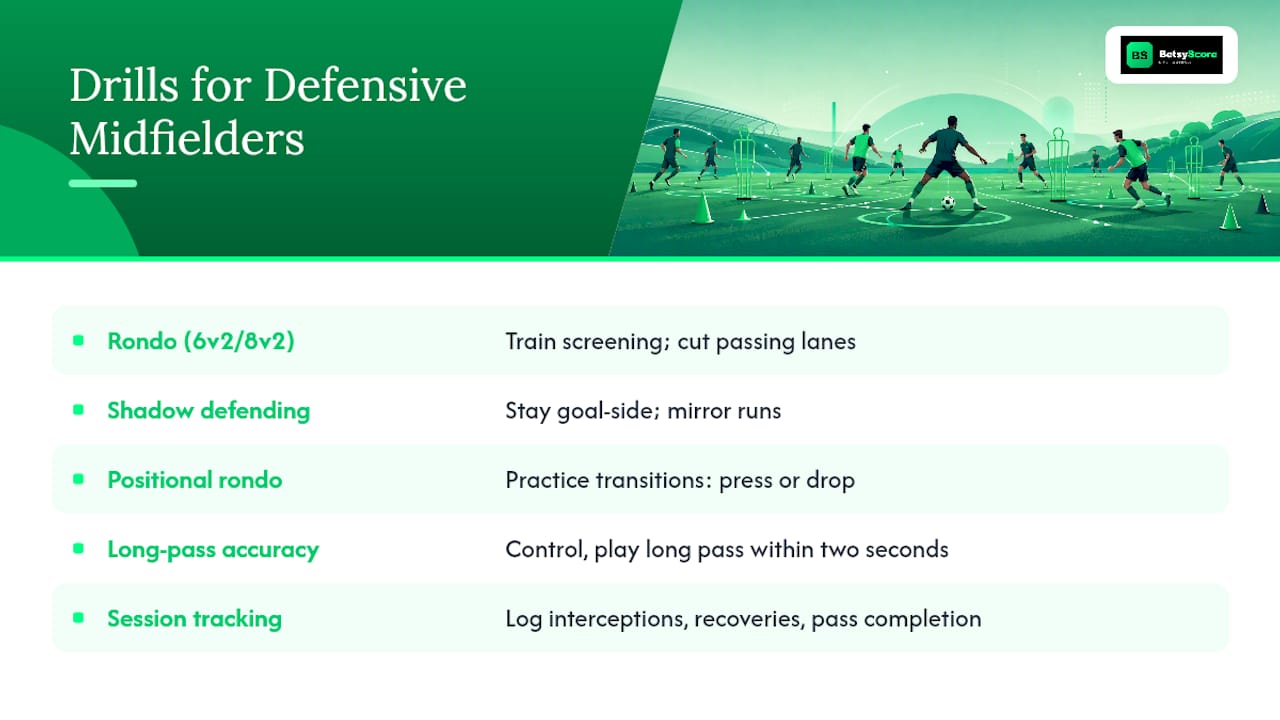
Rondo with a pressing trigger (6v2 or 8v2): The two players in the middle simulate the DM’s screening and interception work. The key coaching point is to force the two defenders to position their bodies to cut passing lanes rather than chase the ball directly. This builds anticipation and spatial awareness.
Shadow defending: The DM follows the movement of an attacking midfielder without making contact, mirroring their runs and maintaining a position between the attacker and the goal. This drill develops the habit of staying goal-side and tracking movement without ball-watching.
Positional rondo with a transition trigger: When the team in possession loses the ball, the DM must immediately press or drop into a defensive shape. This replicates the transition moments that occur most frequently in matches.
Long-pass accuracy under pressure: A server plays the ball to the DM while a pressing player closes quickly. The DM must control, assess, and play a long switch or a vertical pass within two seconds. This builds the technical composure required in a single-pivot role.
Checking the Betsyscore match analysis checklist after training sessions gives coaches a structured framework for converting drill performance into match-relevant notes. Tracking interceptions, recoveries, and pass completion from these drills over several weeks shows whether a player is developing the metrics that matter for the role. For player props and performance-based analysis, soccer player prop resources can also help contextualize individual output within a broader statistical picture.
Betsyscore’s perspective on the modern defensive midfielder
Betsyscore covers more than 200 competitions with live player profiles, real-time stats, and AI-powered match predictions built from expected goals, form, and head-to-head data. When tracking defensive midfielders specifically, the platform’s minute-by-minute momentum reads and live interception data give a clearer picture of how a DM is influencing a match than the final scoreline alone.
The most underrated aspect of the modern DM, from a data perspective, is the correlation between a team’s pass completion from its own half and the quality of its defensive midfielder. Teams that can build cleanly from deep tend to concede fewer transitional chances, and that pattern shows up consistently across Betsyscore’s coverage of the Premier League, La Liga, and Champions League.
For anyone who wants to evaluate a DM’s performance in real time, Betsyscore’s live match stats and AI predictions surface the metrics that matter: interceptions, progressive passes, and possession recovery zones, updated every few seconds throughout the match.

Sources
The following sources informed this guide and offer further reading for coaches, analysts, and fans who want to go deeper on defensive midfielder tactics.
- Different archetypes of defensive midfielders — Total Football Analysis
- Defensive midfielder roles | Guide to Football
- Defensive midfielders | Guide to Football
- Modern DM guide — FootnoteFC
- The importance of defensive midfielders - Soccer Coach Weekly
- Why the transfer value of defensive midfielders keeps rising - ESPN
- Defensive midfielder — Wikipedia
FAQ
What are the main duties of a defensive midfielder?
A defensive midfielder screens passing lanes in front of the back four, wins the ball through interceptions and tackles, starts build-up play by receiving from center-backs, and controls the team’s tempo. Guide to Football’s role breakdown also notes that the DM may drop between center-backs during possession or break forward on counter-attacks depending on the system.
What are the three types of midfielders in soccer?
The three broad midfielder categories are the defensive midfielder (holding/screening role), the central midfielder (box-to-box role), and the attacking midfielder (creative role closest to the forwards). Within the defensive midfielder category alone, Total Football Analysis identifies further archetypes including the destroyer, the deep-lying playmaker, and the all-rounder.
What position do you put your weakest player in soccer?
Coaches typically place less technically developed players in wide midfield or wide defensive positions where positional errors are less immediately costly than in central zones. The defensive midfielder position is one of the most demanding on the pitch and is generally reserved for players with strong positional awareness, passing ability, and physical presence.
What are the top three hardest positions in soccer?
Goalkeeper, central defender, and defensive midfielder are widely considered the most demanding positions because errors in all three directly lead to conceded goals. The defensive midfielder’s difficulty comes from the combination of physical, technical, and tactical demands across 90 minutes, including screening, passing under pressure, and organizing the team’s shape simultaneously.
How do you play defensive midfielder effectively?
Effective defensive midfielder play centers on positioning before the ball arrives: pre-scanning to identify threats, occupying the space between the lines, and making decisions within one second of receiving. Soccer Coach Weekly emphasizes that the DM’s value lies in what they prevent as much as what they create.