Soccer Match Analysis Checklist for Coaches in 2026

A soccer match analysis checklist is a structured guide that directs analysts and coaches through every phase of a game to extract tactical insights that drive decisions. The best checklists go far beyond event summaries. They apply frameworks like the 6W Framework, which categorizes each event by Who, What, Where, When, Why, and What next, to build a coherent tactical picture. Professionals also segment matches into four distinct phases: in-possession, out-of-possession, offensive transition, and defensive transition. Limiting your final report to 3–5 high-impact insights per match, rather than cataloging every touch, is what separates a useful analysis from a data dump.
1. How to structure your soccer match analysis checklist by tactical phase
Breaking a match into four tactical phases is the foundation of any professional football match review checklist. Each phase demands a different set of questions and a different focus for the analyst.
In-possession phase: Observe how the team builds from the back, which passing lanes they access under pressure, and whether the shape creates width and depth consistently.

Out-of-possession phase: Track the defensive block’s compactness, pressing triggers, and how quickly the team transitions to a mid or low block after losing the ball.
Offensive transition: Identify how fast the team shifts from defending to attacking, whether runners make forward runs immediately, and how the team exploits numerical advantages in the first five seconds after winning possession.
Defensive transition: Note the counter-press response, how many players recover behind the ball, and whether the team concedes dangerous counter-attacks due to poor shape.
Professional workflows review video multiple times, each pass focused on one tactical unit such as the backline or the midfield. This prevents cognitive overload and produces more consistent pattern identification.
Pro Tip: Break your video into 3–5 minute clips organized by phase. Reviewing a 10-minute pressing sequence in one sitting produces sharper observations than watching the full 90 minutes once.
2. Essential data accuracy checks for reliable match analysis
Data accuracy is the most underrated step in any soccer data accuracy checklist. Analysts who skip verification produce reports built on faulty foundations, and faulty reports erode coaching trust faster than missing a key tactical pattern.
Reliable match analysis requires verifying API latency and data integrity, targeting sub-15-second updates, and using automated schema validation to catch errors before they reach the report. Cross-referencing multiple data sources before finalizing any report is non-negotiable.
The table below summarizes the six quality criteria every analyst should check before treating data as final.
| Quality criterion | What to check | Warning signal |
|---|---|---|
| Accuracy | Match event counts against video | Stat totals that contradict visible play |
| Completeness | All 90 minutes captured, no gaps | Missing time windows in event logs |
| Timeliness | Data available within 15 seconds of event | Delays exceeding 30 seconds during live play |
| Bias | Consistent definitions across providers | “Carry” counted differently by two sources |
| Licensing | Data use rights confirmed | Unlicensed feeds used in published reports |
| Operational fit | Data format compatible with your system | Schema mismatches causing import failures |
Data inconsistency damages analyst credibility more than missing metrics. Normalizing definitions at the ingestion phase, for example aligning what counts as a “carry” versus a “dribble,” prevents downstream errors that distort the entire analysis.
Pro Tip: Treat all raw event data as provisional until you cross-check it against video evidence. A stat that contradicts what you saw on screen is almost always a data error, not a tactical anomaly.
3. Key elements to include in your match analysis checklist
A match report is a decision-support tool, not an event log. Filtering observations to 3–5 high-impact tactical insights per match gives coaches something they can act on before the next training session.
The following elements belong in every well-built soccer game evaluation guide:
- Build-up pressure resistance: How the team handles pressing in its own half and whether it can progress the ball under duress.
- Final-third chance creation: The number and quality of entries into the attacking third, including expected goals (xG) generated per sequence.
- Set-piece defending: Marking schemes, zonal versus man-to-man assignments, and second-ball recovery rates from corners and free kicks.
- Pressing intensity (PPDA): Passes allowed per defensive action, which measures how aggressively the team presses in the opponent’s half.
- Progressive passes and carries: Ball progression metrics that reveal whether the team advances play through the lines or relies on long balls.
- Transition efficiency: Time elapsed from winning possession to reaching the final third, and the success rate of those sequences.
- Player role execution: Whether individual players fulfill their positional responsibilities in each phase, not just their goal or assist contributions.
Key soccer metrics like xG, PPDA, and progressive passes give analysts a high-signal shortlist that prevents raw data overload. Selecting 3–5 of these per match, based on the opponent’s known tendencies, keeps the report focused and the coaching conversation productive.
4. How to build a practical live tagging and video analysis workflow
A live tagging workflow fails when the template is too complex. Lean tagging templates with a minimal number of dropdowns maintain speed and accuracy under the pressure of a live match. The goal is consistent data capture, not exhaustive event recording.
The most effective tagging categories to include are:
- Build-up entries: Each time the team successfully progresses from its defensive third into the middle third.
- Turnovers: Location, body position, and whether the turnover triggered a counter-attack.
- Pressing triggers: The specific cue (back pass, poor touch, goalkeeper in possession) that initiates the press.
- Shots: Location, foot, and whether the shot followed a set piece, transition, or open-play sequence.
- Recoveries: Where the team wins the ball back and how quickly it transitions after recovery.
Separating the observation phase from the feedback phase is equally important. Analysts who try to write the report while watching the match produce lower-quality observations on both tasks. Watch first, tag consistently, then build the report from the tags.
Closing the feedback loop between match observation and training sessions is what makes video analysis genuinely useful. Coaches benefit most from visual, targeted feedback delivered the day before the next match, not dense written summaries sent a week later.
5. Common soccer analytics misconceptions that weaken analysis
Several persistent misconceptions reduce the quality of match analysis, even among experienced analysts. Recognizing them is the first step toward correcting them.
More data equals better analysis. This is the most common error. Tracking 40 metrics per match produces noise, not insight. The 6W Framework works precisely because it forces the analyst to assign meaning to each event, not just record it.
Possession percentage predicts outcomes. Possession is a context metric, not a performance metric. A team can dominate possession and lose badly if it lacks penetration. xG and PPDA tell a more accurate story about match control.
Video analysis replaces data, or data replaces video. The two methods validate each other. Cross-verifying data provider taxonomies against video evidence is the only reliable way to catch both data errors and analytical blind spots.
A match report should cover everything. A report that covers everything communicates nothing. Analysts who highlight critical moments and tactical themes rather than every event produce reports that coaches actually use.
Live data is always accurate. Live feeds contain errors, especially during high-traffic moments like goals and red cards. Treating live data as provisional and verifying it post-match is standard practice in professional environments.
Key takeaways
A complete soccer match analysis checklist combines tactical phase observation, data verification, and focused insight selection to produce reports that coaches can act on immediately.
| Point | Details |
|---|---|
| Use the 6W Framework | Categorize each event by Who, What, Where, When, Why, and What next to build structured insights. |
| Limit insights to 3–5 per match | Focused reports drive better coaching decisions than exhaustive event logs. |
| Verify data before reporting | Cross-check API data against video evidence to catch errors before they reach the report. |
| Keep tagging templates lean | Fewer dropdowns produce faster, more consistent data capture during live matches. |
| Close the feedback loop | Deliver visual, targeted feedback before the next match, not after the next week. |
Why most match analysis checklists fail before the final whistle
The hardest part of building a match analysis workflow is not knowing what to observe. It is knowing what to leave out. I have reviewed analysis reports from grassroots clubs and semi-professional setups, and the pattern is consistent: the longest reports are the least useful. Coaches do not have time to read 12 pages of event data before a Thursday training session.
The analysts who produce the most impact work with a short, standardized checklist that they apply to every match. Standardization matters more than most people realize. When you use the same template across 20 matches, you can compare patterns across opponents and across time. That comparison is where real tactical intelligence lives.
I also think the industry underestimates how much data inconsistency costs. When a “carry” is defined differently by two providers, or when a live feed drops events during a goal sequence, the downstream analysis becomes unreliable. Checking local soccer team stats against multiple sources before building a report is not paranoia. It is basic quality control.
The best checklists I have seen share one quality: they are built around the decisions the coach needs to make, not around the data the analyst finds interesting. Start with the coaching question, then build the checklist backward from there.
— Aria
Betsyscore gives analysts a live data foundation to work from
Analysts need reliable, real-time data before any checklist can function. Betsyscore delivers live football scores that refresh every few seconds, alongside AI-powered win-probability predictions built from expected goals, recent form, and head-to-head records. That combination gives analysts a verified data layer to cross-reference against their own tagging during and after matches.
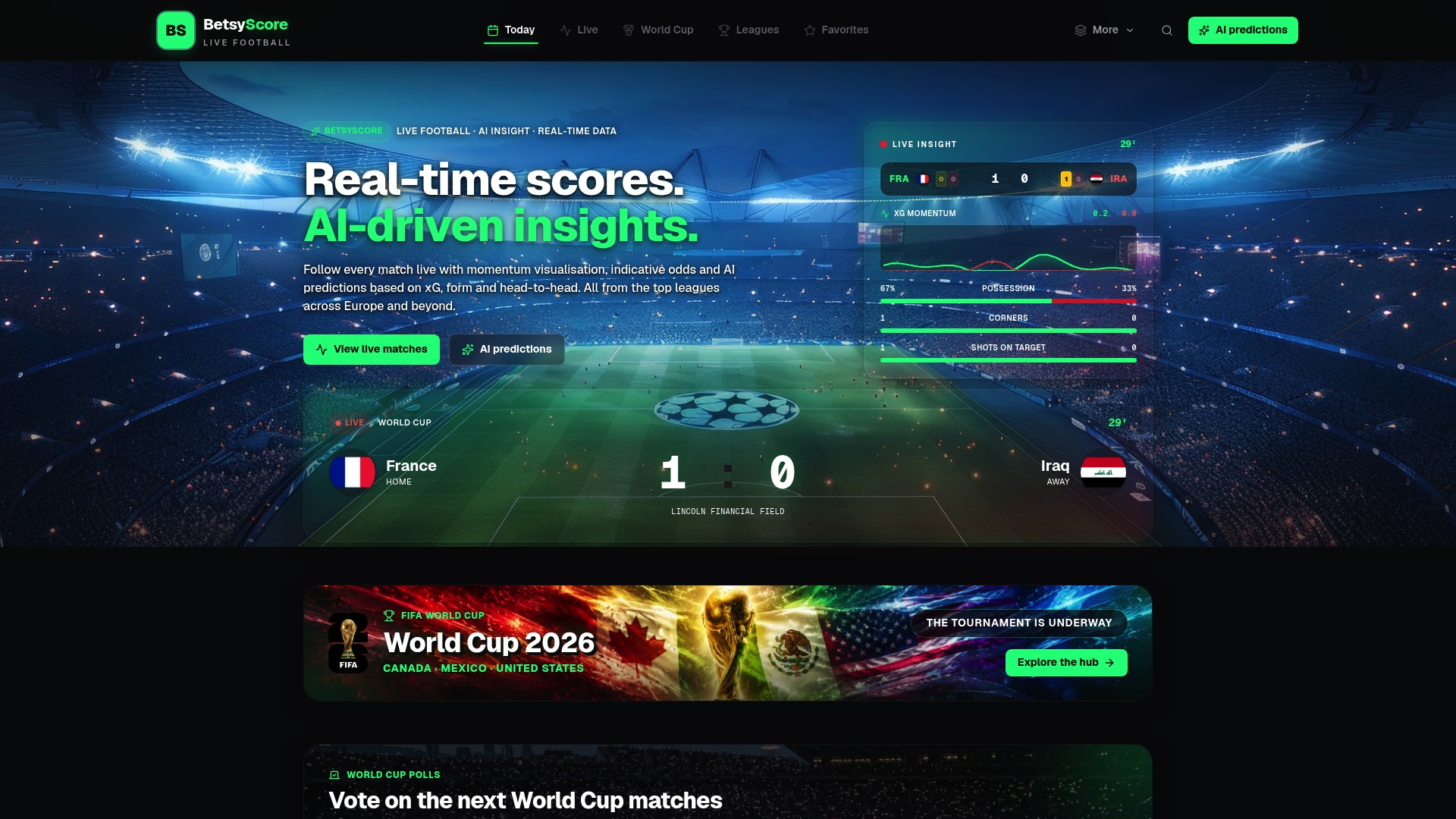
Coverage spans the Premier League, La Liga, Bundesliga, Serie A, the Champions League, and more than 200 competitions worldwide, including the FIFA World Cup 2026. Betsyscore also tracks live lineups, player profiles, and momentum shifts minute by minute. For analysts building a match review workflow, that real-time layer reduces the time spent chasing data and increases the time spent generating insight.
FAQ
What is a soccer match analysis checklist?
A soccer match analysis checklist is a structured guide that directs analysts through tactical phases, data verification steps, and insight selection criteria to produce reports that support coaching decisions. It replaces ad hoc observation with a repeatable, comparable process.
How many tactical insights should a match report include?
Effective match reports focus on 3–5 high-impact tactical insights rather than cataloging every event. This limit improves report clarity and makes the findings easier for coaches to apply in training.
What are the four phases in professional soccer match analysis?
Professional analysts split matches into four phases: in-possession, out-of-possession, offensive transition, and defensive transition. Each phase requires a separate observation focus and a distinct set of checklist questions.
How do analysts verify soccer data accuracy?
Analysts verify accuracy by cross-referencing multiple data sources and checking event data against video evidence before finalizing any report. Targeting sub-15-second API updates and using schema validation catches most errors at the ingestion stage.
What metrics belong on a soccer match analysis checklist?
Key metrics include expected goals (xG), pressing intensity measured by PPDA, progressive passes, set-piece conversion rates, and transition efficiency. These high-signal performance indicators give analysts a focused shortlist that avoids raw data overload.