0.39–0.50 xG Swing: Red Card Impact That Flips Matches
A red card removes a player immediately with no replacement allowed, forcing that team to finish the match a man down while its scoring rate typically drops and its opponent’s rises. The dismissed player faces at least an automatic one-match suspension, with longer bans for serious offenses. The scoreline, tactics, and disciplinary record of the match all shift the moment the referee’s arm goes up.
TL;DR:
- A red card significantly reduces the penalized team’s scoring potential, often shifting expected goals by about 0.39 to 0.50 in mid-game situations.
- The timing of the red card influences its impact, with earlier dismissals causing more substantial scoring and win probability swings.
- Teams respond to a man disadvantage by adopting defensive formations and substitutions focused on minimizing space and conceding chances rather than attacking.
- Most red cards lead to at least a one-match suspension, with longer bans for violent or serious fouls, and overturns are rare outside clear mistakes.
- Real-time tracking platforms like BetsyScore show immediate shifts in win probability and momentum after a red card, offering valuable insights during matches.
Table of Contents
- Red Card Impact by the Numbers: What the Data Actually Show
- Why Timing and Team Strength Change the Red Card’s Damage
- How Coaches Respond to a Man Disadvantage
- What Happens to the Suspended Player Next
- Red Card Impact in Real Matches
- How BetsyScore Tracks a Red Card in Real Time
- Punishment Versus Spectacle: An Editorial Take
- Watch Red Card Impact Unfold Live With BetsyScore
- Sources
- FAQ
Red Card Impact by the Numbers: What the Data Actually Show
Academic research has quantified what fans have long sensed watching from the stands: a sending-off does real, measurable damage to the penalized team’s attack. A study of World Cup football matches found that a red card lowers the sanctioned team’s scoring rate while simultaneously raising the opponent’s scoring rate. That two-way swing is what makes red cards so decisive compared to other in-game events.
Separate analysis of Euro 2008 and World Cup 2006 matches documented a substantial decline in the penalized side’s scoring intensity after the dismissal, paired with a smaller but real increase for the team with the numerical advantage. A broader look at top-five European leagues covering 1,826 matches put a number on the swing: a sending-off with roughly 30 minutes left on the clock often shifts accumulated expected goals by an amount that can be quantified based on team and venue factors.
- Scoring rate for the sanctioned team falls; the opponent’s scoring rate climbs in response.
- A dismissal around the 60-minute mark can significantly swing expected goals.
- These effects feed directly into live win-probability models used by broadcasters and data platforms.
Statistic to watch: an expected-goal swing of 0.39 to 0.50 on a mid-match red card is large enough, in a sport where most games are decided by one goal or less, to flip a likely draw into a likely loss.
One myth worth killing here: the old idea that teams somehow play better with ten men. Research using English Premier League data found sending-offs generally hurt the penalized team’s performance regardless of when they happen, which contradicts the romantic notion that adversity galvanizes a side. Red cards hurt. The data says so consistently.
Why Timing and Team Strength Change the Red Card’s Damage
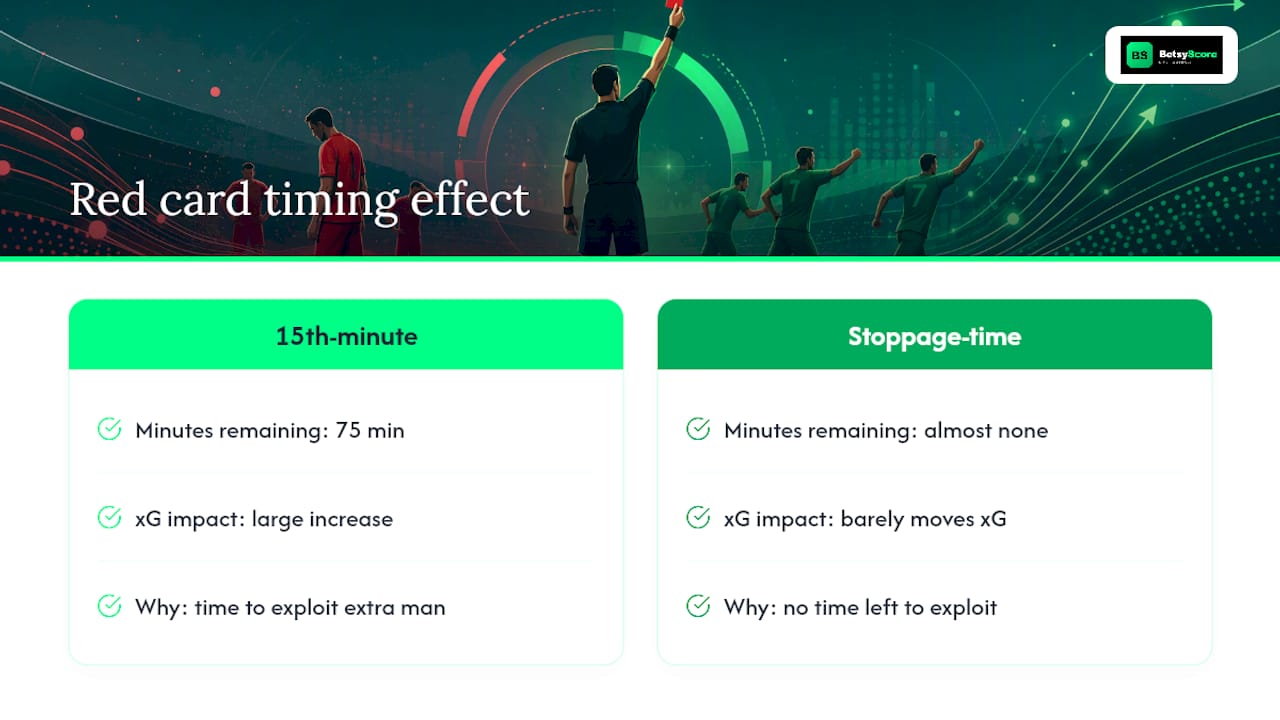
Not every sending-off carries the same weight. A red card in the 15th minute leaves 75 minutes for the numerical disadvantage to compound, and the UAB analysis treats time remaining as one of the strongest variables in the model. A red card in stoppage time, by contrast, barely moves the expected-goal needle because there’s no time left to exploit the extra man.
Team strength complicates the picture further. When a stronger side gets reduced to ten men, the whole match’s scoring intensity often drops. The stronger team can no longer press or control tempo the way it wants, but the weaker team frequently lacks the quality to fully capitalize on the extra space. When the weaker team is the one that gets a man sent off, the effect tends to run the other way. The stronger side’s scoring output often rises more sharply, since it already had the players capable of punishing the gap.
Scoreline and venue matter too. A team already leading and reduced to ten men can shift into a containment mindset that partially offsets the statistical damage. A team trailing and down a man, playing away from home, faces close to the worst-case version of this scenario.
How Coaches Respond to a Man Disadvantage
Losing a player forces an immediate tactical rethink, and most coaches reach for a familiar set of tools rather than improvising from scratch.
- Compact the shape. Formations typically collapse into something narrower and deeper, like a 4-4-1 or a 5-3-1, prioritizing central defense over width.
- Sacrifice the furthest-forward player first. A striker usually comes off before a defender or holding midfielder, since the team needs bodies behind the ball more than it needs a second attacking outlet.
- Reinforce the midfield screen. Coaches often bring on a defensive-minded midfielder to cut passing lanes into the box rather than adding another attacker.
- Match the substitution to the scoreline. A team protecting a lead will often sit deep and manage the clock, a strategy commonly called parking the bus, while a team that’s level or trailing may still attempt controlled possession to avoid conceding a second wave of pressure.
- Manage fatigue deliberately. Ten men covering the same amount of ground as eleven tire faster, so late-game substitutions increasingly focus on fresh legs over tactical specialists.
The common thread across all of these adjustments is subtraction, not addition. Teams down a man rarely try to do more. They try to concede less space and fewer clean chances.
What Happens to the Suspended Player Next
A red card doesn’t end at the final whistle. Most direct red cards carry an automatic one-match suspension at minimum, but the ban length scales sharply with the offense.
- Standard denial-of-goal or reckless-tackle red cards usually draw a single-match ban.
- Violent conduct or serious foul play typically brings multi-match suspensions, sometimes stretching well beyond one game.
- Tournament competitions, like the World Cup, often apply stricter, more clearly codified suspension rules with narrower appeal pathways than domestic leagues.
- Domestic associations, such as The FA in England, publish specific suspension tables that vary by offense category and competition.
Clubs pursuing an appeal face a steep climb. Tournament disciplinary panels generally reserve overturns for cases of mistaken identity or clear procedural error, not disagreements about severity, which is why the majority of red cards shown on the pitch stand as issued.
Red Card Impact in Real Matches
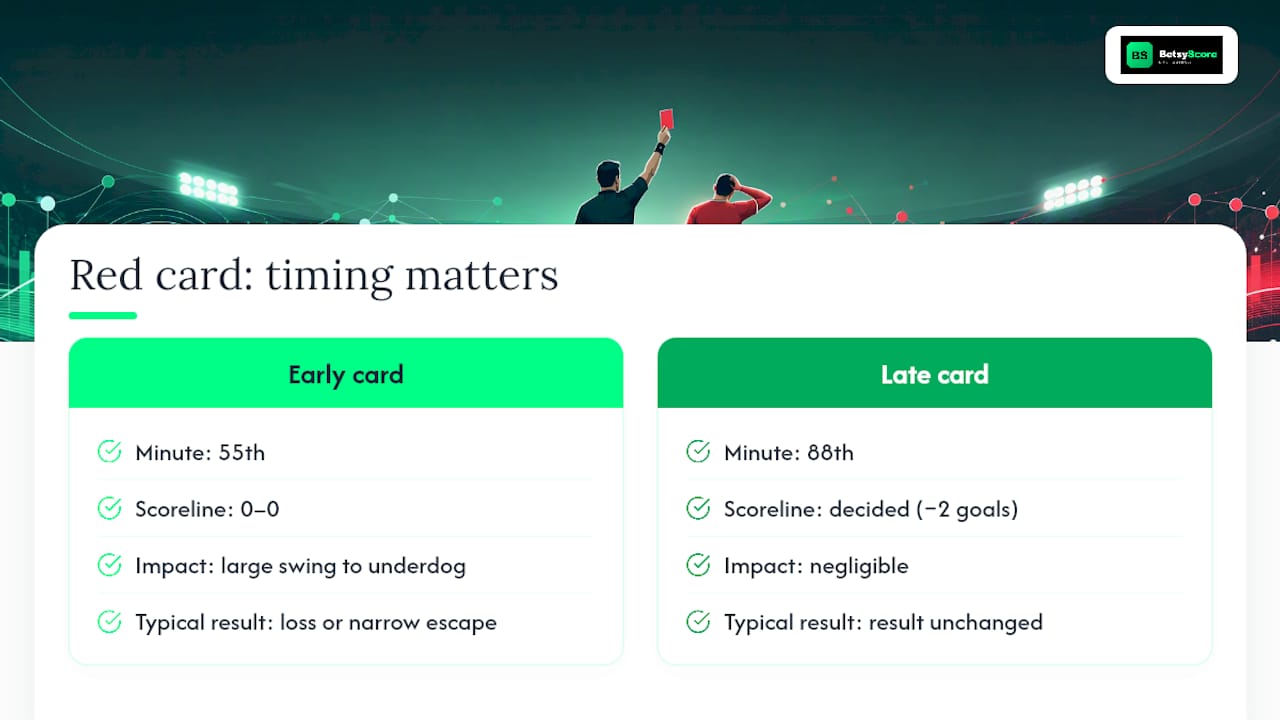
Consider a common in-game scenario: a defender is sent off in the 55th minute of a scoreless match against a team of similar quality. Based on the expected-goal research above, that single incident can shift win probability for the reduced side from something close to even odds down to a clear underdog position, often before a single additional shot is taken. The eventual result, more often than not, tracks that early statistical shift: a loss or a narrow escape rather than a comeback win.
Contrast that with a red card shown in the 88th minute of a match already decided by two goals. The expected-goal impact there is close to negligible, because there’s no time left for the numerical disadvantage to matter. The lesson for fans: context around the red card, particularly the clock and the scoreline, tells you more about the outcome than the card itself.
How BetsyScore Tracks a Red Card in Real Time
The moment a sending-off happens, several inputs update at once: player count on the pitch, possession share, and the substitution pattern that typically follows. A platform like BetsyScore folds those changes straight into its live win-probability and momentum readouts, so the shift described in the studies above shows up as a visible swing rather than an abstract statistic.
- Win-probability percentages recalculate immediately after the dismissal is confirmed.
- The momentum meter reflects the loss of a player through shifting possession and territorial data.
- Expected-goal tracking adjusts as the reduced team’s attacking threat drops in-model.
Pro Tip: Watch the win-probability line right after a red card rather than just the scoreline. It often reveals how much danger the reduced team is actually in before the next goal confirms it.
Punishment Versus Spectacle: An Editorial Take
Red-card enforcement is inconsistent enough that identical fouls draw different outcomes depending on the referee, the competition, and the moment. That inconsistency fuels most red-card arguments among fans. Where do you think the line between deterrence and theater actually sits?
— Aria
Watch Red Card Impact Unfold Live With BetsyScore
Studying the research is one thing. Watching the win-probability line move in real time when a defender gets sent off in the 60th minute is another entirely. Some platforms refresh win probability, momentum, and expected-goal data every few seconds rather than waiting for a stat-sheet update after the final whistle.

Head to the Live scores hub during any in-progress match and watch what happens the instant a card comes out. Pair that with the AI Predictions page beforehand to see how form, expected goals, and head-to-head data set the baseline that a red card then disrupts. The next time a sending-off happens in a match you’re following, pull up BetsyScore and watch the numbers move.
Sources
- Effects of a red card on goal-scoring in World Cup football matches | Empirical Economics | Springer Nature Link
- Influence of Red and Yellow cards on team performance in elite soccer
- 2026 World Cup red card rules explained: How it works, suspension unavoidable for USA’s Folarin Balogun - NBC Sports
FAQ
Is a Red Card Automatically a Three-Game Ban?
No. Most direct red cards carry a one-match automatic suspension, and the ban only extends to multiple games for serious offenses like violent conduct. Three-game bans typically apply to the most severe misconduct categories, not a standard sending-off.
How Long Does a Red Card Suspension Last?
A standard red card usually means missing the next scheduled match. Serious offenses can extend that ban well beyond one game, and specific lengths vary by competition and association, as The FA’s disciplinary tables show for domestic English soccer.
What Happens if a Player Gets Three Red Cards in a Season?
There’s no single universal rule triggering an extra penalty at exactly three red cards. Accumulated misconduct is generally reviewed case by the relevant disciplinary body, with repeat offenders facing harsher scrutiny and longer bans on subsequent incidents.
Can a Red Card Be Overturned?
Rarely, and usually only for mistaken identity or a clear procedural error by the referee. Tournament disciplinary panels tend to limit appeal pathways tightly, so a red card shown on the pitch almost always stands as issued.