Convert Expected Cards to Live Football Betting Signals for Bettors
Expected cards, often shortened to xB or expected bookings, estimate the probability that a foul turns into a yellow or red card, then sum those probabilities into a running total for each team. Fans use it to read discipline trends in real time, bettors use it to price card markets, and analysts use it to separate reckless teams from unlucky ones. The metric updates throughout a match as fouls, scorelines, and referee decisions accumulate.
TL;DR:
- Expected cards estimate the probability of a foul resulting in a yellow or red card, summing these probabilities for a real-time match total.
- Models use features like foul location, match context, and referee tendencies, often employing ensemble machine learning techniques for accurate predictions.
- Live updates incorporate match developments such as goals, red cards, and tactical changes, avoiding simple time-based scaling of pre-match estimates.
- Converting expected cards into betting probabilities requires adjusting for bookmaker margins and understanding market-specific settlement rules.
- Effective dashboards display uncertainty bands, driver explanations, and sample sizes to help fans and bettors interpret live expected-card data accurately.
Table of Contents
- What Are Expected Cards, and How Do They Differ From Raw Card Counts?
- How Are Expected-Card Models Built?
- How Do You Update Expected Cards During a Live Match?
- How Do You Convert Expected Cards Into Betting Probabilities?
- What Should a Live Expected-Cards Dashboard Show Fans and Bettors?
- How Betsyscore Applies Expected-Cards Thinking to Live Matches
- See Expected-Card Style Forecasts in Action on Betsyscore
- Sources
- FAQ
What Are Expected Cards, and How Do They Differ From Raw Card Counts?
Expected cards model something raw counts cannot: the likelihood that any given foul results in a booking. A researcher building an xB model assigns a probability to each foul based on its severity, location, and context, then adds those probabilities across the match to produce an expected total. That is fundamentally different from just tallying fouls or cards after the fact, and it mirrors how expected goals models treat shot quality instead of shot counts alone.
The distinction matters because foul volume and booking likelihood often diverge. A team committing 18 fouls in midfield with no cards shown has low xB, while a team with 9 fouls that include two reckless tackles can carry a higher expected total. This is why xB research applied to the FIFA World Cup 2022 treated booking probability as the core unit, not foul frequency.
A few practical distinctions worth keeping straight:
- Yellow and red cards should be modeled separately, since reds are rare and change games disproportionately.
- Expected bookings estimate probability of a card per foul, not a raw foul tally.
- Booking-points markets (common in fantasy and spread betting) assign different weights to yellows and reds, so always check settlement rules before comparing a model’s output to posted odds.
How Are Expected-Card Models Built?
An xB model draws on a handful of recurring inputs: match minute, score difference, foul location on the pitch, distance and angle from goal, cumulative foul counts per player and team, and pressure-style features similar to VAEP, which weighs how much a passage of play threatens to produce a shot or goal. These features feed a classifier that outputs a booking probability for each foul, and those probabilities sum into the match-level expected count.
Statistic Callout: Iterative testing on xB models found that adding features and richer data consistently improved predictive performance, with results validated against observed defensive behavior at the 2022 World Cup.
Gradient-boosting ensembles, including XGBoost-style architectures, show up often in this research because booking events are rare relative to total fouls, and ensembles handle that class imbalance better than simple logistic models. Before trusting any xB number, check for a few trust signals:
- Sample size and competition coverage behind the model, since a handful of matches produces noisy estimates.
- Calibration and scoring performance, meaning whether predicted probabilities match observed booking rates.
- Provenance of referee statistics, since referees and teams show comparable heterogeneity across Europe’s Big 5 leagues, and a “strict referee” label built on five matches means far less than one built on fifty.
- Whether yellow and red cards were modeled as separate outcomes rather than combined into one blended figure.
How Do You Update Expected Cards During a Live Match?
A pre-match xB estimate is a starting point, not a fixed forecast. Live models need to condition on what has actually happened: cards already shown, the current scoreline, substitutions, tactical shifts, red cards, and elapsed minutes all shift the probability of the next booking.

The biggest mistake in live tracking is scaling a season average by the fraction of time remaining, as if cards arrive at a constant rate. They don’t. Joint modeling of goals and bookings in English football found that a red card actually increases the goal rate of the team with a numerical advantage, showing how scoreline and bookings status feed back into each other rather than acting as separate, static inputs.
A workable live recalibration process looks like this:
- Start from the pre-match baseline, adjusted for confirmed lineups and referee assignment.
- Update after each recorded foul or card, feeding in elapsed time and current match state.
- Treat referee tendencies as a range of uncertainty, not a single fixed number.
- Flag any shift driven by a red card or a tactical substitution rather than blending it silently into the trend.
- Re-check the sample size behind any referee or team baseline before publishing a new figure.
Pro Tip: Watch for a booking cluster right after a controversial decision. Players often push back verbally or physically in the next few minutes, and that short window frequently carries a higher booking probability than the surrounding run of play.
How Do You Convert Expected Cards Into Betting Probabilities?
Turning an expected count into a usable probability means moving past the raw number and asking what it implies for a specific market line. A common approach applies a Poisson-style calculation to the expected total, though raw Poisson often understates real-world clustering. Cards bunch together after flashpoints far more than a clean Poisson distribution predicts, so serious models apply an adjustment for that underdispersion or overdispersion before quoting a threshold probability.
Before comparing any model output to bookmaker odds, run through these checks:
- Confirm settlement rules for the specific market. Some books count a second yellow as a red for booking-points purposes, others don’t, and a practical cards calculator notes common conventions like 10 points for a yellow and 25 for a red, though these vary by operator.
- Adjust the model’s implied probability for bookmaker margin before judging whether a price offers value; comparing a raw model output to a vig-inflated line will always look more attractive than it is.
- Separate pre-match estimates from live, in-play estimates. A number generated before kickoff carries far more uncertainty than one updated at the 70th minute with actual foul data.
- Always report the calibration, sample size, and competition behind the figure you’re using, since a Champions League referee’s tendencies don’t transfer cleanly to a domestic league fixture.
What Should a Live Expected-Cards Dashboard Show Fans and Bettors?
A dashboard earns its keep by separating real signal from noise, and that means showing more than a single scary number climbing during a tense match. The essential elements are the expected total, a team-by-team split, probability bands around that total (not a false-precision point estimate), cards already recorded, and how much match time remains.
Good dashboards also expose their drivers instead of hiding behind a black box. That means labeling the referee’s baseline with its sample size, noting lineup or tactical changes, and flagging exactly which event pushed the estimate up or down. Interpreting live match statistics well means learning to read a minute-by-minute momentum shift the same way you’d read a shifting win-probability line.
- Show uncertainty bands, not a single number, since a “2.3 expected cards” figure hides a real range of outcomes.
- Always attach a provenance flag to referee-based inputs so users know if it’s built on five matches or fifty.
Pro Tip: A sudden jump in expected cards right after a hard tackle is often noise settling into signal, but a slow, steady climb across 20 minutes with no single flashpoint usually reflects a genuinely combative match, not a data glitch.
How Betsyscore Applies Expected-Cards Thinking to Live Matches
Betsyscore’s live match center runs on the same principles researchers use to build xB models: continuously updated inputs, not static pre-match snapshots. Scores, AI-powered win probabilities, and a minute-by-minute momentum read all shift as fouls, cards, substitutions, and scoreline changes come in across more than 200 competitions.
That live-updating approach is exactly what a sound expected-cards workflow demands: condition on what just happened, not on a preseason average. Betsyscore’s instant stats let fans and analysts inspect the same underlying drivers a model would use, including foul counts, cards shown, and shifting match state, across everything from the Premier League to the World Cup. Machine learning approaches behind those live football forecasts treat every match minute as new information, which is precisely the mindset expected-cards analysis rewards.
— Aria
See Expected-Card Style Forecasts in Action on Betsyscore
Some platforms give you a live-updating view that static pre-match card previews can’t match. Instead of a single number frozen at kickoff, you get win probabilities and momentum reads that shift minute by minute as fouls, cards, and scoreline changes actually happen on the pitch.
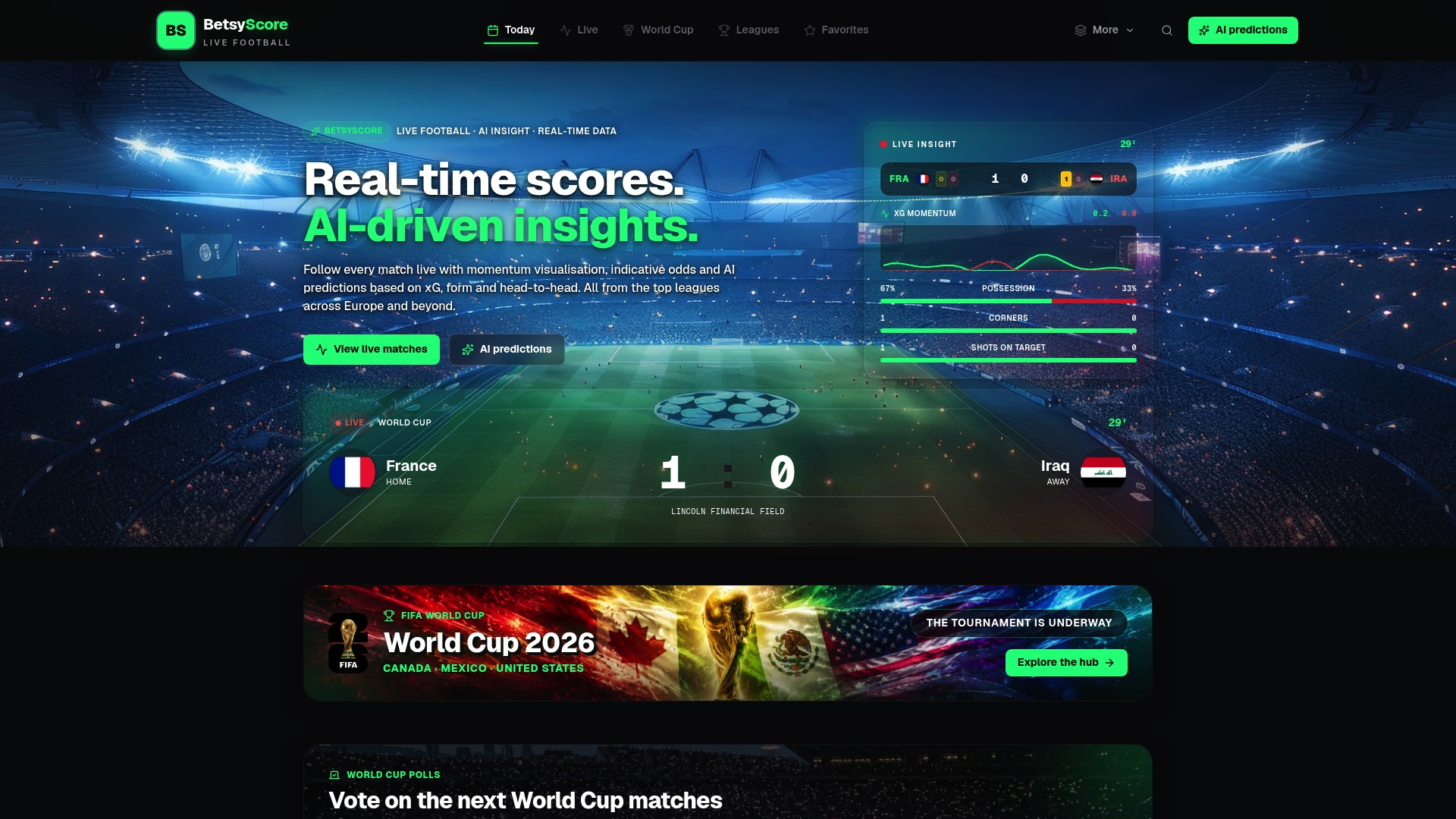
Open the live match center during any in-progress fixture and watch how the momentum read and AI-powered probabilities move alongside real match events, including bookings. Pair that with the predictions page to see win-probability percentages built from expected goals, recent form, and head-to-head data. Pick a live game right now and track how the numbers respond the next time a card gets shown.
Sources
- Investigating Fouling Efficiency in Football Using Expected Booking (xB) Model
- Joint modelling of goals and bookings in association football
- Yellow fever: an investigation into referee consistency in the ‘Big 5’ leagues of European football using a bivariate mean-parameterized Conway–Maxwell–Poisson copula model
- World Cup 2026 Cards Calculator | Yellow Cards & Booking Points
FAQ
What Does “Expected Cards” Mean in Football?
Expected cards, or xB, estimate the probability that a foul results in a booking, then sum those probabilities into an expected total for a match. The concept mirrors expected goals but focuses on disciplinary outcomes instead of scoring chances.
Are Expected Cards the Same as Booking-Points Markets?
No. Expected cards are a probability-based forecasting metric, while booking-points markets are betting products that assign fixed point values to yellow and red cards. Settlement rules for booking-points markets vary by bookmaker, so always check how second yellows and straight reds are scored before comparing a model’s output to the posted line.
Does Expected Cards Cover Both Yellow and Red Cards?
Most xB research treats yellow cards as the primary target because they’re far more frequent and produce enough data to train a reliable model. Red cards get modeled separately since they’re rarer and have an outsized effect on match outcomes, including changes to the opposing team’s scoring rate once a team plays with an extra man.
Why Do Referee Statistics Matter for Card Forecasts?
Referees vary meaningfully in how strictly they call fouls, and research across Europe’s Big 5 leagues found referees and teams show comparable levels of heterogeneity. Always check the sample size behind a referee’s card average before trusting it, since a figure built on a handful of matches can mislead.
Where Can I Watch Expected-Cards Style Forecasts Update Live?
Betsyscore’s live match center updates win probabilities and momentum reads continuously as match events unfold, including cards, giving you a real-time view rather than a static pre-match number. Current features and coverage details are listed directly on the site.