Watch Betsyscore Live: Machine Learning in Football for Analysts
Machine learning in football works as a decision support tool. It converts event data, tracking feeds and wearable output into calibrated win probabilities, tactical suggestions and injury risk flags. Model families range from gradient boosting to graph neural networks, and none of them replace a coach’s judgment. What follows covers where these systems actually work, what to trust, and how to build or evaluate one yourself.
TL;DR:
- Match outcome predictions benefit from graph neural networks, which improve accuracy by modeling player interactions and team structures over time.
- Using tracking data for spatial and relational insights justifies the complexity of advanced models, but baseline XGBoost models remain strong initial choices.
- Proper data preprocessing, especially timestamp synchronization and careful feature construction, is crucial for model reliability and avoiding information leaks.
- Performance metrics like calibration curves and time-aware validation are essential to assess the real-world usefulness of prediction models.
- Live prediction systems, such as Betsyscore, demonstrate ongoing accuracy and drift monitoring, providing real-time insights without the need for custom development.
Table of Contents
- Where Machine Learning in Soccer Actually Gets Used
- Which Models Actually Work for Football Analytics
- Data Sources and Preprocessing That Actually Matter
- How to Tell If a Football Prediction Model Actually Works
- Building Your First Match Prediction Pipeline
- How Betsyscore Turns Match Data Into Live Predictions
- Where This Technology Goes From Here
- See Betsyscore’s Machine Learning Predictions Live
- Sources
- FAQ
Where Machine Learning in Soccer Actually Gets Used
Match outcome prediction is the most visible application, but it’s far from the only one. Academic reviews consistently point to outcome prediction and event detection as the two most common ML applications in football, largely because both problems map cleanly onto supervised learning with abundant labeled data. Tactical analysis and injury risk assessment follow close behind, though they demand richer inputs.
Here’s how the major use cases break down by data need and typical output:
- Match outcome and in-play probabilities: consume team form, expected goals (xG), and head-to-head history; output a probability distribution across win, draw, and loss.
- Tactical routine analysis (corner kicks, set pieces): needs positional tracking data; output is a ranked list of recommended player positions or passing options.
- Event detection (shots, tackles, key passes): works from video-derived event streams; output is a classified timeline of match actions.
- Player performance analysis: blends event data with physical metrics; output is a performance score or percentile ranking against peers.
- Injury risk modeling: relies on wearable load data and historical injury records; output is a probability score flagging elevated risk.
- Scouting and recruitment: combines performance stats across leagues; output is a similarity ranking against a target player profile.
A quick rule of thumb: if the application involves spatial relationships between players, you need tracking data. If it’s about outcomes or discrete events, event-stream data alone usually suffices. This distinction matters more than most beginners realize. It determines your entire data acquisition strategy before you write a line of model code.
Which Models Actually Work for Football Analytics
Start with classical models. Logistic regression, Random Forest, and XGBoost handle tabular data well and remain the strongest baseline for match prediction using team-level stats like recent form, xG differential, and rest days. They’re fast to train, easy to interpret, and often within a few percentage points of far more complex systems.
Sequence models like LSTMs and temporal CNNs earn their keep when the question involves momentum or in-game state changes. They pick up on patterns across a match timeline that a static feature vector misses entirely.
Graph neural networks (GNNs) are where things get genuinely interesting. Football is fundamentally relational. Eleven players interact constantly, and a GNN encodes those pairwise interactions directly rather than flattening them into a feature list. Temporal graph neural networks extend this by snapshooting the passing network across sliding time windows, capturing how team structure evolves as a match progresses. On event datasets, temporal GNNs delivered 3 to 9 percentage points of accuracy improvement and a 5 to 17% relative reduction in Brier score over non-graph baselines, a meaningful gap when you’re pricing probabilities against betting markets or building fan-facing predictions.
- Classical ML: best first baseline, interpretable, cheap to run.
- Temporal models: capture in-match momentum shifts.
- GNNs and temporal-GNNs: model player interactions directly, often outperform feature-fusion approaches.
- Transformers and spatiotemporal encoders: justified only with high-frequency tracking data and heavy engineering budgets.
Pro Tip: Don’t jump straight to a GNN because it sounds impressive. Build the XGBoost baseline first, measure its Brier score, then test whether a graph-based model actually earns its complexity with a measurable lift.
Data Sources and Preprocessing That Actually Matter
Event data logs discrete actions: passes, shots, tackles, fouls, each timestamped and tagged with location coordinates. Tracking data captures continuous player and ball positions, typically at 10 to 25 frames per second, and it’s what tactical and spatial models need. Wearable sensors add physiological layers: heart rate, distance covered, high-speed running bursts, which feed directly into injury-risk models.
StatsBomb’s Open Data remains the standard public entry point for event-level analysis, though coverage skews toward specific competitions and seasons, so watch for sampling bias before generalizing findings across leagues. Commercial feeds from tracking providers fill gaps but come at real cost and licensing complexity.
Preprocessing steps that actually move the needle:
- Synchronize timestamps across event and tracking streams before merging any datasets.
- Impute missing positional data carefully. Gaps during broadcast cuts are common and can silently corrupt features.
- Build passing graphs where nodes represent players and edges represent pass frequency or co-presence on the pitch.
- Convert raw shot events into xG using shot location, angle, and body part rather than relying on binary goal/no-goal labels.
Label choice deserves real care. If you’re predicting pre-match outcomes, never let post-match information leak into your training labels. It sounds obvious until you’re constructing features and accidentally include a stat only knowable after full time. Given how much of this analysis depends on player-level physiological data, treat wearable and health records with the same security discipline you’d apply to any sensitive personal data, since a 2024 systematic review flagged data security as a recurring risk across AI deployments in football.
How to Tell If a Football Prediction Model Actually Works
Better metrics matter more:
- Log loss and Brier score measure how well-calibrated your predicted probabilities are, not just whether you picked the right winner.
- Calibration curves show whether a predicted 70% win probability actually wins about 70% of the time across many matches.
- Precision and recall matter most for injury-risk and event-detection tasks, where false negatives carry real cost.
- Time-aware validation (forward-chaining across seasons) beats random cross-validation every time, since random splits leak future information into training data and inflate performance estimates artificially.
Common failure modes include data leakage, spurious correlations picked up from small samples, and biased datasets that overrepresent top-tier leagues. On the operational side, a poorly validated load-management model can flag a healthy player as high-risk or miss a genuine warning sign, so systematic reviews warn against deploying such systems without careful validation against clinical or coaching oversight. Always report calibration alongside raw accuracy when sharing results with anyone who’ll act on them.
Building Your First Match Prediction Pipeline
A working prediction pipeline follows a fairly consistent sequence, whether you’re modeling match outcomes or player performance trends.
- Define your target and baseline. Decide exactly what you’re predicting (match winner, total goals, injury probability) and set a baseline to beat, whether that’s bookmaker implied odds or a simple form-based average.
- Assemble your feature set. Combine team form over the last five to ten matches, xG differentials, rest days, and, if tracking data is available, passing-graph features like network centrality or possession chains.
- Train the baseline first. Run logistic regression or XGBoost before anything fancier. Evaluate strictly with time-based holdouts, never random splits, and track both accuracy and Brier score.
- Test graph or temporal models only if the data justifies it. If you have tracking-level access, prototype a temporal-GNN and compare its lift against your baseline using the same held-out test set.
- Plan for deployment constraints. Live in-play probabilities need low latency, meaning your model has to score in milliseconds, not minutes. Set up drift monitoring since team form and squad composition shift constantly across a season.
- Keep a human in the loop. No model should auto-generate tactical or medical recommendations without review from someone who understands the context a spreadsheet can’t capture.
Worthwhile experiments once your baseline is solid: run ablation studies to see which features actually drive predictive power, try synthetic data augmentation for rare events like red cards, and use interpretability tools like SHAP values to check whether your model is learning genuine patterns or picking up noise.
Pro Tip: Before scaling up to graph models, run an ablation test removing your passing-graph features entirely. If accuracy barely drops, the added complexity isn’t paying for itself yet.
How Betsyscore Turns Match Data Into Live Predictions
A real-time football platform applies this pipeline to generate AI-powered match predictions that estimate win probabilities from expected goals, recent form, and head-to-head records, refreshed continuously as a match unfolds. Alongside that sits a minute-by-minute momentum read, showing which side is controlling play rather than just who’s ahead on the scoreboard.

Read these outputs the way you’d read any calibrated model: a 65% win probability doesn’t guarantee a result, it estimates a tendency across many similar situations. Momentum swings during stoppage time or after a red card, and drift is normal. You can watch these signals update live across Betsyscore’s predictions page and see how the numbers move as match context changes.
Where This Technology Goes From Here
Expect graph-based models and generative tactical assistants to keep gaining ground as tracking data becomes more accessible. For analysts, the priority checklist stays the same: measure rigorously, validate on time-based splits, protect athlete safety, and demand interpretability. Start small, verify carefully, and never cut coaches out of the loop.
— Aria
See Betsyscore’s Machine Learning Predictions Live
This platform provides win-probability percentages and momentum tracking continuously across more than 200 competitions, updating frequently rather than sitting static until kickoff.
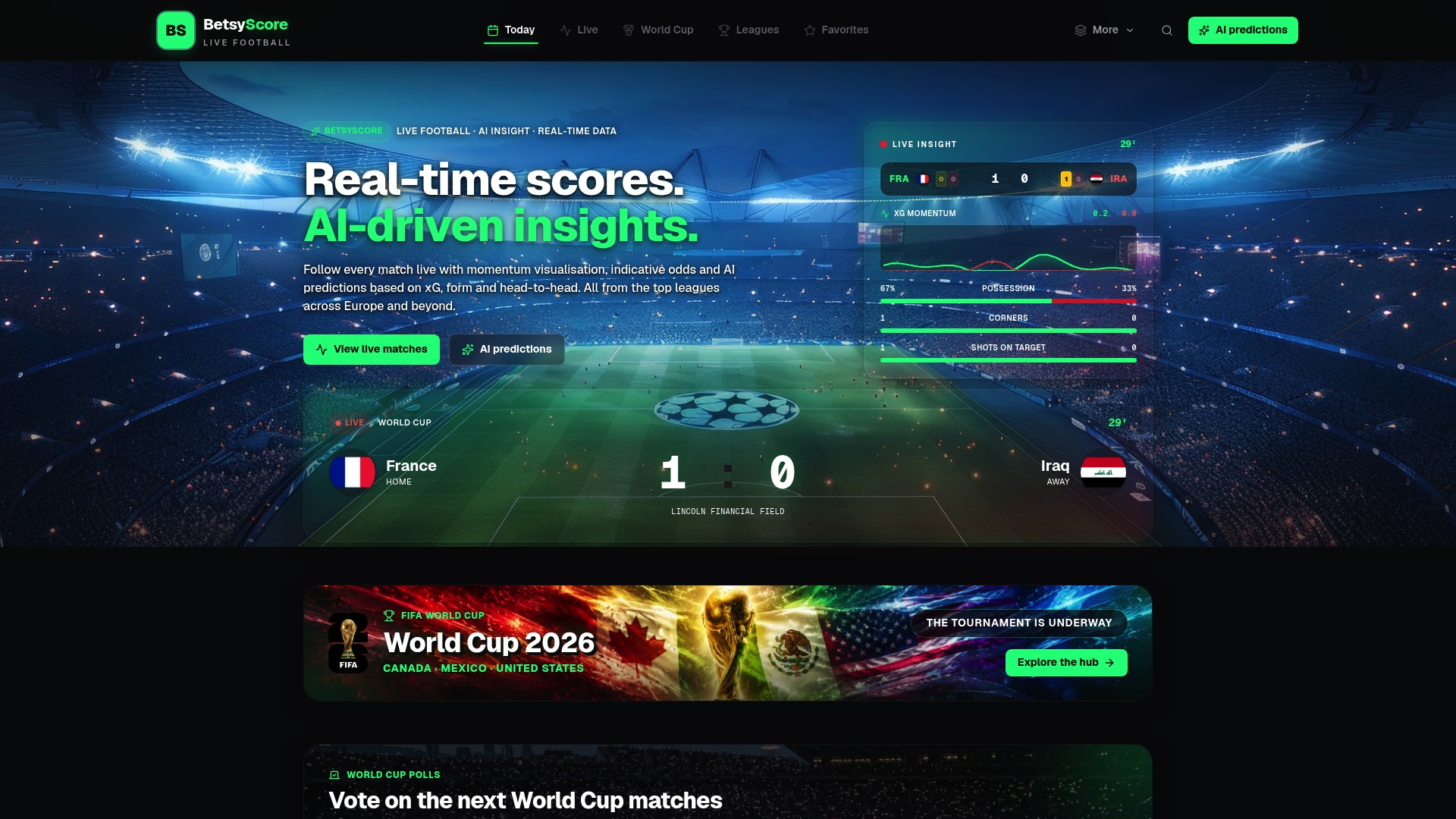
If you’ve been building your own baseline model or testing a GNN prototype, watching how a live production system handles calibration and drift in real time is one of the fastest ways to sanity-check your own assumptions. Head to Betsyscore’s live match page to see current probabilities and momentum reads update in real time, or browse AI predictions to study how the percentages shift across different competitions and match states.
Sources
For deeper technical grounding, read the TacticAI evaluation paper on corner-kick modeling, the systematic review of ML applications in soccer, and the temporal-GNN study on sports outcome prediction. Pay particular attention to each paper’s validation methodology, not just its headline results.
- Systematic review identifying AI applications and associated risks in football codes (2024)
- Machine learning application in soccer: a systematic review (PMC9806754)
- Temporal graph neural networks for sports outcome prediction: modeling dynamic player interactions and evolving team structures
FAQ
Are professional football teams actually using AI?
Yes. Clubs and research partners have deployed systems like TacticAI for tactical set-piece analysis, and a 2024 systematic review of 190 peer-reviewed articles documented widespread AI adoption across performance analysis, scouting, and injury prevention in football specifically.
How accurate is machine learning at predicting football matches?
Accuracy varies significantly by model and available data, but well-calibrated models measure success through Brier score and calibration rather than raw win/loss accuracy. Temporal graph neural networks improved accuracy by 3 to 9 percentage points and cut Brier score by 5 to 17% relative to simpler baselines on event datasets, showing real but incremental gains rather than guaranteed certainty.
How is artificial intelligence used in football beyond predictions?
Beyond match outcomes, AI powers tactical routine analysis, event detection, player performance scoring, injury risk modeling, and scouting recruitment. TacticAI’s corner-kick recommendations were preferred by Liverpool FC domain experts 90% of the time in a blind evaluation against real-world setups, a strong signal that these tools can produce coach-usable output.
How can machine learning be used in sports analytics generally?
Machine learning applies across sports through pattern recognition in event and tracking data, predictive modeling for outcomes and injuries, and interaction modeling through graph-based approaches. In soccer specifically, supervised learning, deep learning, and hybrid models dominate across outcome prediction, performance analysis, and injury detection use cases.
Can I see live machine learning predictions for football without building my own model?
Yes. Betsyscore publishes live win probabilities and momentum reads across major competitions, refreshed continuously, so you can study calibrated outputs directly on its predictions page without building or training anything yourself.