AI Football Predictions: Read Probabilities, BetsyScore Tested
AI football predictions convert match data into calibrated probabilities across markets like 1X2, BTTS, and Over/Under, plus supporting outputs like expected goals and predicted scorelines. The credible platforms publish their calibration and backtest metrics rather than just their wins. Treat every probability as a long-run rate, not a forecast of a single outcome, and use it to spot where a bookmaker’s price disagrees with the model’s read of the match.
TL;DR:
- Prediction platforms that publish calibration and backtest metrics provide more reliable data than those that only show winning streaks or simplified statistics.
- Models that incorporate ensemble architectures, including Dixon-Coles, gradient-boosted trees, and neural networks, trained with real-time data, outperform single-technique systems.
- Comparing model probabilities to bookmaker implied probabilities reveals valuable edges, especially on mismatched fixtures where markets are slow to adjust.
- Consistent accuracy in the 67% to 71% range and low Ranked Probability Score indicate robust calibration for well-built football prediction models.
- Using probabilistic edge calculations before betting, combined with lineup checks and live market monitoring, improves decision-making over gut feeling alone.
Table of Contents
- What Do AI Football Predictions Cover? Markets and Outputs Explained
- How Are Football Prediction Algorithms Actually Built?
- How Accurate Are AI Football Predictions?
- How Do You Turn a Prediction Into a Betting Decision?
- How Do Live AI Predictions Update During a Match?
- BetsyScore: Live AI Predictions in Practice
- AI Predictions vs. Traditional Methods and Human Tipsters
- Where Have AI Football Predictions Gotten It Right?
- Ethical Considerations and the Misuse of AI Football Predictions
- What I’ve Learned Watching This Space Evolve
- Try Live AI Predictions Before Your Next Match
- Sources
- FAQ
What Do AI Football Predictions Cover? Markets and Outputs Explained
A prediction engine worth your attention rarely outputs a single number. It produces a spread of related figures, each answering a slightly different question about the same match.
1X2 is the classic three-way outcome market: home win, draw, or away win, expressed as a probability for each. BTTS (both teams to score) asks whether both sides will find the net at least once, regardless of final score. Over/Under markets set a goal threshold, usually 2.5, and ask whether the match will finish above or below it. Correct score predictions go further, assigning a probability to specific final scorelines like 2-1 or 1-1, which is why they carry lower individual probabilities even when the model is confident about the general shape of the game.
Beyond the market probabilities themselves, most serious platforms surface a handful of supporting outputs:
- Expected goals (xG): a decimal estimate of how many goals each team “should” score based on shot quality and location, independent of what actually happens on the scoreboard.
- Predicted scoreline: the single most likely final score, derived from the full probability distribution rather than a guess.
- Confidence flags: a marker showing how tightly clustered the model’s probability mass is, since a 40% favorite in a wide-open match reads differently than a 40% favorite in a near coin-flip.
- Edge or value markers: a flag showing where the model’s probability diverges meaningfully from the odds a bookmaker is offering.
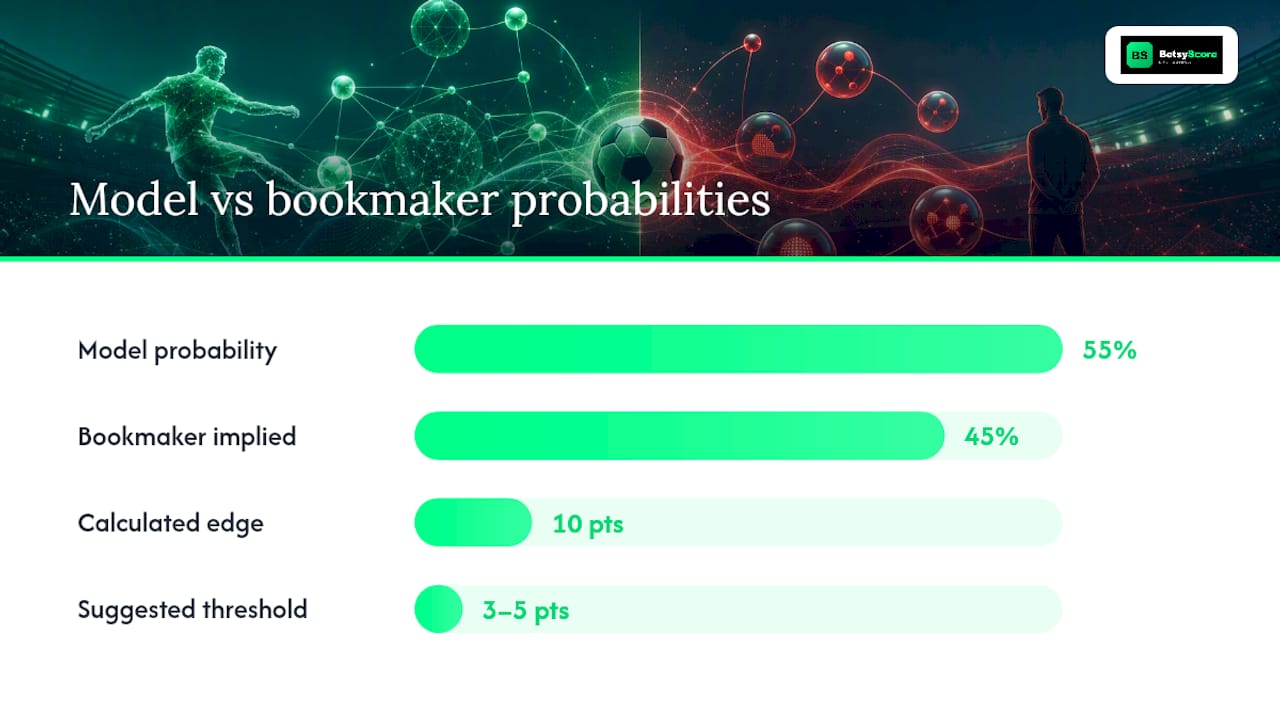
That last output is the one worth learning to read carefully. If a model gives a team a 55% chance to win and the bookmaker’s odds imply only 45%, the gap between those two numbers is the “edge.” ScoutingStats builds its entire prediction feed around exactly this comparison, publishing model probabilities alongside bookmaker implied probabilities so users can see the gap themselves rather than trusting a black-box recommendation. That transparency, showing the math instead of just the pick, is what separates a useful prediction tool from a tipster’s hunch.
How Are Football Prediction Algorithms Actually Built?
Every credible football prediction algorithm starts with data ingestion, and the breadth of that intake determines the ceiling on accuracy. Historical match results are the baseline. Event-level data, particularly the shot locations and quality metrics behind xG, adds texture that a final score alone can’t capture. Bookmaker odds get pulled in too, not because a model needs to copy the market, but because odds movement itself encodes information, like sudden money on an away win signaling a lineup change the model hasn’t seen yet. Lineup confirmations, injury feeds, and fixture congestion round out the picture.
None of this data is useful without a model architecture built to weigh it correctly. Here’s what that typically looks like under the hood:
- Dixon-Coles or Poisson models treat goal scoring as a random process with team-specific attack and defense strengths, producing a full score matrix rather than a single pick.
- Gradient-boosted trees (LightGBM, XGBoost) handle the messier, non-linear relationships between dozens of features, like how a team’s away form interacts with a three-day rest deficit.
- Neural networks are often used specifically to model xG from raw shot event data, since they handle spatial and sequential patterns better than tree-based methods.
- A calibrated meta-learner, frequently an isotonic-calibrated logistic regressor, sits on top and blends the outputs of the other models into one final probability.
This layered structure is called an ensemble, and it exists because no single model handles every situation well. Footy-Prophet, an open-source project that stacks LightGBM, a PyTorch-based xG model, and Dixon-Coles together, is a clear public example of this architecture producing predicted scores, xG estimates, and outcome probabilities from one pipeline.
Pro Tip: If a platform only mentions one modeling technique, like “we use machine learning,” treat that as a red flag rather than reassurance. The strongest systems name their components because ensembles genuinely outperform single models.
Feature engineering matters as much as the model choice. Form decay weights recent matches more heavily than results from two months ago, since a team’s current shape usually tells you more than its season average. Rest and fixture congestion account for the reality that a side playing its third match in eight days performs differently than a fully rested one. Head-to-head priors, venue effects, and set-piece tendencies add further nuance that raw win/loss records miss entirely.
Stacked ensembles that combine Elo ratings, Dixon-Coles, and gradient-boosted models, then calibrate the result against bookmaker odds, tend to modestly improve their Ranked Probability Score compared to any single model run alone. That’s a consistent enough pattern that most production systems now ingest odds as a calibration feature rather than treating them as noise to ignore.
Retrain cadence is the detail casual readers overlook. Models retrained with live data, lineup leaks, in-play odds movement, and breaking injury news, are measurably more reliable than models trained once before the season and left untouched. A model that hasn’t updated since Tuesday is working with stale inputs by kickoff on Saturday. Curious readers can see this architecture applied to marquee fixtures in how AI predicts Champions League matches, where lineup and form data shift right up to kickoff.
How Accurate Are AI Football Predictions?
Accuracy is the wrong first question. Calibration is the right one. A model can pick winners correctly more often than not and still be poorly calibrated if its confidence levels don’t track reality.
Three metrics show up repeatedly in serious methodology write-ups:
- RPS (Ranked Probability Score): measures how well a full probability distribution matches the actual outcome, rewarding models that get the ordering of likelihood right, not just the top pick. Lower is better.
- Brier score: a squared-error measure of probability accuracy, useful for binary-style questions like BTTS.
- Accuracy: the simple percentage of matches where the model’s top pick actually happened, useful but easy to game with a model that only ever picks favorites.
A production LightGBM Poisson approach with Bayesian live updates has published seasonal test results showing RPS in the range of roughly 0.196 to 0.202, with accuracy on its highest-confidence predictions running around 67% to 71%. Numbers in that neighborhood represent a realistic, credible range for a well-built model, not a marketing exaggeration. Anything claiming dramatically higher accuracy across all matches, not just high-confidence subsets, deserves skepticism.
Comparing a model’s pre-match probabilities to the bookmaker’s closing odds is one of the most useful sanity checks available, since the closing line reflects the aggregated judgment of the entire betting market. A model that consistently diverges wildly from the close, in either direction, is either finding genuine edge or has a calibration problem, and only a tracked sample over time tells you which.
Watch for these warning signs before trusting any platform’s numbers:
- Small sample claims, like “80% accurate this month” based on a dozen matches.
- Selective reporting that highlights wins and quietly omits misses.
- No published methodology, data sources, or update frequency.
- Round, suspiciously clean win rates with no variance shown across leagues or seasons.
Pro Tip: Favor platforms that publish rolling weekly or monthly backtests instead of a single lifetime stat. A rolling window shows you whether performance is holding up now, not just whether it looked good once.
Notably, performance varies meaningfully by league; La Liga tends to be statistically easier to model than Ligue 1, and international qualifiers, with their frequent mismatches, often show tighter calibration than tightly contested domestic leagues. A platform’s overall accuracy figure can hide real differences at the competition level. For more on interpreting these numbers as a bettor rather than a statistician, see football results prediction guidance.
How Do You Turn a Prediction Into a Betting Decision?
Getting from a probability percentage to a placed wager takes a repeatable process, not a gut call. Here’s the sequence worth following every time:
- Check the model’s probability for the market you’re interested in, whether that’s 1X2, BTTS, or Over/Under.
- Convert the bookmaker’s odds into implied probability by dividing 1 by the decimal odds (odds of 2.20 imply roughly 45.5%).
- Calculate the edge by subtracting the implied probability from the model’s probability. A model showing 55% against a bookmaker implying 45% gives you a 10-point edge.
- Apply a threshold before acting. Many disciplined bettors treat anything under a 3 to 5 point edge as noise rather than signal, though this is a guideline to adapt, not a fixed rule.
Before that bet actually goes down, run through a short filter checklist. Confirm the lineup is set, since a predicted edge built on an assumed starting eleven evaporates the moment a key player is rested. Check for late injury news that hasn’t fully filtered through the odds yet. Look at market liquidity, since thin markets on smaller leagues can carry odds that move sharply on a single large bet, distorting the implied probability you calculated. Watch for recent odds movement too, since a sudden shift often means someone with better information moved first.
Staking discipline determines whether a genuine edge turns into long-term profit or gets erased by variance. A conservative fractional Kelly approach, betting a small fraction of the “full” Kelly-recommended stake, cushions against the inevitable losing streaks that come even with a real statistical edge. Flat staking, wagering the same modest amount every time regardless of confidence, is a simpler alternative that many beginners find easier to sustain. Either way, set a daily or weekly exposure cap and keep a written log of every bet, its edge at the time, and the result.
Pro Tip: Paper-bet any new system for at least a few weeks before risking real money. Track your hypothetical ROI and calibration during that stretch; it’s the only reliable way to know if a strategy works before it costs you anything. The AI predictions page is a practical place to practice this filtering process against live markets before staking real money.
How Do Live AI Predictions Update During a Match?
In-play models work from a different starting point than pre-match ones: a fixed prior belief that shifts continuously as the match unfolds. This is Bayesian updating in practice. The model starts with a pre-match probability distribution, then adjusts it event by event as goals, cards, and substitutions arrive.
A red card in the 30th minute doesn’t just change the scoreline odds. It reshapes the entire distribution, since a team playing down a man for 60 minutes faces a materially different xG trajectory than the pre-match model assumed. Live systems typically apply non-linear time decay alongside score-aware momentum adjustments, which is why a 1-0 lead with 10 minutes left carries a very different win probability than the same 1-0 lead at halftime.
The inputs feeding these live updates typically include:
- A live xG stream tracking shot quality as it happens, not just the final tally.
- Shot events, corners, and other in-possession signals.
- Cards and substitutions, weighted by which player left the pitch.
- Minute-by-minute momentum reads showing which side is generating pressure right now, independent of the scoreline.
The practical catch for bettors is execution risk. There’s inherent latency between when a model updates its probability and when a sportsbook adjusts its odds to match, and that gap closes fast on major matches but can linger on smaller ones. Slippage, where the odds you see aren’t the odds you get by the time a bet confirms, is common in-play. Liquidity also tends to thin out on secondary markets like next-goal or correct score once a match is underway, meaning a real edge can be hard to actually capture at a fair price.
BetsyScore: Live AI Predictions in Practice
BetsyScore applies most of the principles above directly. Its AI-powered predictions generate win probability percentages from expected goals, recent form, and head-to-head records, while live scores refresh every few seconds and a minute-by-minute momentum read shows which side is controlling the match as it happens.
Coverage runs across more than 200 competitions, including the FIFA World Cup 2026, the Premier League, La Liga, Bundesliga, Serie A, and the Champions League, with live lineups, player profiles, and tournament leaderboards layered on top. The Football Match Prediction Algorithm guide walks through the modeling approach behind these numbers, giving readers the same kind of transparency this article has been arguing for: published logic instead of a black box. That’s the workflow worth applying: check the probability, confirm the lineup, watch the momentum read, then decide.
AI Predictions vs. Traditional Methods and Human Tipsters
Traditional football prediction leans heavily on narrative: recent form described in prose, a pundit’s gut feeling about “momentum,” or a tipster’s reputation built on a handful of well-publicized wins. None of that is inherently worthless. Experienced human analysts often catch context an algorithm misses entirely, like a manager’s tactical tendencies in must-win games or a dressing-room story affecting morale.
The gap shows up in consistency and accountability. A human tipster’s track record is usually self-reported and rarely includes the full history of misses. An AI model trained on thousands of matches doesn’t get emotionally attached to a big away win last month, and a well-run platform publishes its complete backtest, wins and losses both, rather than a curated highlight reel.
The two approaches aren’t strictly opposed, either. Ensemble approaches paired with careful feature engineering, like form decay and head-to-head weighting, represent current best practice precisely because they encode the same intuitions a sharp human analyst uses, just applied consistently across every match rather than selectively. The strongest bettors tend to use AI probabilities as the quantitative backbone and reserve human judgment for genuinely qualitative factors, like locker room reports, that no dataset captures well. Neither replaces the other completely; each covers the other’s blind spot.
Where Have AI Football Predictions Gotten It Right?
Open-source projects offer some of the clearest evidence of what a well-built model can actually do, because their methodology and results are public rather than marketing claims. TikaML’s LightGBM Poisson system publishes season-by-season RPS scores in the 0.196 to 0.202 range along with 67% to 71% accuracy on its highest-confidence tier, giving anyone the ability to check the claim against the code itself rather than trusting a headline number.
The more interesting case studies tend to come from mismatched fixtures, where models spot value bookmakers slow to reprice. Stacked ensemble systems that fold in bookmaker odds as a calibration input have shown consistent, if modest, improvements in Ranked Probability Score specifically in these edge-case matches, like international qualifiers between sides at very different competitive levels, where the pre-match line sometimes lags the model’s read.
None of this amounts to a system that never misses. The honest version of the “successful prediction” story isn’t a single flawless call, it’s a model that stays disciplined across hundreds of matches, gets its probability distributions right more often than not, and openly shows the matches where it got it wrong alongside the ones where it didn’t. ScoutingStats’ approach of publishing full probability distributions rather than just a pick reflects this same instinct: the credibility comes from the complete record, not the highlight reel.
Ethical Considerations and the Misuse of AI Football Predictions
Probability isn’t certainty, and the biggest ethical risk in this space is a platform, or a user, forgetting that distinction. Marketing language that implies guaranteed outcomes, or strips out the uncertainty entirely, misleads people into betting more than a probabilistic edge actually justifies.
There’s a real responsibility around problem gambling here too. AI predictions can make betting feel more scientific and therefore safer than it is, which is precisely the psychological trap worth naming directly. A model’s edge over the bookmaker is typically a handful of percentage points, not a guaranteed windfall, and framing it otherwise risks encouraging stakes people can’t afford to lose.
Data integrity matters as well. A model trained on biased or incomplete historical data, say, one that underrepresents lower-tier leagues or smaller national teams, can produce confidently wrong outputs for exactly the matches where information is thinnest. Overfitting is the technical cousin of this problem: a model tuned too tightly to past seasons can look brilliant in backtests and then underperform the moment football’s usual unpredictability, an unexpected red card, a freak deflection, reasserts itself. Responsible platforms address this by publishing complete performance histories, including their misses, and by framing every output as a probability rather than a promise.
What I’ve Learned Watching This Space Evolve
The gap between what AI prediction marketing promises and what the numbers actually support is usually small but real. Treat every output as a probabilistic input to your own judgment, never a prophecy. Track your results honestly, favor providers that publish complete backtests rather than cherry-picked wins, and keep a betting log. Small, consistent stakes beat confident, oversized ones every time.
— Aria
Try Live AI Predictions Before Your Next Match
BetsyScore puts the exact workflow covered here into one live feed: win probabilities built from expected goals, form, and head-to-head records, updated alongside momentum reads that shift minute by minute as a match unfolds.
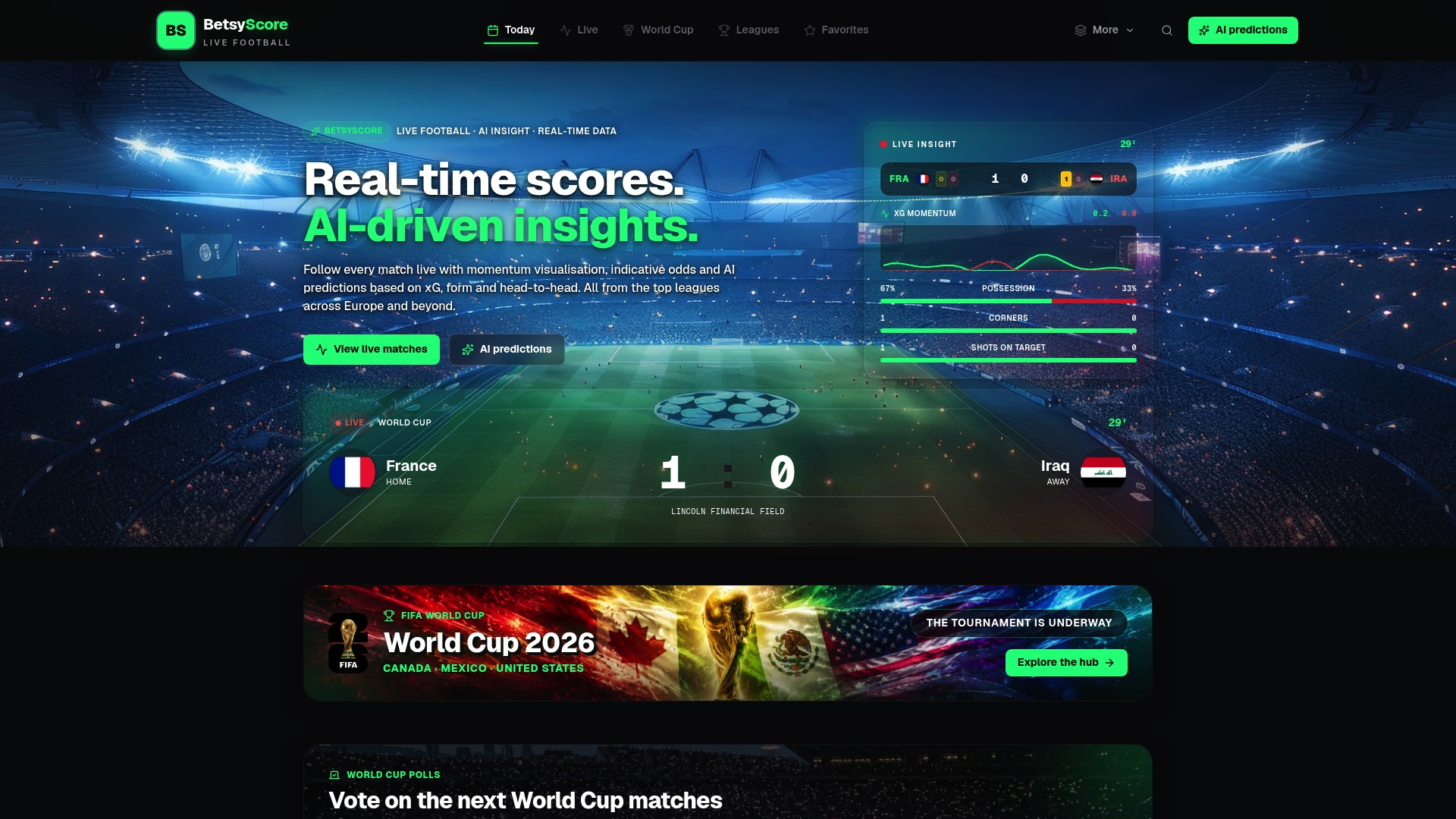
Rather than jumping between a stats site, an odds comparison tool, and a separate live-score app, you get all three signals in one place, across World Cup 2026, the Premier League, Champions League, and 200-plus other competitions. That means less time reconciling numbers from different sources and more time actually applying the filter checklist covered above before a match kicks off. Check the current live predictions and scores for today’s fixtures, or browse the full AI predictions page to see how the probability breakdowns and edge markers look across markets before your next bet.
Sources
Readers who want to go deeper into the mechanics can explore Footy-Prophet and TikaML for runnable ensemble code, football-predictor for stacked model benchmarks, and this Poisson goal model explainer for the statistical foundation nearly every scoreline model still leans on.
- Machine learning sports predictions: behind big wins (WSC Sports blog)
- Humble-Librarian/Footy-Prophet
- AI Football Predictions Today — ScoutingStats
FAQ
Is There Any AI for Football Predictions?
Yes. Multiple platforms and open-source projects, including ScoutingStats and ensemble systems like Footy-Prophet, use machine learning to generate probability-based predictions across markets like 1X2, BTTS, and Over/Under. BetsyScore builds its own AI predictions from expected goals, form, and head-to-head data across more than 200 competitions.
Can I Use ChatGPT to Predict Football Matches?
ChatGPT can discuss team form and reasoning in natural language, but it isn’t built on the structured statistical pipeline, xG models, Dixon-Coles, gradient-boosted ensembles, that dedicated prediction platforms use, and it has no live data feed for lineups or in-play odds. Treat it as a research assistant for context, not a calibrated probability source.
Who Is the Most Accurate Football Predictor?
No single provider can honestly claim to be “the most accurate” across every league and market, since performance varies by competition and even the strongest published systems show accuracy in the 67% to 71% range only on their highest-confidence predictions. Judge accuracy by whether a platform publishes rolling calibration data, not by marketing claims.
What Is the Best AI Sports Predictor?
The strongest AI sports predictors share three traits: published calibration metrics like RPS or accuracy, transparent methodology showing which models and data feed the ensemble, and full backtests that include losses, not just wins. Platforms like BetsyScore and ScoutingStats build their credibility around showing that complete picture rather than a curated highlight reel.
How Do I Know if an AI Prediction Is Reliable?
Check whether the platform publishes its calibration metrics, such as RPS or accuracy on a rolling basis, states its data sources and retraining frequency, and shows both wins and losses over a meaningful sample. A prediction with no visible methodology behind it is closer to a guess than a forecast.