AI Football Match Predictions: How to Compare Tools

AI football match predictions are win, draw and loss probabilities produced by software from data such as expected goals, recent form and head-to-head records. The best tools show their inputs, publish a track record and present percentages as estimates, not promises. This guide explains the main types of tool, how accurate they have proven in recent research, and the criteria that separate a useful prediction page from a decorative one.
TL;DR
- AI football predictions fall into three types: statistical models built on expected goals and form, simulation engines, and general-purpose chatbots. Only the first two run real calculations.
- In two 2026 World Cup evaluations, frontier language models performed on par with betting-market favorites and did not beat the markets’ Brier score.
- Compare tools on competition coverage, markets offered, live updating, a verifiable prediction record and transparency about inputs.
- BetsyScore combines win-probability percentages, a minute-by-minute momentum read and live scores across more than 200 competitions.
- Treat every percentage as an estimate. No tool can guarantee a result.
Table of Contents
- What AI football predictions actually are
- The data behind a credible prediction
- How accurate are AI football predictions?
- Where AI predictions go wrong
- The main types of AI prediction tool
- Seven criteria for comparing tools
- How to compare prediction histories fairly
- Our perspective
- Try BetsyScore’s predictions
- A practical routine for using predictions
- FAQ
- Sources
What AI football predictions actually are
A football prediction is a forecast of a match outcome. An AI prediction is the same forecast generated by a model: a statistical rating system, a machine-learning model trained on historical matches, or a large language model that reasons over text.
These approaches differ in a way that matters to readers. Simulation engines use team ratings, betting-market odds and recent form to simulate matches or whole tournaments, according to a roundup of World Cup 2026 forecasting tools. Chatbots, by contrast, generate reasoned judgements from text. The same source notes that chatbots do not run real simulations, so the percentages they print are not true probabilities.
That distinction is the first filter when you compare tools. Ask whether a number comes from a calculation on structured data or from a model describing what it thinks a plausible answer looks like.

The data behind a credible prediction
Most serious football models draw on the same core inputs.
- Expected goals (xG). A measure of chance quality. Each shot is assigned a probability of becoming a goal, and the sum describes how many goals a team “should” have scored. It is more stable than the actual scoreline over a short run of matches.
- Recent form. Results and underlying performance over a window of recent fixtures, usually weighted so that the latest matches count more.
- Head-to-head records. Past meetings between the two sides, useful as context but a weak signal when squads and managers have changed.
- Lineups and availability. Who actually starts. A prediction published before lineups are confirmed should be updated once they are.
- Market odds. Many models use bookmaker prices as an input, because the market already aggregates a large amount of public information.
BetsyScore’s own model uses expected goals, recent form and head-to-head records to produce win-probability percentages, and it adds a momentum read that shows which side is on top minute by minute. For a technical walk-through, see our practitioner’s guide to match prediction algorithms.
How accurate are AI football predictions?
The most useful evidence comes from the 2026 FIFA World Cup, which gave researchers a tournament that no model could have seen in its training data.
An analysis by Ding, Guo and Xu tested four frontier models on 104 World Cup matches. The models converged on identical top picks in 92% of matches, and none outperformed the Brier score of pre-match betting markets. The authors suggest the reason: the models largely re-express public information that markets already price in.
A second evaluation, by Wang and colleagues, tracked six frontier language models through the tournament. It reported an average match-outcome accuracy of 63.9%, on par with betting-market favorites. The same paper observes that accuracy tracks how lopsided a fixture is rather than how much the model knows, and that it often collapses in the most competitive, data-rich matches.
Three practical conclusions follow.
- A tool that matches the market is doing a respectable job. Beating it consistently is much harder than marketing pages imply.
- Heavy favorites are easy to call. A high headline accuracy figure may simply reflect an easy schedule.
- Evenly matched games, where a prediction is most wanted, are where every model is weakest.
Where AI predictions go wrong
Knowing the failure modes helps you read any percentage sensibly.
Draws are underpredicted. One public tracker of the 72-match World Cup group stage found that several AI models underpredicted draws, and that the five AIs it followed converged on favorites and made the same mistake about Belgium. The author attributes this to an inherited-dataset problem. It is a single personal analysis, so treat it as an illustration, but the pattern it describes fits the academic findings above.
Percentages can look more precise than they are. A figure such as 54% describes a distribution of outcomes, not a verdict. A side given 54% still loses or draws in nearly half of comparable situations.
Football is unpredictable. A single deflection, red card or goalkeeping error can decide a match. The roundup cited earlier states plainly that any site promising guaranteed wins is misleading readers.
If you use predictions alongside betting, the safest framing is that they are forecasting aids. Never stake money you cannot afford to lose, and if gambling is becoming a problem, contact a licensed counselor or a national problem-gambling helpline in your country.

The main types of AI prediction tool
We do not rank rivals by name, but the market splits into recognizable types. Each has strengths and trade-offs.
| Type | How it works | Strengths | Limits |
|---|---|---|---|
| Match-data platforms with built-in models | Models run on structured data (xG, form, head-to-head) and sit beside live scores and lineups | Predictions update with the match; one place for context | Quality depends on the model’s transparency and record |
| Dedicated prediction sites and apps | Daily tips by league and market, often BTTS and over/under | Wide market choice, quick to scan | Often built around betting-odds anchors; history may be selective |
| Tournament simulation engines | Thousands of simulated runs using ratings and odds | Good for title and qualification chances | Less useful for a single match scoreline |
| General chatbots | Language models write a reasoned pick on request | Flexible, can explain the logic | No real simulation; percentages are not true probabilities |
| Self-service predictor widgets | You enter fixture details and receive a forecast | Fast, good for what-if checks | Narrow context; usually no live updating |
The top-ranking pages for this topic reflect the same split: daily prediction lists by league, explainers of how models work, and single-fixture predictors. A reader choosing among them is really choosing which type fits the job.
Seven criteria for comparing tools
Use these questions on any prediction page, including ours.
1. Competition coverage
Check that your leagues are covered, not only the biggest ones. BetsyScore covers the FIFA World Cup 2026, the Premier League, La Liga, Bundesliga, Serie A, the Champions League and more than 200 competitions worldwide. If you follow the Eredivisie, Ligue 1 or the Europa League, confirm they are present before you commit to a tool.
2. Markets offered
Match outcome is the baseline. Many fans also want both-teams-to-score, goal totals and predicted scorelines. Our BTTS predictions page shows both-teams-to-score probabilities, and the AI score predictions page lists predicted scorelines for each match.
3. Live behavior
A pre-match number goes stale the moment a goal is scored. Tools that refresh during play, and show how pressure shifts, are more informative than a static pick. Our explainer on how live AI match data works covers what updates and when.
4. Transparency of inputs
A good page tells you what drives the number. If a tool will not say whether it uses xG, form, odds or lineups, you cannot judge whether its output deserves trust.
5. A verifiable record
This is the criterion most pages skip. Look for a public, dated record of past predictions, including misses, with the competition and the market stated. We publish an AI prediction record for World Cup 2026 so readers can check results against the original forecasts.
6. Calibration, not only accuracy
A tool is well calibrated when events given 60% happen roughly 60% of the time. Picking winners is not enough. The academic evaluations above used the Brier score, which penalizes confident wrong calls, and it is a fairer test than a simple hit rate.
7. Cost and access
Some tools are free, some charge subscriptions, some are ad-supported. Prices change often, so check the provider’s own page for current terms before relying on any figure you read elsewhere. BetsyScore is an ad-supported media platform, so reading its scores and predictions does not require a payment from fans.
How to compare prediction histories fairly
Track records are easy to flatter. When you read one, check the following.
- Same sample. Compare tools over the same competition and the same period. A record built on cup mismatches is not comparable with one built on a balanced league.
- Baseline. Ask what simply backing the favorite would have scored. If a tool barely beats that, the model adds little.
- All predictions included. A record that only displays “top picks” or winning tips hides the misses.
- Probabilities, not just picks. Check whether stated percentages matched real frequencies.
- Time stamps. A prediction should be published before kickoff and left unedited.
- Draws. See how a tool handles them, since several models underpredict them.
A short worked example shows why this matters. Suppose a tool calls 100 matches and picks the winner correctly in 64. That sounds strong. But if 60 of those matches featured a clear favorite who would have won anyway, the tool added only a few correct calls beyond the baseline. This is the same logic behind the finding that accuracy follows fixture lopsidedness.
Our perspective
We build BetsyScore around one belief: a prediction is only useful when the reader can see what produced it and can check how it performed afterwards.
That is why our predictions sit beside the evidence. A win-probability percentage is shown with the context that shaped it, such as expected goals, recent form and head-to-head history. The momentum view then shows, minute by minute, whether the match is moving toward or away from that forecast. Scores refresh every few seconds, so the picture changes as the match does.
The research above shapes how we present results. Frontier models have not beaten the betting market on a clean tournament test, and we see no reason to claim otherwise. The honest value of a model is a disciplined, consistent estimate that removes some of the bias fans bring to their own team, along with a public record against which it can be judged.
Our method for reading probabilities is explained in our guide to AI football predictions and how to read probabilities. For competition-specific applications, see how we approach Champions League matches and Serie A probabilities.
— Aria
Try BetsyScore’s predictions
If you want match forecasts, live scores and momentum in one place, start with BetsyScore’s AI predictions. Each fixture shows win probabilities for both sides and the draw, built from expected goals, form and head-to-head records.
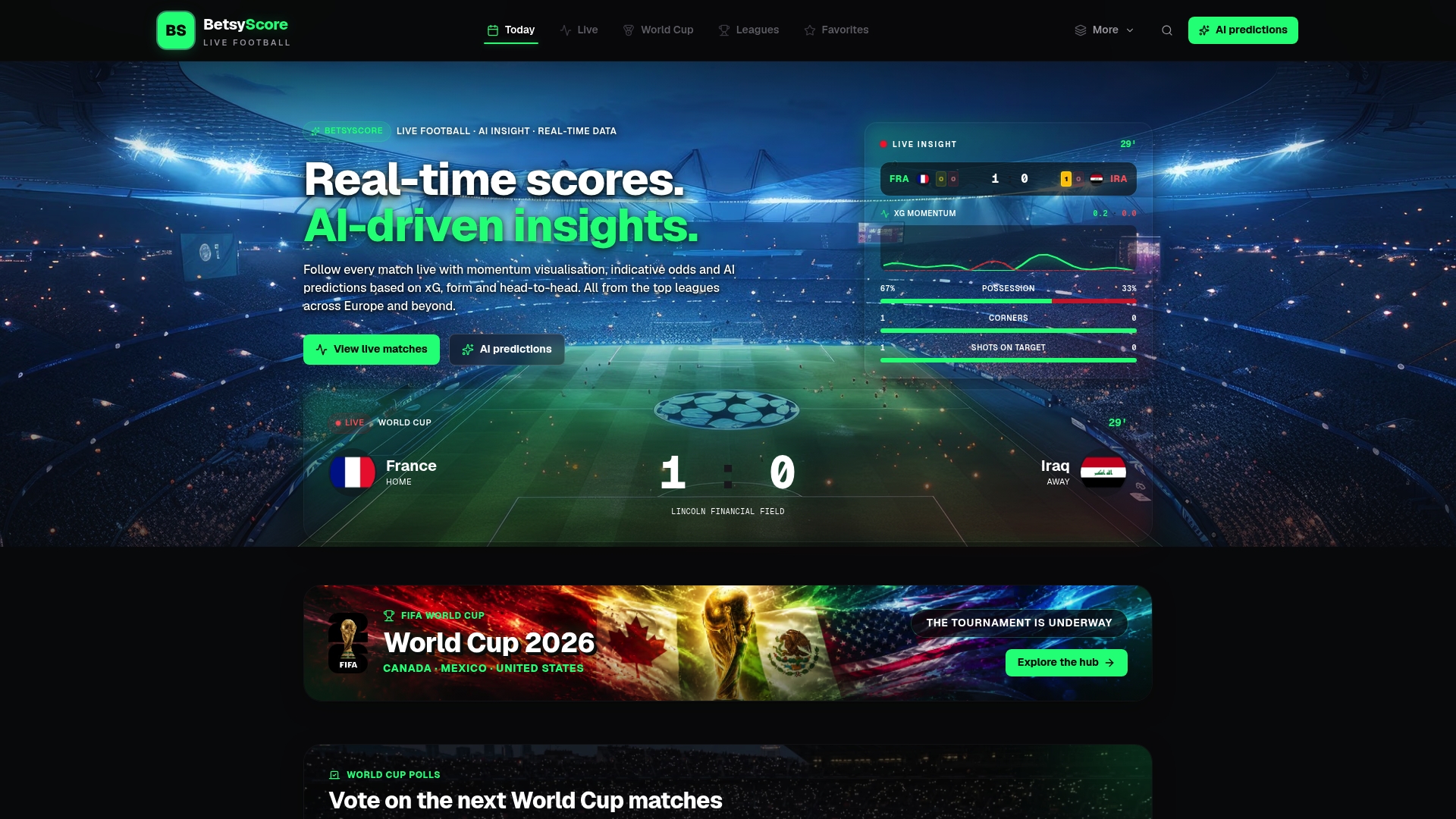
During a match, open the live scores page to follow lineups, stats and the momentum read as the game develops. Fans who prefer a fast overview can begin on the BetsyScore homepage.
A practical routine for using predictions
Predictions help most when they fit into a simple habit.
- Before the match. Read the win probabilities and note the gap between the sides. A narrow gap signals an open game.
- Check the inputs. Compare the model’s view with recent form and confirmed lineups. Late absences can change a forecast.
- During the match. Use the momentum read to see whether the pre-match view is holding. A favorite with a high percentage but little momentum deserves caution.
- After the match. Compare the result with the forecast. One result says little, but a pattern across fifty matches says a lot.
- Keep a log. If you analyze or write about football, record forecasts and outcomes yourself. It is the same discipline used in the research cited above.
For related reading, our guide to football results prediction for fans and bettors covers how different audiences use forecasts.
FAQ
Are AI football match predictions accurate?
They are about as accurate as betting-market favorites, not better. A 2026 World Cup evaluation of six language models found an average outcome accuracy of 63.9%, and another study found no model beat the market’s Brier score. Accuracy is highest in lopsided fixtures and lowest in evenly matched ones.
Can I use ChatGPT or another chatbot for football predictions?
You can, but the percentages it gives are not true probabilities, because chatbots do not run real simulations. They can explain reasoning and summarize form. For numbers, use a tool built on structured match data and check its published record.
What data do AI football prediction tools use?
Most use expected goals, recent form, head-to-head records, lineups and sometimes betting-market odds. Simulation engines combine team ratings with odds and form to model whole tournaments. The better tools state which inputs they use.
Are free AI predictions as good as paid ones?
Price alone does not tell you quality. What matters is transparency of inputs, a dated record that includes misses, and sensible calibration. Check each provider’s own page for current pricing, since terms change.
Can AI predictions guarantee a win?
No. Football is unpredictable, and a percentage is an estimate of likelihood, not a promise. Any site claiming guaranteed wins should be treated with suspicion.
Sources
- Best AI Tools to Predict the FIFA World Cup 2026 Winner
- FIFA World Cup 2026 as a Contamination-Free Benchmark (Ding, Guo and Xu)
- WorldCup Arena: Prospective, Leakage-Free Evaluation of Frontier LLMs (Wang et al.)
- How the five AIs actually did (Max Glenister)