How AI Predicts Champions League Matches in 2026
AI predicts Champions League matches by running tens of thousands of simulations using structured team data, expected goals models, and historical knockout performance to produce statistically grounded probability forecasts. This process, formally called probabilistic match modeling, goes far beyond simple win-loss records. For the 2025/26 Champions League final, AI systems assigned PSG a 56% win probability via more than 10,000 simulations factoring in goal involvements and defensive metrics. That figure tells you exactly how much confidence the model carries and where uncertainty remains. Soccer enthusiasts and analysts who understand this process read AI forecasts with far greater accuracy than those who treat them as simple predictions.
How AI predicts Champions League matches: data inputs and metrics
AI match prediction starts with structured data feeds. Platforms draw from sources like API-Football, which delivers 15–20 key metrics per team including recent form, head-to-head records, league standings, and tactical profiles. The richness of this input directly determines how reliable the output becomes.
The core metrics that feed Champions League AI analysis include:
- Expected Goals (xG): Measures shot quality rather than shot volume, giving a truer picture of attacking threat.
- Recent form: Weighted results from the last 5–10 matches, with more recent games carrying greater influence.
- Head-to-head records: Historical outcomes between the two clubs, adjusted for squad changes and tactical evolution.
- Squad quality ratings: Aggregated player ratings that reflect depth, not just starting eleven strength.
- Tactical profile: Pressing intensity, defensive line height, and possession sequences that define how a team plays.
- Home and away splits: Performance differentials that account for travel, crowd noise, and pitch familiarity.
Normalized probability outputs strip bookmaker margins from raw likelihoods, so the three outcomes (home win, draw, away win) sum to exactly 100%. This matters because it removes commercial bias and gives analysts a clean statistical baseline. The Champions League benefits from unusually dense data coverage, which makes these inputs more consistent than in lower-tier competitions.
How do AI models simulate match outcomes and calculate probabilities?
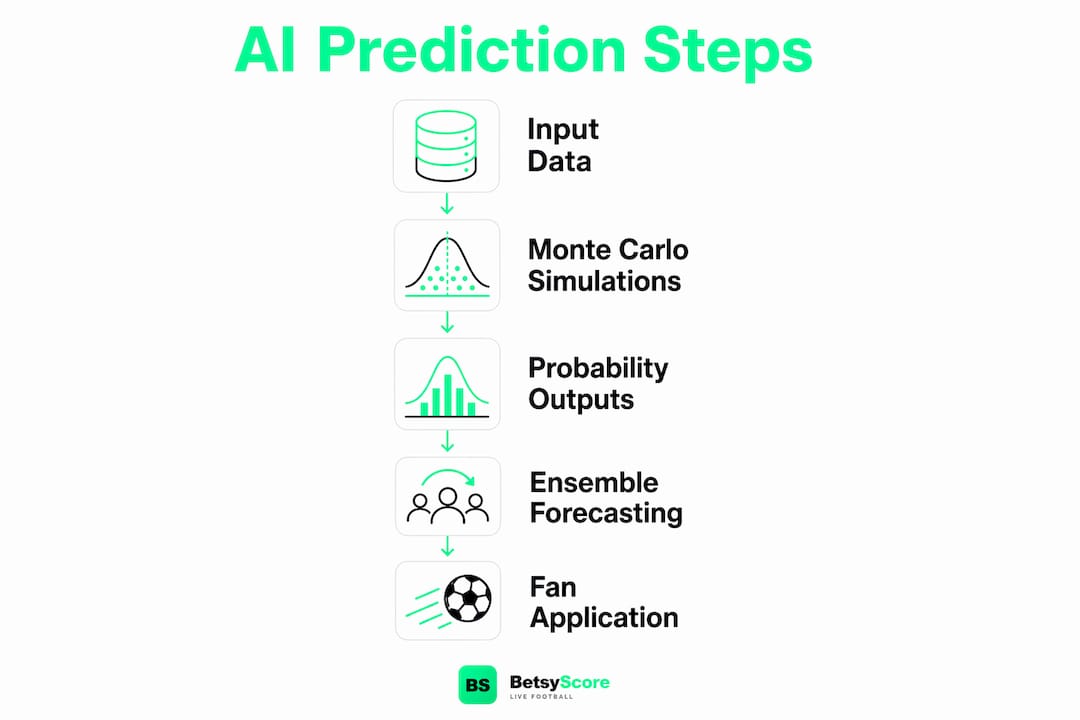
Monte Carlo simulation is the dominant method in AI sports forecasting for elite tournaments. The process works in a specific sequence that builds probability from the ground up.
- Set baseline parameters. The model loads each team’s xG rate, defensive solidity score, home or away adjustment, and recent form weighting.
- Run individual match simulations. Each simulation plays out one version of the match using randomized outcomes within the statistical ranges defined by the parameters.
- Repeat at scale. AI runs 10,000+ simulations per match, generating a full distribution of possible scorelines rather than a single predicted result.
- Incorporate knockout scenarios. Extra time and penalty shootout probabilities are layered in for two-legged ties and finals, since these stages change outcome math significantly.
- Aggregate the distribution. The model counts how often each outcome appears across all simulations and converts those frequencies into win, draw, and loss percentages.
- Calibrate against recent data. Outputs are tested against results from the current and previous Champions League seasons to check for systematic over or underestimation.
The result is not a single prediction but a probability distribution. A model saying “PSG wins 56% of the time” means that in 5,600 of 10,000 simulated matches, PSG came out on top. The remaining 4,400 simulations produced draws or Arsenal wins.
Pro Tip: When reading AI probability outputs, focus on the gap between the two teams rather than the absolute number. A 56% vs. 44% split signals a genuinely competitive match. A 72% vs. 28% split signals a clear favorite.
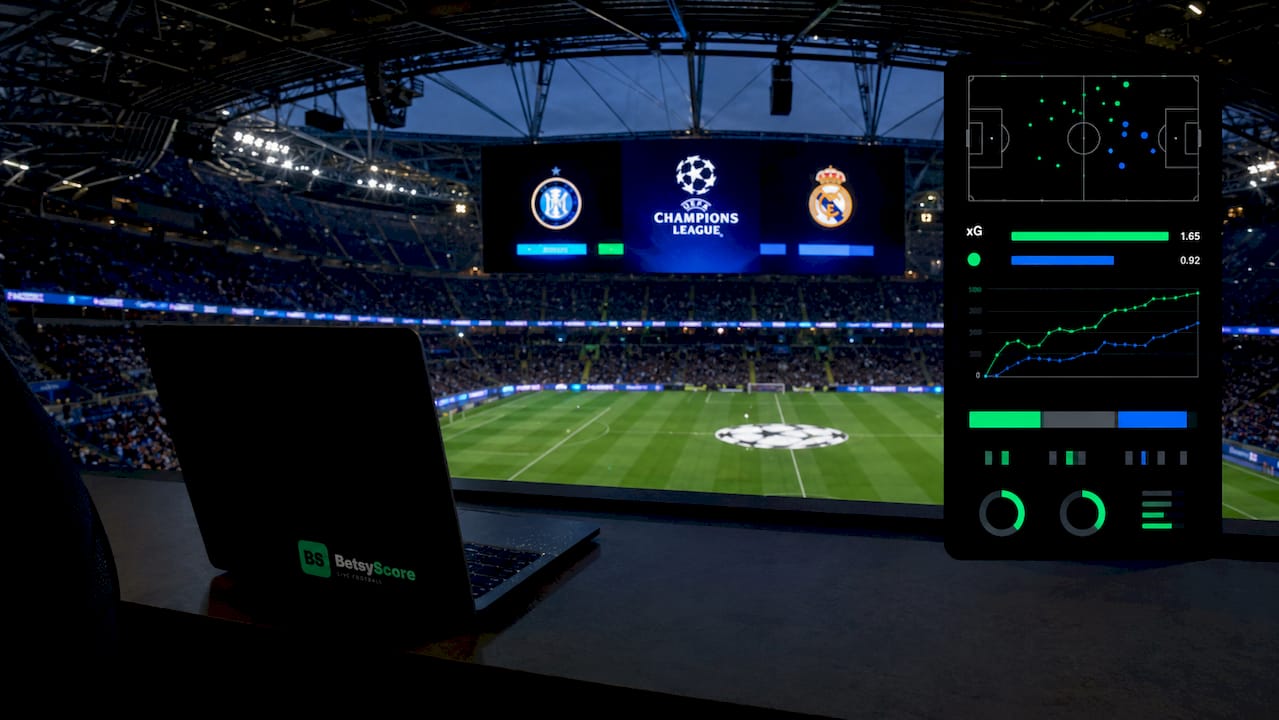
Higher data standardization in Champions League matches reduces model variance compared to domestic leagues with uneven data availability. This means the simulations are more trustworthy at this level than they would be for a mid-table Ligue 2 fixture.
What role does ensemble forecasting play in Champions League predictions?
Ensemble forecasting is the practice of combining outputs from multiple AI models to produce a single, more stable forecast. No individual model is perfectly calibrated, so averaging across 10 or more systems reduces the impact of any one model’s blind spots.
For the 2026 Champions League final, 8 of 10 AI models predicted a 2-1 PSG win, producing aggregate confidence levels in the 55–65% range. That level of consensus across independent systems is a meaningful signal. When models built on different algorithms and data weightings converge on the same scoreline, the forecast carries more weight than any single model’s output.
Hybrid models take this further by anchoring AI outputs to bookmaker market prices. Markets reflect the collective judgment of thousands of informed bettors, and blending market odds with objective data yields the most accurate forecasts for high-profile tournaments. The AI handles the statistical heavy lifting; the market provides a real-time sanity check.
“The best AI forecasting for elite tournaments integrates real-time bookmaker odds with detailed performance data to balance collective human market wisdom and objective metrics.”
Hybrid approaches also incorporate soft variables that pure data models miss. Injury news announced 48 hours before kickoff, a manager’s public comments about squad rotation, or a club’s reported internal tension all carry predictive weight. Human judgment remains indispensable for interpreting these non-quantifiable influences. The strongest forecasting systems treat AI output as a starting point, not a final answer.
The main challenges for ensemble systems include:
- Model correlation: If multiple models draw from the same data source, their errors are correlated rather than independent, reducing the benefit of aggregation.
- Weighting decisions: Deciding how much influence to give each model requires its own layer of judgment and historical testing.
- Soft variable integration: Morale shifts, travel fatigue, and dressing room dynamics resist quantification but demonstrably affect results.
What makes Champions League predictions harder than domestic league forecasts?
The knockout format is the primary driver of prediction difficulty in the Champions League. A domestic league season averages 38 matches per team, giving AI models a large sample to work with. A Champions League campaign can end after six group stage matches plus a two-legged knockout round. Small samples amplify variance.
| Factor | Domestic League | Champions League |
|---|---|---|
| Matches per team per season | 38 | 6–13 |
| Data density | High | Very high per match |
| Format variance | Low (round-robin) | High (knockout) |
| Squad rotation frequency | Moderate | High |
| “Club DNA” effect | Low | High |
AI predictions are most reliable in tournaments with rich, consistent datasets, and the Champions League delivers exactly that through UEFA’s standardized tracking infrastructure. Every match generates xG data, pressing intensity metrics, and possession sequence records at a consistent quality level. This partially offsets the small-sample problem.
The concept of Champions League DNA presents a genuine modeling challenge. Real Madrid’s historical record in knockout rounds, Bayern Munich’s consistency across decades, and Liverpool’s capacity to perform under pressure all reflect something that historical win rates capture only partially. This intangible factor adds unpredictability to AI forecasts and remains an active area of research. Analysts who understand this limitation read AI outputs with appropriate skepticism when historically dominant clubs are involved.
You can also review UEFA rankings and their influence on seeding and match context, since these rankings feed directly into how AI models weight squad quality and historical performance.
How can analysts and fans apply AI predictions practically?
AI probability outputs are probabilistic guides, not certainties. A 70% win probability means the favored team loses 30% of the time. Treating any forecast as a guarantee produces consistently poor analysis.
Pro Tip: Check whether multiple independent AI systems agree on the same outcome before treating a forecast as high-confidence. Consensus across ensemble models is a stronger signal than any single platform’s output.
The most effective approach to using Champions League AI analysis combines several practices:
- Track consensus signals. When ensemble outputs converge on the same result, the forecast is more reliable than a single model’s call.
- Update for late team news. Lineup changes announced close to kickoff can shift xG baselines significantly. Always check whether the AI model has incorporated the confirmed starting eleven.
- Compare AI probabilities to market odds. A large gap between the two suggests either the model has information the market lacks or the model has a systematic error worth investigating.
- Avoid single-metric dependence. xG alone does not capture defensive organization, set-piece threat, or goalkeeper form. Use it as one input among several.
- Treat low-probability outcomes seriously. A 25% chance is not negligible. Over four matches with those odds, the low-probability outcome is expected to occur at least once.
Platforms that publish their model methodology and update predictions in real time give analysts the transparency needed to apply these practices effectively. Betsyscore’s AI predictions page shows win-probability percentages built from xG, recent form, and head-to-head records, updated as match conditions change.
Key Takeaways
AI predicts Champions League matches most reliably when ensemble forecasting, Monte Carlo simulation, and hybrid human-AI inputs combine with the standardized, high-density data that elite European competitions provide.
| Point | Details |
|---|---|
| Monte Carlo simulation drives outputs | AI runs 10,000+ match simulations to produce win, draw, and loss probability distributions. |
| xG is the core input metric | Expected Goals measures shot quality and forms the statistical backbone of most prediction models. |
| Ensemble forecasting reduces bias | Aggregating 10+ AI models produces more stable forecasts than any single system alone. |
| Champions League DNA resists quantification | Historical pedigree and psychological edge add unpredictability that current models only partially capture. |
| Human judgment fills the gaps | Late lineup changes, morale shifts, and injury news require human interpretation alongside AI outputs. |
AI predictions are powerful tools, not oracles
I have spent years working with AI-generated football forecasts, and the most common mistake I see is treating a high-confidence prediction as settled fact. A model that assigns 65% confidence to a result is telling you it expects to be wrong 35% of the time. That is not a flaw. That is the model being honest.
What impresses me most about current Champions League AI analysis is the speed and scale of data processing. No human analyst can simultaneously weight xG differentials, pressing intensity, head-to-head records, and squad depth across both squads in real time. AI does this in seconds and does it without emotional bias toward a preferred outcome.
Where I remain cautious is around soft variables. The 2026 final between PSG and Arsenal illustrated this clearly. PSG’s statistical profile was stronger across most metrics, and the AI consensus reflected that. But Arsenal’s tactical discipline and the specific pressure of a final introduce variables that historical data captures imperfectly. The models got the direction right. Whether they get the margin right is a different question.
The future of this field points toward tighter integration between AI outputs and human contextual knowledge. Analysts who understand how the models work, what data they use, and where their blind spots lie will extract far more value from these tools than those who simply read the probability number and act on it. Transparency in model methodology is not a technical nicety. It is the foundation of trustworthy forecasting.
— Aria
Betsyscore’s AI-powered Champions League analysis
Betsyscore brings together live scores, AI win-probability forecasts, and real-time match data for the Champions League and more than 200 competitions worldwide.
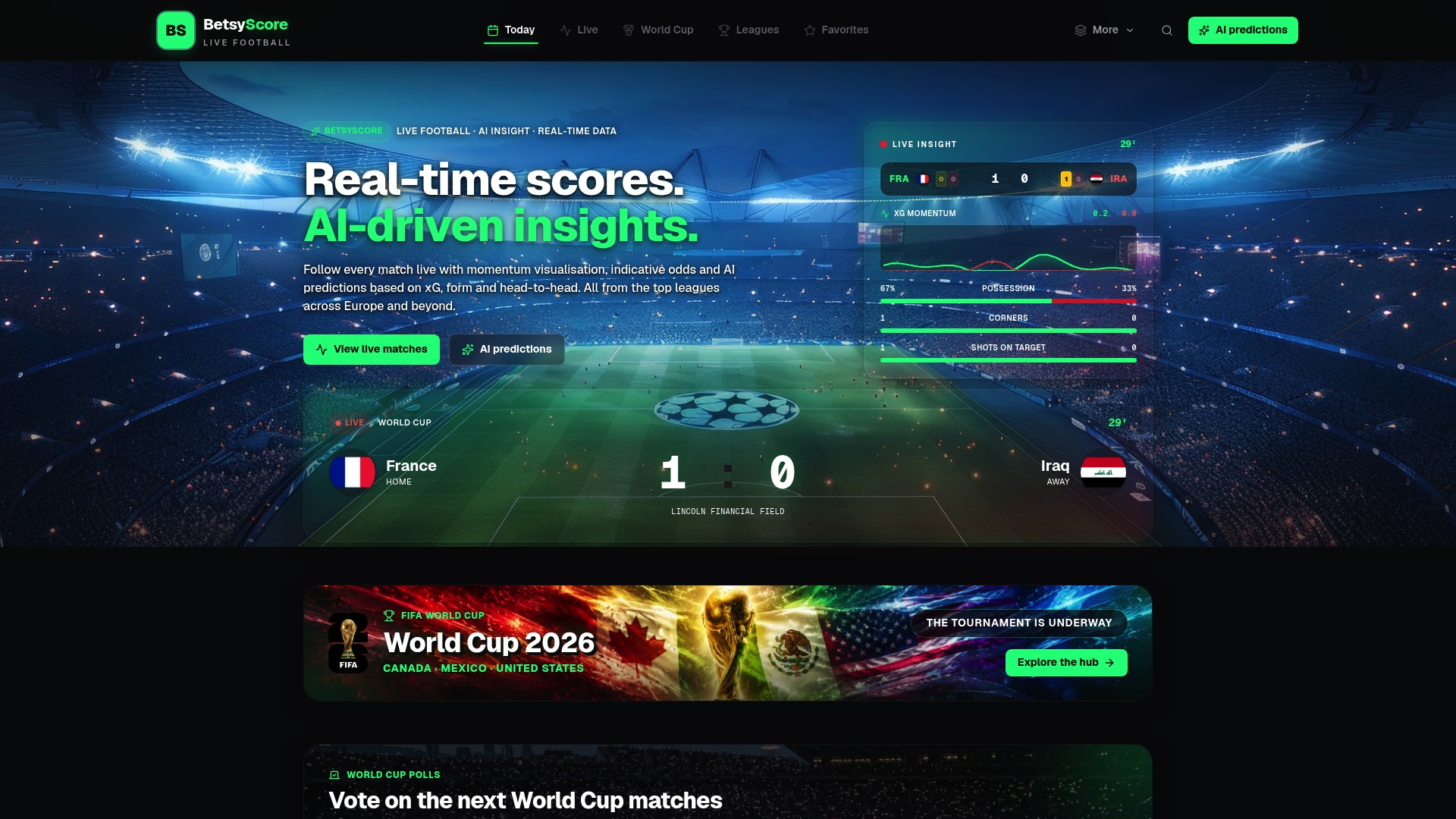
The platform’s live match center refreshes every few seconds, showing momentum shifts alongside updated win probabilities built from xG, recent form, and head-to-head records. Analysts can track how AI forecasts change as a match unfolds, comparing pre-match predictions against live data in real time. Coverage extends across the Premier League, La Liga, Bundesliga, Serie A, and the FIFA World Cup 2026, applying the same data-first methodology across every competition. For fans who want to go deeper than the scoreline, Betsyscore is built for exactly that purpose.
FAQ
How does AI calculate Champions League win probabilities?
AI runs Monte Carlo simulations, often 10,000 or more per match, using inputs like xG, squad quality, and head-to-head records to generate a probability distribution across win, draw, and loss outcomes.
What is expected goals (xG) and why does it matter for predictions?
Expected Goals measures the quality of scoring chances rather than the number of shots. It gives AI models a more accurate picture of a team’s true attacking and defensive performance than raw goal tallies.
Are AI Champions League predictions accurate?
AI predictions are statistically grounded but not certain. Ensemble models producing consensus across 10+ systems offer the strongest reliability, particularly in data-rich competitions like the Champions League.
Why is the Champions League harder to predict than domestic leagues?
The knockout format reduces the number of matches per team, which amplifies variance. Additionally, factors like Champions League DNA and squad rotation patterns are difficult for AI models to fully quantify.
Can AI account for last-minute lineup changes?
AI models that update in real time can incorporate confirmed lineups before kickoff, but models using pre-match data alone may miss the impact of late changes. Always check whether the platform you use reflects the confirmed starting eleven.