What Does Football Promotion Mean? A Fan's Guide
In football, promotion is when a club moves up from a lower division to a higher division based on its results over a season. It is the defining reward of open league systems worldwide, and it works alongside relegation to keep competition meaningful at every level of the pyramid.
Three things to know immediately:
- Automatic promotion: The top finishers in a division move up without playing any additional matches.
- Promotion playoffs: Clubs finishing just outside the automatic spots compete in a short knockout bracket for one final promotion place.
- Relegation (the flip side): The weakest clubs in the higher division drop down to make room for the promoted teams.
Example: In England, clubs near the top of the EFL Championship earn automatic promotion to the Premier League. Clubs finishing just below those spots then play a playoff to claim the remaining promotion place.
Table of Contents
- How open league pyramids work and why promotion exists
- How teams earn promotion on the pitch and off it
- What promotion looks like in England and the United States
- How playoff formats and tiebreakers determine the final promotion spot
- What promotion changes for a club
- When promotion is decided and what happens next
- How fans can follow promotion races live using data and standings
- Key Takeaways
- Why promotion races deserve more attention than title races
- Follow promotion races with Betsyscore
- Useful sources
- FAQ
How open league pyramids work and why promotion exists
The open league model organizes football into a vertical hierarchy of divisions, or tiers, where movement between levels is earned on the pitch. A club that wins enough matches rises; a club that loses too many falls. This structure is sometimes called a pyramid because the number of clubs increases at each lower level.
The logic is meritocratic. Promotion and relegation together ensure that the strongest clubs compete at the highest level and that no club holds a permanent place it has not earned. Wikipedia’s overview of promotion and relegation describes this as the foundation of open leagues, contrasting them with closed leagues where membership is fixed regardless of performance.
For U.S. fans, the contrast with domestic sports is instructive. Major League Soccer (MLS) has historically operated as a closed league: franchises hold permanent membership, and no team is relegated or promoted based on season results. The NFL, NBA, MLB, and NHL follow the same model. Open pyramids are the global norm in football, but they remain a relatively unfamiliar concept to American sports audiences.
Key reasons leagues adopt promotion and relegation:
- Every match carries consequence, even late in the season when title races are settled.
- Lower-division clubs have a genuine path to the top flight.
- The system rewards investment and performance rather than franchise fees.
- Fan engagement stays high across all tiers because survival or advancement is always at stake.
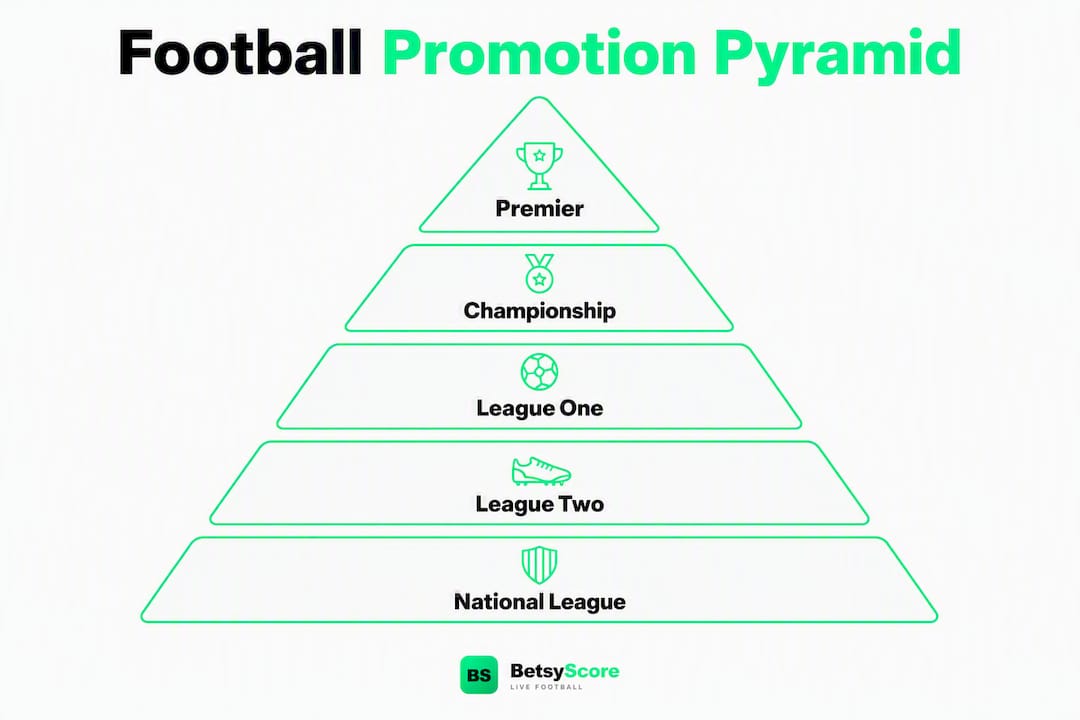
The English football pyramid, for example, runs from the Premier League at the top through the EFL Championship, League One, League Two, the National League, and dozens of regional steps below that. Clubs have moved from the ninth tier to the top flight over decades, a journey that would be impossible in a closed system.
How teams earn promotion on the pitch and off it
Earning promotion involves two distinct processes: the sporting route and the administrative clearance. Both must be satisfied before a club officially moves up.
Sporting routes to promotion:
- Finish in an automatic promotion place. Most leagues reserve the top one to three positions for automatic promotion. In the EFL Championship, the top two clubs go up directly. In League One and League Two, three clubs earn automatic promotion.
- Win a promotion playoff. Clubs finishing just outside the automatic spots enter a playoff bracket. The playoff winner claims the final promotion place for that division.
- Win the division outright. The champions always earn automatic promotion, often with a trophy presentation, regardless of how many total automatic spots exist.
The playoff bracket, step by step:
- Clubs finishing in playoff-eligible positions (typically 3rd–6th in a four-team bracket) are seeded by league position.
- Higher seeds host the first leg of two-legged semifinal ties.
- The aggregate winner of each semifinal advances to a single-leg final, often played at a neutral venue.
- The final winner earns the last promotion spot for that division.
Off-field requirements that can block promotion:
Even after a club secures the sporting right to move up, promotion is not guaranteed. FA regulations for the national league system specify that clubs must meet ground grading standards covering stadium capacity, pitch quality, floodlighting, and safety infrastructure. Financial checks are also standard. A club that fails these inspections by the league’s deadline can be denied promotion despite finishing in a qualifying position, with the place passing to the next eligible club.

What promotion looks like in England and the United States
The English system provides the clearest illustration of how football league promotion works in practice, and the U.S. context shows how different a closed system looks by comparison.
English pyramid: promotion counts by level
| Division | Clubs promoted | Method |
|---|---|---|
| EFL Championship | 3 | Top two automatic plus one playoff winner |
| EFL League One | 4 | Top three automatic plus one playoff winner |
| EFL League Two | 4 | Top three automatic plus one playoff winner |
| National League | 2 | Automatic champion plus playoff winner |
The English football league system ties these counts together across levels 1 through 8, with lateral transfers between parallel regional divisions at lower steps to maintain geographic balance. The Championship playoff final, held at Wembley Stadium, is frequently cited as one of the most valuable single matches in club football given the financial consequences of reaching the Premier League.
National League specifics
The National League sits at the fifth tier of English football. Its champion earns automatic promotion to League Two. A multi-team playoff then decides the second promotion spot, with eligibility and bracket size governed by FA national league system regulations. Clubs at this level face particularly detailed ground grading checks because moving into the EFL requires meeting higher facility standards.
U.S. context: MLS and USL
MLS remains a closed league as of 2026, with no promotion or relegation between it and lower divisions. The United Soccer League (USL) has publicly discussed implementing a promotion and relegation system linking its tiers, though full implementation has been subject to ongoing negotiations and votes among club owners. For fans curious about how La Liga handles promotion and relegation as a contrast to the U.S. model, the Spanish system offers another instructive example of a fully open pyramid.
How playoff formats and tiebreakers determine the final promotion spot
Playoff structures vary considerably across leagues and countries, and the details matter when a club’s season comes down to a single match or a goal-difference calculation.
Common playoff formats:
- Four-team bracket: The most common format in English football. Positions 3–6 play two-legged semifinals, with the winners meeting in a single-leg final.
- Six-team bracket: Used in some leagues, where the top two seeds receive a bye into the semifinals.
- Single-leg throughout: Smaller leagues sometimes run the entire playoff as one-off matches to reduce fixture congestion.
- Two-legged finals: Some competitions use a home-and-away final rather than a neutral venue, giving aggregate score the deciding role.
Tiebreakers when clubs finish level on points:
Most leagues apply these in order: goal difference, then goals scored, then head-to-head record. If clubs remain level after all standard criteria, some competitions use a playoff match or drawing of lots. The Promedios system, historically used in Argentine football, calculates a club’s average points per game across multiple seasons rather than a single campaign, making it much harder for a newly struggling club to be relegated or for a recently promoted club to face immediate drop.
Global promotion and relegation formats also include two-legged relegation/promotion playoffs in Germany, where the Bundesliga’s 16th-placed club faces the second division’s 3rd-placed club over two legs to determine which one plays top-flight football the following season.
A concrete example path:
A club finishes 3rd in the EFL Championship, one point behind the second automatic promotion place. It enters the playoffs as the top seed. After winning its two-legged semifinal on aggregate, it faces the 6th-placed club in the Wembley final. A single goal decides the match. That club is promoted to the Premier League despite never finishing in the top two during the regular season.
What promotion changes for a club
Promotion reshapes a club across multiple dimensions simultaneously, and the changes begin before the new season kicks off.
Financial and commercial impact: Moving from the EFL Championship to the Premier League delivers a substantial increase in broadcast and commercial revenue, driven primarily by the Premier League’s domestic and international media rights deals. Promotion’s financial consequences are described as transformational, improving recruitment appeal and raising operational costs in equal measure. Sponsorship values rise, kit deals improve, and matchday revenue increases with larger crowds and higher ticket prices.
Sporting demands: A promoted club must upgrade its squad to compete at the higher level. Players who performed well in the Championship may not be adequate against Premier League opposition, creating immediate pressure on the transfer budget. Clubs that fail to strengthen sufficiently often face relegation in their first season back, a pattern sometimes called the “yo-yo” effect.
Operational changes: Staffing, travel, and matchday logistics all scale up. Grounds may require upgrades to meet top-flight standards. Medical and sports science departments typically expand.
Community and fan impact: Promotion generates significant local economic activity. Attendances rise, merchandise sales increase, and the club’s profile in its community grows. For supporters of smaller clubs, promotion to a higher division can represent a once-in-a-generation event.
Pro Tip: After a promotion is confirmed, expect ticket prices and season-ticket demand to rise sharply for the following season. If you plan to attend matches at a newly promoted club, act on season-ticket renewals or new applications as soon as they open.
When promotion is decided and what happens next
The timeline from the final whistle of the regular season to official confirmation of promotion follows a structured sequence.
- Regular season concludes: Final league table positions are confirmed. Automatic promotion places are awarded immediately.
- Playoff window opens: Typically within one to two weeks of the regular season ending, semifinals begin.
- Playoff final: Held within three to four weeks of the regular season’s conclusion, often at a high-profile neutral venue.
- Administrative checks: Promoted clubs submit documentation for ground grading inspections and financial reviews. Deadlines are published in advance by the relevant league or FA body.
- Official confirmation: The league formally ratifies promoted clubs, usually within days of the playoff final and completion of inspections.
- Pre-season preparation: Clubs begin transfer activity, pre-season scheduling, and operational planning for the higher division.
Rare cases exist where promotion is denied at the administrative stage. A club that fails ground grading may be given a deadline to remedy deficiencies, or the promotion place may pass to the next eligible club. FA regulations publish the grading standards and inspection deadlines that govern this process.
How fans can follow promotion races live using data and standings
Tracking a promotion race in real time requires more than checking a league table once a week. The final weeks of a season can shift standings dramatically, and live data gives fans a far clearer picture of what is happening.
- Check the live table after every match. Points gaps between clubs in promotion and playoff positions change with each result. A live standings view that updates in real time shows exactly where each club stands as matches conclude.
- Review win probability and expected goals (xG) before key fixtures. AI-powered predictions built from xG, recent form, and head-to-head records give a probability estimate for each outcome. Betsyscore’s AI predictions use this methodology to produce win-probability percentages for matches across more than 200 competitions. These are probability estimates, not certainties, and work best when read alongside form data and injury news.
- Watch momentum reads during decisive matches. Minute-by-minute momentum indicators show which side is controlling a match as it unfolds, useful for understanding whether a promotion-chasing club is genuinely on top or holding a fragile lead.
For fans who want to combine these signals effectively, Betsyscore’s guide on how to analyze a football match explains how to read xG, form, and head-to-head data together. Predictive models are tools for informed assessment, not guarantees. Injuries, red cards, and weather can override any pre-match probability in a single moment.
Key Takeaways
Promotion in football is the merit-based process by which top-performing clubs move up a division, decided through automatic places and playoffs, and subject to off-field licensing checks before it is officially confirmed.
| Point | Details |
|---|---|
| Definition of promotion | A club moves from a lower division to a higher one based on its season results in an open league system. |
| Two main routes | Automatic promotion (finishing in the top positions) and playoff promotion (winning a knockout bracket for the final spot). |
| Off-field checks matter | Clubs must pass stadium, safety, and financial inspections before promotion is officially confirmed. |
| Financial consequences | Moving to a higher division, especially the Premier League, brings substantial increases in broadcast and commercial revenue. |
| Betsyscore for live tracking | Betsyscore’s live table, AI win-probability predictions, and momentum reads help fans follow promotion races in real time. |
Why promotion races deserve more attention than title races
There is a reasonable argument that the promotion and relegation battle at the bottom of the top flight, or the top of the second tier, produces more sustained tension than a title race. A title race often involves two or three clubs separated by a handful of points. A promotion race can involve six or eight clubs within three or four points of each other across the final ten matchdays, with every result in every concurrent fixture affecting the table simultaneously.
What often goes underappreciated is how the playoff format amplifies this further. A club that finishes 6th, having looked like a mid-table side for most of the season, can win two matches and reach the top flight. That structural possibility keeps fans of clubs well outside the automatic spots genuinely invested through May. The criticism that playoffs introduce an element of randomness is fair, but it is also precisely what makes them compelling viewing.
For fans new to the open pyramid model, the most useful reframe is this: in a closed league, the worst team in the top division is still in the top division next year. In an open system, that same team could be playing in front of half the crowd, in a smaller stadium, against opponents it has never faced, twelve months later. The stakes are not abstract.
Follow promotion races with Betsyscore
Promotion races move fast, and the table can shift on a Tuesday night fixture that most fans miss. Betsyscore gives you the data to stay current without waiting for a morning recap.

Live scores refresh every few seconds across more than 200 competitions, including the EFL Championship, League One, League Two, and the National League. The AI prediction engine produces win-probability percentages for each match, built from expected goals, recent form, and head-to-head records, so you can assess a promotion six-pointer before it kicks off. Momentum reads then show you which side is controlling the match as it unfolds. Whether you follow the soccer player props angle or simply want to know if your club is going up, the data is there.
Check Betsyscore live scores to follow tonight’s promotion fixtures in real time.

Useful sources
- Promotion and relegation — Wikipedia: Authoritative overview of how open league systems work globally, including history and formats.
- English football league system — Wikipedia: Level-by-level breakdown of promotion and relegation counts across the English pyramid.
- How does promotion and relegation work around the world? — GIS Sport: Covers international formats including Promedios, two-legged playoffs, and regional variations.
- English football league system guide — Sports Illustrated: Practical guide to Championship and Premier League promotion mechanics.
- World soccer league tiers explained — Betsyscore: Background on global league structures and how promotion links tiers worldwide.
FAQ
What does promotion mean in football?
Promotion means a club finishes high enough in its division to move up to the next tier for the following season, either through automatic qualification or by winning a playoff.
How many teams get promoted in a typical football league?
Most leagues promote two to four clubs per season. In the EFL Championship, three clubs are promoted: the top two automatically and one through the playoffs.
What happens if a promoted club fails ground standards?
If a club earns sporting promotion but fails stadium or safety inspections, the league can deny the promotion and award the place to the next eligible club, as outlined in FA national league system regulations.
Do the top two in the Championship always get promoted?
Yes. The top two clubs in the EFL Championship earn automatic promotion to the Premier League regardless of how close the third-placed club is on points.
Does MLS use promotion and relegation?
No. MLS operates as a closed league, meaning no club is promoted or relegated based on season performance. The USL has discussed implementing a promotion and relegation system, but it has not been fully adopted as of 2026.