How Football Relegation Battles Work: A Fan's Guide
Football relegation is defined as the automatic demotion of a club from one league division to a lower one, based solely on final league standings. Understanding how football relegation battles work is central to following leagues like the Premier League, La Liga, and the Bundesliga, where the fight to avoid the bottom positions carries as much drama as any title race. These battles shape club finances, squad planning, and fan loyalty for years. The English Football League (EFL) and its promotion and relegation system set the global standard for how this process operates.
How football relegation battles work: rules and mechanics
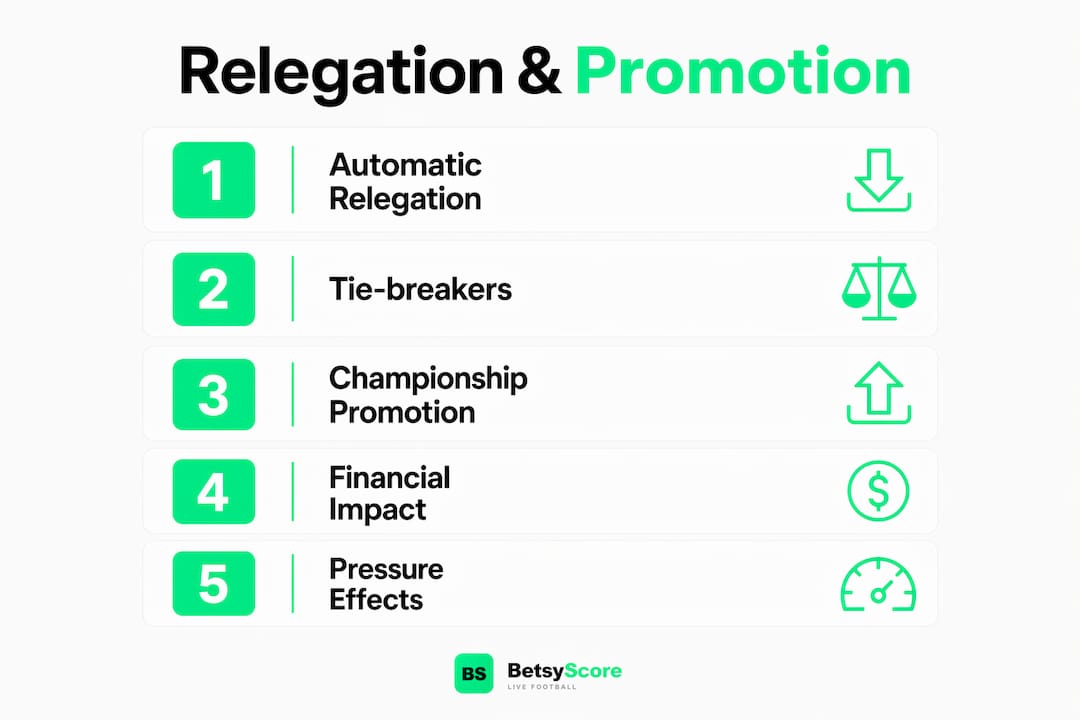
The Premier League relegates the bottom three teams automatically at the end of each 38-game season. The 18th, 19th, and 20th-placed clubs drop to the EFL Championship with no playoffs, no appeals, and no exceptions. League position alone decides fate.

When two or more clubs finish level on points, the Premier League applies a strict tie-breaker hierarchy: goal difference first, then total goals scored, then head-to-head record. In practice, goal difference is the critical decider in close battles far more often than goals scored or head-to-head results. Every goal conceded in a routine mid-table match can matter by the final week of the season.
Pro Tip: Track goal difference from matchday one, not just points. A club that concedes heavily in early-season defeats often pays the price in april and may when the table tightens.
No Premier League club has ever been separated by a playoff match. The head-to-head tiebreaker is theoretically possible but has never been needed. The system is clean and absolute.
Promotion from the Championship
Clubs relegated from the Premier League enter the EFL Championship, a 24-team second division. The top two Championship clubs earn automatic promotion back to the Premier League. From the 2026/27 season, the Championship playoff format expands to six teams: 3rd and 4th place receive semifinal byes, while 5th through 8th play one-leg qualifiers. The playoff winner earns the third promotion spot. This change adds more clubs to the promotion conversation and raises the stakes across a wider portion of the table.
| Finishing position | Outcome |
|---|---|
| 1st–2nd (Championship) | Automatic promotion to Premier League |
| 3rd–8th (Championship) | Playoff competition for third promotion spot |
| 18th–20th (Premier League) | Automatic relegation to Championship |
| Bottom 3 (Championship) | Relegated to League One |
What are the financial consequences of relegation?
Relegated clubs typically lose around 66% of their revenue following demotion. That loss comes from three sources: broadcast rights income, commercial sponsorship, and matchday revenue. A club earning £100 million in the Premier League can find itself operating on roughly £34 million the following season. That is not a budget adjustment. It is a structural crisis.
Parachute payments exist to prevent total financial collapse. The Premier League distributes these payments to relegated clubs over three years. The structure is as follows:
- Year one: 55% of the standard Premier League broadcast share
- Year two: 45% of the standard broadcast share
- Year three: 20%, but only for clubs with two or more years of Premier League tenure
Parachute payments allow clubs to plan a financial transition rather than face an immediate collapse. They fund wage obligations, contract buyouts, and squad rebuilds across a manageable timeline.
The payments also create a competitive imbalance inside the Championship. Clubs receiving parachute payments carry a significant financial advantage over Championship clubs that have never been promoted. This tension shapes transfer activity, wage structures, and the overall competitiveness of the second division. Clubs without parachute support must rely on youth development, loan markets, and tight wage control to compete.
How does relegation pressure affect players and managers?
Relegation battles create intense psychological pressure that affects performance as much as statistical standings. Players in survival fights report heightened anxiety, disrupted form, and difficulty executing under scrutiny. The weight of a relegation battle changes how squads train, how coaches set up tactically, and how individuals perform in high-stakes moments.
Managerial turnover accelerates sharply during relegation battles. Clubs dismiss managers early in a survival fight, betting that a new voice can reset a squad’s mentality and extract more points from the remaining fixtures. This pattern repeats across leagues every season. A manager hired in october to save a club from relegation faces a fundamentally different challenge than one building a project from preseason.
“Relegation battles generate fan passion and maintain engagement throughout league seasons, preventing downtime. Low-placed teams fight for survival, adding drama beyond title races.”
Home and away dynamics shift under relegation pressure. Clubs fighting survival tend to become more defensively organized at home, prioritizing clean sheets over attacking output. Away from home, the same clubs often struggle with the psychological burden of playing in hostile environments while carrying the weight of a poor season. Fan expectations at home fixtures add pressure that can either galvanize a squad or expose its fragility.
Pro Tip: Watch how a relegation-threatened club sets up in the first 15 minutes of a home game. Defensive shape and pressing intensity reveal whether the manager has the squad mentally ready or is managing fear.
How do relegation battles compare across major leagues?
The Premier League’s relegation battle is the most financially consequential in world football, but the football relegation process operates across every major European league with its own structural details.
La Liga
La Liga also relegates three clubs from its 20-team top division. The tie-breaker rules in La Liga differ from the Premier League: head-to-head record takes priority over goal difference when clubs are level on points. This makes direct clashes between relegation rivals even more decisive. A single result between two bottom-half clubs can determine which one survives.
Bundesliga
The Bundesliga operates a 18-team division. The bottom two clubs are relegated automatically. The 16th-placed club enters a two-leg playoff against the third-placed club from the 2. Bundesliga. This playoff mechanism adds a layer of drama absent from the Premier League system and has produced some of the most memorable matches in German football history.
USL and emerging systems
The United States is moving toward a promotion and relegation model. The USL Premier Division launches in 2028 with an initial two-up, two-down system, expanding to three-up, three-down once the structure stabilizes. This mirrors the English pyramid model and represents a significant shift for American soccer culture, which has historically operated closed leagues.
The table below compares key structural differences across leagues:
| League | Teams | Auto relegation spots | Playoff relegation |
|---|---|---|---|
| Premier League | 20 | 3 | None |
| La Liga | 20 | 3 | None |
| Bundesliga | 18 | 2 | 1 (16th place) |
| EFL Championship | 24 | 3 | None |
Closed-league formats in American sports, such as the NFL and NBA, offer no equivalent mechanism. Every team enters the next season regardless of performance. The absence of relegation removes a layer of accountability that open-pyramid systems enforce by default. Leagues with relegation systems consistently generate higher engagement across the full table, not just at the top.
Key Takeaways
Relegation battles are decided by points, then goal difference, then goals scored, with financial consequences that can reshape a club for years.
| Point | Details |
|---|---|
| Automatic relegation rule | The bottom three Premier League clubs are relegated after 38 games with no exceptions. |
| Goal difference decides close battles | Goal difference is the first tiebreaker and the most common decider in tight relegation fights. |
| Revenue loss is severe | Relegated clubs lose around 66% of revenue, offset partially by three-year parachute payments. |
| Psychological pressure is real | Managerial turnover and player anxiety accelerate during survival battles, affecting results directly. |
| Relegation enforces meritocracy | League position alone determines fate, creating full accountability for clubs at every level. |
Why relegation battles matter more than most fans realize
I have followed football long enough to know that the most gripping weeks of any Premier League season rarely involve the title race. They involve the bottom three. The clubs fighting relegation play every match as if it is a final. That intensity is not manufactured. It is structural.
What strikes me most is how relegation enforces a kind of financial honesty that closed leagues cannot replicate. A club that overspends, mismanages its squad, or appoints the wrong manager faces a direct consequence. Demotion is not a slap on the wrist. It is a multi-year financial and sporting setback. That accountability keeps clubs honest in a way that no salary cap or luxury tax fully achieves.
The comparison to American sports is instructive. NFL and NBA teams that finish last still return the following season with the same franchise rights intact. In football, finishing last means starting over in a lower division. That difference in stakes changes everything about how clubs are run, how players perform in pressure moments, and how fans engage with their clubs across a full season.
Relegation triggers major structural shifts that reverberate for years. I have seen mid-table clubs transformed by a single relegation season: squads dismantled, managers replaced, academies deprioritized, and fanbases fractured. The clubs that survive those years intact tend to be the ones with clear identity and financial discipline before the drop. The ones that do not often spend a decade rebuilding.
— Aria
Follow every relegation battle live with Betsyscore
Relegation battles move fast. A midweek result can shift three clubs’ survival odds overnight, and the standings change with every goal.

Betsyscore tracks every match in real time, with live scores and standings that update every few seconds across the Premier League, La Liga, Bundesliga, Serie A, and more than 200 competitions worldwide. The platform’s AI-powered match predictions calculate win probabilities using expected goals, recent form, and head-to-head records, giving fans a data-backed read on which clubs are most at risk before kickoff. Detailed league tables, goal difference breakdowns, and momentum trackers make Betsyscore the most complete tool for following a relegation race from the first matchday to the last.
FAQ
What is relegation in football?
Relegation is the automatic demotion of a club from one league division to a lower one, based on finishing in the bottom positions of the final league table. The Premier League relegates the bottom three clubs after 38 games each season.
How are tied teams separated in a relegation battle?
The Premier League uses goal difference first, then total goals scored, then head-to-head record to separate clubs level on points. Goal difference is the most common decider in close relegation fights.
Do relegated clubs receive any financial support?
Yes. Premier League clubs receive parachute payments over three years: 55% of the standard broadcast share in year one, 45% in year two, and 20% in year three for clubs with sufficient tenure. These payments help clubs manage the transition without immediate financial collapse.
How does relegation work in the Bundesliga?
The Bundesliga automatically relegates the bottom two clubs from its 18-team division. The 16th-placed club plays a two-leg playoff against the third-placed club from the 2. Bundesliga to determine the final promotion and relegation spot.
Does the United States have promotion and relegation in soccer?
The USL is introducing a promotion and relegation system with the launch of the USL Premier Division in 2028, starting with two up, two down and expanding to three up, three down as the system matures.