La Liga Promotion and Relegation: How It Works
La Liga promotion and relegation is a merit-based system where teams move between Spain’s top-flight Primera División and the second-tier Segunda División based on their final league standings each season. Three teams drop down and three teams come up every year, governed by rules set jointly by La Liga and the Real Federación Española de Fútbol. The system applies to all 20 clubs across a 38-game season, with no exceptions for club size or history. Every point from matchday one carries real consequences.
What is La Liga promotion and relegation?
La Liga’s promotion and relegation system is the formal mechanism that determines which clubs compete in Spain’s top division each season. La Liga features 20 teams, composed of the top 17 finishers from the prior season plus three promoted clubs from Segunda División. That composition resets every summer, meaning no club holds a permanent place in the top flight.
The rules governing movement between divisions are set before the season begins. Promotion and relegation criteria are agreed upon between La Liga and the Real Federación Española de Fútbol and cannot be changed once the campaign is underway. That rule protects competitive integrity and gives every club a stable framework to plan around.
The system applies equally to clubs of all sizes. Historically prominent clubs like Deportivo de La Coruña and Málaga have been relegated, while smaller clubs from cities like Girona have earned promotion and competed at the highest level. Performance over a full 38-game season is the only criterion that matters.
How does the relegation process work in La Liga?
Automatic relegation applies to the three clubs finishing in positions 18, 19, and 20 at the end of the season. The bottom three teams drop directly to Segunda División with no playoff reprieve. There is no safety net once the final standings are confirmed.

The points threshold for safety shifts from season to season. Teams have been relegated with as many as 42 points in a 38-game campaign, which means the old benchmark of 40 points no longer guarantees survival. That variability reflects how competitive the bottom half of the table has become. Fans tracking the relegation battle cannot rely on a fixed number.
When two or more clubs finish level on points, La Liga uses head-to-head results as the primary tie-breaker. A mini-table built from the matches between the tied clubs determines which team finishes higher. Goal difference across all league games serves as the secondary criterion if the head-to-head mini-table is also level.
The financial consequences of relegation are severe. Relegation can reduce a club’s valuation by around 30%, with broadcasting revenue and sponsorship income falling sharply. Those losses can take multiple seasons to recover, and some clubs never return to the top flight.
- Positions 18, 19, and 20 trigger automatic relegation with no exceptions.
- The 40-point safety benchmark is no longer reliable; 42 points has not always been enough.
- Head-to-head results form the primary tie-breaker between clubs level on points.
- Financial losses from relegation include reduced broadcast fees and lower sponsorship value.
- Relegation often triggers player departures, further weakening a club’s ability to bounce back quickly.
Pro Tip: Watch the head-to-head record between clubs separated by one or two points in the final weeks. That mini-table, not goal difference, decides who goes down when points are level.
What is the promotion process from Segunda División to La Liga?
Promotion from Segunda División to La Liga follows a two-track system. The top two clubs in Segunda División earn automatic promotion at the end of the regular season. The third promotion spot is decided by a knockout playoff involving the clubs that finish 3rd through 6th.
The playoff format runs as follows:
- The 3rd-place club hosts the 6th-place club in a two-legged semi-final.
- The 4th-place club hosts the 5th-place club in a two-legged semi-final.
- The two semi-final winners meet in a two-legged final for the final promotion spot.
- If aggregate scores are tied after both legs, no penalty shootout is used. The higher-seeded club advances.
- The winner of the final earns promotion to La Liga for the following season.
That structure rewards clubs that performed consistently across the full Segunda División campaign. Finishing 3rd rather than 6th provides a meaningful advantage because the higher seed advances in any tied aggregate. A team that coasts through the second half of the season and finishes 6th faces a harder path than one that pushed for 3rd.
One firm eligibility rule applies: reserve teams cannot be promoted to La Liga regardless of where they finish in Segunda División. This rule exists to prevent conflicts of interest when a reserve side and its parent club would compete in the same division. Real Madrid Castilla and Barcelona B, for example, can win Segunda División on paper but will never earn promotion.
The playoff typically concludes in june, just weeks before the new La Liga season begins. Clubs that win promotion through the playoff have very little time to strengthen their squads before facing top-flight competition. That compressed window makes the Segunda División standings during the regular season critically important for squad planning.
Pro Tip: If you follow a Segunda División club with promotion ambitions, prioritize finishing in the top three over simply reaching the playoff. The seeding advantage in tied aggregates is a structural edge that can decide promotion without a single extra kick.
What are the tie-breaking rules and points benchmarks?
La Liga’s tie-breaking system prioritizes head-to-head performance above all other criteria. When clubs finish level on points, the head-to-head mini-table built from their direct matches takes precedence over overall goal difference. This means a club can have a better goal difference across all 38 games and still finish below a rival it lost to twice.
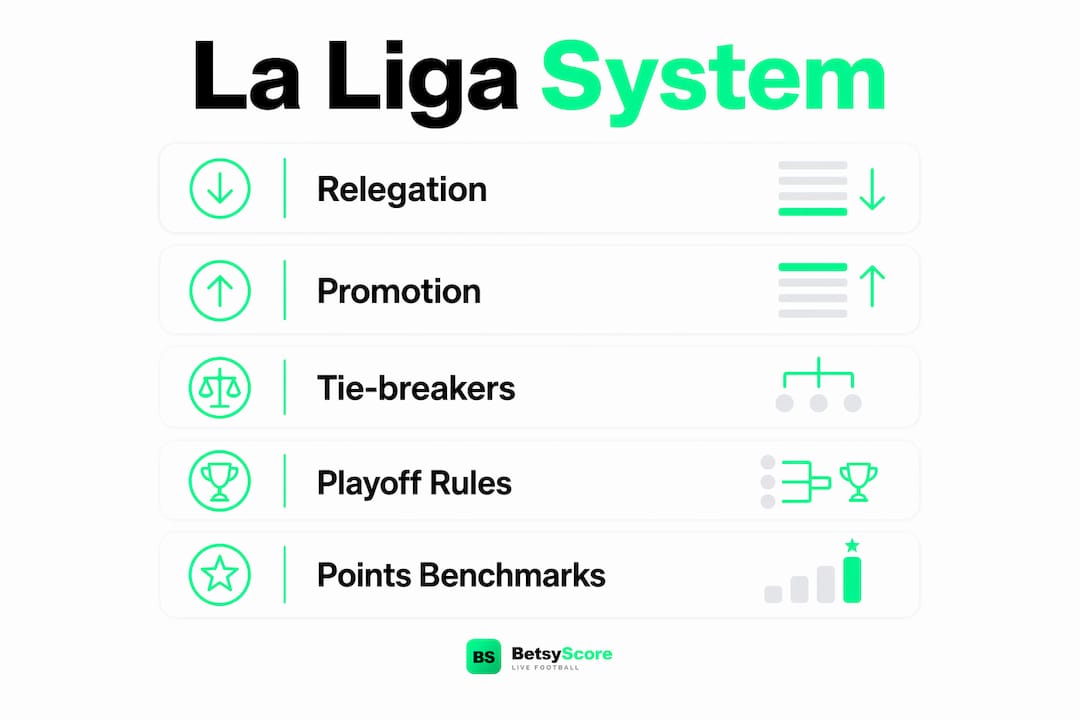
The points needed to avoid relegation varies significantly by season. The table below shows the general range observed in recent La Liga campaigns and the criteria applied at each stage of a tie.
| Criterion | Application |
|---|---|
| Head-to-head mini-table | Primary tie-breaker for clubs level on points |
| Overall goal difference | Secondary tie-breaker if head-to-head is also level |
| Goals scored (all games) | Tertiary criterion if goal difference is equal |
| Safe points threshold | Variable; 40 points is no longer a guarantee |
| Playoff tie (no penalty shootout) | Higher-seeded club advances automatically |
The absence of penalty shootouts in promotion playoffs is one of the most distinctive features of the Spanish system. Playoff ties favor the higher-seeded team after 90 minutes and any extra time, placing enormous weight on where a club finishes in the regular season. A club that secures 3rd place in Segunda División holds a structural advantage over every club below it in the playoff bracket.
Teams in the relegation zone often adopt a points-first approach in the final third of the season, targeting direct wins over rivals rather than chasing goal difference. That behavior is rational given the head-to-head tie-break rule. Clubs that understand the criteria can make calculated decisions about which fixtures matter most.
How does promotion and relegation shape La Liga’s dynamics?
The promotion and relegation system creates genuine competitive pressure across the entire La Liga table, not just at the top. Clubs in positions 14 through 17 spend much of the season calculating their distance from the bottom three. That tension drives attendance, broadcast interest, and matchday intensity well beyond the title race.
The financial stakes reinforce that pressure. Relegation triggers significant revenue losses, including reductions in broadcasting fees and sponsorship income, which can challenge a club’s long-term sustainability. A club that drops to Segunda División typically faces a budget cut that makes it harder to attract the players needed to return quickly. Some clubs enter a cycle of relegation and near-promotion that lasts years.
Promotion brings the opposite effect. Newly promoted clubs receive access to La Liga’s broadcast distribution, which represents a substantial increase in annual revenue. That funding allows promoted clubs to invest in their squads and infrastructure. Clubs like Girona have used promotion as a platform to establish themselves as credible top-flight competitors.
The La Liga promotion rules also shape the transfer market. Clubs that secure survival in april or may become buyers, while relegated clubs become sellers. Fans can track those shifts in real time through player transfer activity, which accelerates sharply once promotion and relegation outcomes are confirmed.
- Promotion delivers increased broadcast revenue and higher commercial value.
- Relegation reduces club valuation by around 30% and triggers player departures.
- The playoff system keeps six Segunda División clubs competing at full intensity deep into the season.
- Head-to-head tie-break rules encourage clubs to prioritize direct rivalry fixtures.
- Reserve team ineligibility protects competitive integrity across both divisions.
Key takeaways
La Liga’s promotion and relegation system is a merit-based structure where final league position, not club status, determines which teams compete in Spain’s top flight each season.
| Point | Details |
|---|---|
| Automatic relegation | The bottom three clubs (positions 18, 19, 20) drop to Segunda División with no reprieve. |
| Points threshold variability | Forty points no longer guarantees safety; teams have been relegated with 42 points. |
| Promotion playoff format | Teams finishing 3rd through 6th in Segunda División compete in a two-legged knockout for the third promotion spot. |
| No penalty shootouts | Tied playoff aggregates are resolved by seeding, rewarding strong regular-season performance. |
| Financial impact | Relegation can reduce a club’s valuation by around 30%, with broadcast and sponsorship revenue falling sharply. |
Why the playoff format is the most underrated part of this system
Most fans focus on the relegation battle at the bottom of La Liga, but the promotion playoff in Segunda División is where the system’s design is most interesting. The decision to eliminate penalty shootouts and advance the higher seed in tied aggregates is not a minor procedural detail. It is a deliberate choice that rewards consistency over a 42-game regular season.
That rule changes how clubs approach the final weeks of the Segunda División campaign. A club sitting in 4th place with two games left has a real incentive to push for 3rd, even if both positions guarantee a playoff spot. The seeding advantage in a tied aggregate can be the difference between promotion and another season in the second tier.
The system also creates a more honest measure of a club’s readiness for La Liga. A team that earns automatic promotion by finishing 1st or 2nd has demonstrated sustained quality. A team that scrapes through the playoff via seeding has still proven it can perform under pressure across a long season. Both paths produce clubs that have genuinely earned their place.
The financial consequences add another layer of significance. Clubs that understand the 30% valuation drop that follows relegation plan their squads differently. They invest in depth for the final third of the season rather than front-loading spending on marquee signings. That is a rational response to a system that punishes late-season collapses severely.
Spanish football’s promotion and relegation structure is one of the most complete in European football. The rules are transparent, the criteria are fixed before the season starts, and the playoff format produces genuine drama without relying on luck. That combination is worth understanding in full.
— Aria
La Liga standings and predictions, live on Betsyscore
Betsyscore covers every La Liga match with live scores that update every few seconds, giving fans a real-time view of the standings as the promotion and relegation picture develops.

AI-powered predictions on Betsyscore analyze win probability using expected goals, recent form, and head-to-head records, making it straightforward to assess which clubs are most at risk of relegation or best placed for a promotion run. The platform tracks all 20 La Liga clubs across the full season. Follow the La Liga live standings on Betsyscore for up-to-date scores, match predictions, and promotion and relegation data throughout the campaign. You can also check AI match predictions for deeper analysis on every fixture.
FAQ
What is La Liga promotion and relegation?
La Liga promotion and relegation is the system that moves the bottom three La Liga clubs down to Segunda División and brings three Segunda División clubs up each season. The process is governed by rules set jointly by La Liga and the Real Federación Española de Fútbol before each campaign.
How many teams get relegated from La Liga each season?
Three teams are relegated from La Liga each season. The clubs finishing in positions 18, 19, and 20 drop automatically to Segunda División with no playoff option.
How does promotion from Segunda División to La Liga work?
The top two clubs in Segunda División earn automatic promotion. The third promotion spot goes to the winner of a knockout playoff between the clubs finishing 3rd through 6th in Segunda División.
What happens if playoff aggregate scores are tied?
No penalty shootout is used. The higher-seeded club from the regular-season standings advances automatically, which is why finishing as high as possible in Segunda División matters beyond just reaching the playoff.
How many points does a team need to avoid relegation in La Liga?
There is no fixed safe number. Teams have been relegated with as many as 42 points in a 38-game season, meaning the traditional benchmark of 40 points no longer guarantees survival.