UEFA Champions League Tickets: How to Buy Them Safely

UEFA Champions League tickets reach fans through two official routes. Tickets for the final are sold by UEFA through a public application on its own ticket portal and allocated by lottery. Tickets for every other match are sold by the participating clubs, with a guaranteed share for visiting supporters. Anything bought elsewhere carries a risk of cancellation and refused entry. This guide sets out how each route works, what the 2026 final cost, and how to protect a purchase.
TL;DR
- The final is sold through UEFA.com/tickets. For the 2026 final in Budapest, applicants entered a lottery and were not served first come, first served.
- The 2026 final was priced from €70 (Fans First) to €950 (Category 1). Prices for each final are published by UEFA when the sale opens.
- For other matches, tickets come from the clubs. Under the 2026/27 regulations, home clubs must offer visiting supporters at least 5% of stadium capacity.
- UEFA warns that tickets from unauthorised sellers may be cancelled, and holders refused entry. Use official channels and the official resale platform.
Table of Contents
- Where official Champions League tickets are sold
- How the final ticket application works
- What the final cost in 2026
- How many tickets reach the public
- Tickets for other matches: the club route
- Avoiding scams and invalid tickets
- Why the final’s venue matters for your plans
- A practical timeline for fans
- Our perspective
- Follow every Champions League match with BetsyScore
- FAQ
- Sources
Where official Champions League tickets are sold
There is no single box office for the whole competition. The channel depends on the match.
| Match | Official source | How tickets are allocated |
|---|---|---|
| Final | UEFA’s ticket portal | Public application, then lottery; finalist clubs receive their own allocation |
| League phase and knockout matches | The home club, plus the visiting club for away supporters | Club rules: membership, loyalty points, access codes or general sale |
| Resale of final tickets | UEFA’s official resale platform | Face value, no seller fees |
For the 2026 final in Budapest on May 30, general public ticket sales opened exclusively via UEFA.com/tickets. The sale and allocation of tickets reserved for finalist supporters were coordinated directly with the clubs. A fan of a finalist therefore has a second path, through the club, that supporters of other teams do not.
For a match earlier in the competition, start with the home club’s official website and its ticketing announcements. Clubs set their own rules, and demand for the biggest fixtures usually means priority goes to members or season-ticket holders.
How the final ticket application works
The final is the only match where UEFA itself runs a public sale. The process follows a consistent pattern.
Register first, then apply
Applicants had to register on the UEFA ticket portal before submitting a ticket request. Registering before the window opens removes avoidable stress, because the application period is short.
A short window, not a queue
The 2026 general public sale opened on March 16 and remained open until 11:00 CET on March 19. Because the allocation was by lottery after the application period ended, applying in the first minute offered no advantage over applying on the last day.
The recurring pattern is useful for planning: the public sale for a final has opened in the spring, roughly two months before the match, once the finalists are still undecided. The exact dates change every year, so check UEFA.com/tickets for the current schedule.

Card details and the €1 hold
Applicants had to provide credit or debit card details. According to UEFA’s support pages, EUR 1.00 was temporarily blocked and released after the application phase, usually within 30 days depending on the bank or card issuer. This is a card verification step. It is not a ticket price or a deposit.
Choosing between team-specific and open entries
In the 2023 final lottery, applicants could choose to enter regardless of their team’s qualification or only if their team qualified. UEFA allocated quotas fairly between the two groups, taking account of the applications in each. A neutral fan who wants to attend whichever teams reach the final should keep this choice in mind when the form opens.
Terms that apply to every applicant
The terms and conditions for the 2026 final also state that participating clubs could set allocation rules, including membership or access-code requirements for the tickets they distribute. Read the terms before applying: they cover permitted use of tickets, entry conditions and what happens if a ticket is obtained in breach of the rules.
What the final cost in 2026
Prices are set by category, and the spread is wide. For the 2026 final, UEFA listed prices from €70 to €950, depending on the category:
| Category | 2026 face value |
|---|---|
| Fans First | €70 |
| Category 3 | €180 |
| Category 2 | €650 |
| Category 1 | €950 |
These are face values for one final. They are a reference point, not a forecast: UEFA publishes the price list for each final when its sale opens. Seating position, the stadium and the category structure all affect the figures. Face value is also the benchmark against which any other offer should be measured. A listing far above these figures is not an official price.
How many tickets reach the public

Stadium capacity limits what any lottery can offer. For the 2026 final, 39,000 of 61,400 tickets were available for fans and the general public. Each finalist received 17,200 tickets, and the remaining tickets were sold worldwide.
Two practical points follow from these numbers:
- The supporters of the two finalists have a much larger guaranteed pool than any other group of fans. If your club reaches the final, the club route is usually your best option.
- Demand from around the world competes for a limited share. Applying through the lottery is a chance, not a reservation, and travel plans should stay flexible until the result.
Tickets for other matches: the club route
League-phase and knockout games are ticketed by the clubs. The main rule fans should know concerns the away end. Under Article 45 of the 2026/27 competition regulations, home clubs must make at least 5% of stadium capacity available to visiting supporters. Prices may not exceed those for comparable adult tickets for home supporters, or €50.
The same article entitles the visiting club to 200 top-category tickets for premium supporters, sponsors and others, and 75 of them must be provided free of charge.
For a fan, this translates into a simple checklist:
- Away match: go to your own club’s ticketing page. Clubs usually apply their own priority systems, based on membership or past attendance.
- Home match: check the club’s membership and general sale rules. Some fixtures sell out to members before a general sale begins.
- Neutral fan: look for hospitality packages and general sale windows announced by the home club, and use only the club’s own pages.
The competition format also shapes which teams you can see and when. Our guide to the Champions League standings, rules and tiebreakers explains how the league phase decides who advances. The article on Champions League seeding covers how opponents are drawn, which helps when planning for a specific fixture.
Avoiding scams and invalid tickets
This is the section that matters most once demand exceeds supply. UEFA warns against buying tickets on the secondary market or from unauthorised third parties, websites, agencies or touts. Such tickets may be cancelled, and holders may be refused entry or ejected from the stadium.
The practical rules:
- Buy only where the organiser or the club sells. For the final, that is UEFA’s portal. For other matches, it is the club’s official site.
- Expect mobile delivery. For the 2026 finals, tickets were delivered via the official UEFA Mobile Tickets app. A seller offering a printed copy, a screenshot or a PDF should be treated with suspicion.
- Be wary of prices far above face value. Compare any offer with the official category prices above.
- Do not rely on marketplace guarantees. A money-back promise does not help if the ticket is cancelled at the gate and you are already at the stadium.
- Never send payment by bank transfer, gift card or cryptocurrency to a stranger offering tickets on social media.
Reselling a ticket you cannot use
Fans who bought in the public sale and cannot attend are not left without options. They could resell their tickets at face value through UEFA’s official resale platform, with no seller fees. The Associated Press noted in March 2026 that this policy provides a more consumer-friendly environment than some other major sporting events that allow market-based resale pricing. For buyers, the resale platform is also the one secondary route that UEFA itself recognizes.
Why the final’s venue matters for your plans
The final is played at a single neutral stadium chosen in advance, which is why a ticket application can be made months before the finalists are known. The reasoning behind neutral venues, and what it means for travelling supporters, is covered in our fan guide on why the Champions League uses neutral venues. For a fan planning travel, the venue is the one fixed variable: flights and accommodation can be researched before the lottery result, and the match opponents follow later.
A practical timeline for fans
The details change each season, but the sequence stays stable.
- Autumn to winter: follow your club’s ticketing announcements for league-phase games. Join the membership or loyalty scheme if the club uses one.
- Winter: register on the UEFA ticket portal ahead of the final sale, so account details and card information are ready.
- Spring: the public application window for the final opens, and stays open for a few days. Apply once, with accurate details.
- After the lottery: successful applicants receive confirmation and mobile tickets. Unsuccessful applicants have their €1 hold released, usually within 30 days.
- Before the match: check the stadium’s entry rules and use the official app. If plans change, use official resale.
Our perspective
Buying a ticket is the start of a match, not the end of the decision. Fans who attend a Champions League game are usually the best informed in the stadium, and that is the audience we build for.
At BetsyScore, we believe a fixture is more rewarding when you understand it before kick-off. Our win-probability percentages are built from expected goals, recent form and head-to-head records, and our momentum read shows which side is on top minute by minute. A fan travelling to a knockout tie can arrive with a clear picture of how the two teams have been performing, and follow the shifts in the match live from the stands.
Live scores that refresh every few seconds, confirmed lineups and instant stats across more than 200 competitions mean that supporters who cannot get a ticket are not shut out of the experience either. We designed the platform to be useful before, during and after every match, whether you are in the stadium or watching from another continent.
Aria
Follow every Champions League match with BetsyScore
Whether your application succeeds or not, you can follow every fixture in detail. BetsyScore offers live scores that update every few seconds, along with lineups and match stats. Our AI match predictions give win probabilities based on expected goals, form and head-to-head records, so you can read a tie before you travel to it.
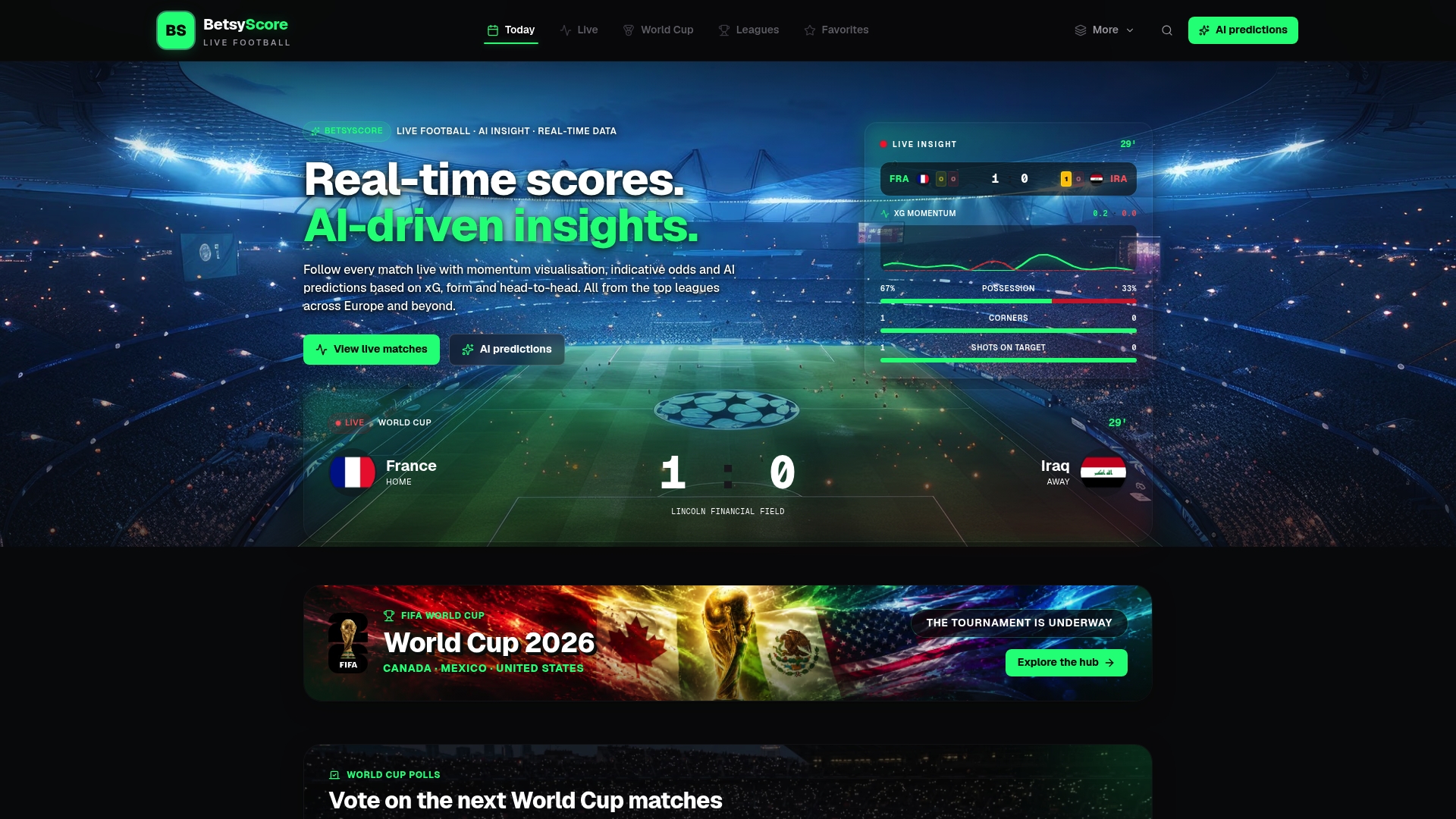
To see how a specific game looks on paper, open the predicted scorelines for today’s matches, or browse the home page at BetsyScore for the full list of competitions.
FAQ
Where can I buy official UEFA Champions League final tickets?
The official source is UEFA’s ticket portal at UEFA.com/tickets. For the 2026 final, general public sales ran exclusively through it, while tickets for finalist supporters were handled directly by the two clubs. Registration on the portal was required before applying.
Is the final ticket sale first come, first served?
No. For the 2026 final, tickets were allocated by lottery after the application period closed. Applying on the first day gave no advantage over applying on the last day of the window. Applicants had a small hold of €1 placed on their card, which was released after the application phase.
How much do Champions League final tickets cost?
For the 2026 final, face values were €70 for Fans First, €180 for Category 3, €650 for Category 2 and €950 for Category 1. Each final has its own price list, published by UEFA when the sale opens. Treat these figures as the benchmark for any offer you see elsewhere.
How do I get tickets for an away Champions League match?
Contact your own club. Under the 2026/27 regulations, home clubs must make at least 5% of stadium capacity available to visiting supporters, at a price no higher than comparable home adult tickets or €50. The visiting club decides how to distribute that allocation, so follow its official announcements.
Are tickets from resale websites safe?
UEFA advises against buying from unauthorised third parties, and says such tickets may be cancelled, with holders refused entry. The safe resale route for the final is UEFA’s own platform, where tickets are resold at face value without seller fees. If a ticket is not on an official channel, assume it may not be valid.
Sources
- Ticket sales for general public open for 2026 UEFA Champions League final (UEFA)
- What does the 1 € amount correspond to when applying for tickets (UEFA support)
- Applications closed for Champions League final tickets (UEFA, 2023)
- UEFA Champions League final 2026 ticketing terms and conditions (UEFA)
- Article 45, Visiting team tickets, Regulations of the UEFA Champions League 2026/27
- UEFA warns fans over risks of unauthorised ticket purchases (UEFA)
- Champions League final tickets frozen by UEFA (AP News)