What Is the UEFA Conference League? Format, Rules, History
The UEFA Conference League is European football’s third-tier club competition, sitting below the Champions League and Europa League in UEFA’s hierarchy. Launched in 2021 and rebranded in 2024 to drop “Europa” from its name, it gives clubs from smaller and mid-ranked leagues a genuine path to continental football. Its winner earns a spot in the following season’s Europa League.
TL;DR:
- All 36 teams in the Conference League must advance through at least one qualifying round before entering the league phase, which replaces traditional group stages.
- The league phase involves each team playing eight matches against different opponents, with only the top eight automatically qualifying for the knockout round of 16.
- Entry into the competition is primarily based on domestic performance and UEFA coefficient rankings, affecting how many qualifying rounds a club must survive.
- The Conference League is scheduled for Thursday nights, with the final typically held in late May or early June at a neutral venue.
- Winning the tournament grants a spot in the next season’s Europa League, providing a significant step up in exposure and revenue for lower-ranked clubs.
Table of Contents
- Where the Conference League Fits in European Football
- How Does the UEFA Conference League Work? Format Explained
- Who Qualifies for the Conference League?
- Conference League vs. Europa League vs. Champions League
- Why UEFA Created the Conference League in 2021 and Renamed It in 2024
- What Winning the Conference League Actually Gets You
- Recent Winners and Records That Matter
- When and Where to Watch Conference League Matches
- How Betsyscore Tracks Every Conference League Matchday
- Where to Verify These Facts
- The Conference League Deserves More Credit Than It Gets
- Sources
- FAQ
Where the Conference League Fits in European Football
UEFA runs three club competitions in a clear order of prestige: the Champions League at the top, the Europa League in the middle, and the Conference League as the entry tier. Each one draws from a different band of clubs, but they are not walled off from one another. A team’s results can bump it up or down the ladder mid season.
Clubs that finish third in their Champions League league phase group typically drop into the Europa League knockout rounds, and Europa League sides eliminated at certain stages can fall into the Conference League. That movement is part of what makes the competition feel connected to the bigger tournaments rather than a standalone afterthought.
On the calendar, the Conference League shares its midweek slot with the Europa League, with matches mostly played on Thursday nights, according to UEFA’s official competition page. That keeps Tuesdays and Wednesdays clear for Champions League fixtures, giving fans a full week of European football without direct overlap.
A quick structural snapshot:
- Champions League: top tier, Tuesday and Wednesday nights, the highest prize money and prestige
- Europa League: second tier, Thursday nights, strong mid-table and cup-qualified clubs
- Conference League: third tier, also Thursday nights, entry point for clubs from smaller UEFA associations
The competition draws teams from a broad swath of the continent. More than 170 clubs take part across a full season, representing well over 30 UEFA national associations, which is part of why the group stage often features matchups you would never see in the Champions League.
How Does the UEFA Conference League Work? Format Explained
No club enters the Conference League league phase directly. Every team, without exception, has to come through a qualifying round first, according to Wikipedia’s competition entry. That single rule shapes the entire competition. It means the 36 clubs you see in the league phase each September have already survived at least one two-legged qualifying tie, sometimes several.
Here’s how the season unfolds from start to finish:
- Qualifying rounds begin in early July, months before most fans are paying attention, and run through August.
- Play-off round in late August determines the final clubs to reach the league phase.
- League phase runs from September through January, with all 36 teams sharing one combined table.
- Knockout play-offs in February pit teams ranked 9th through 24th against each other for a spot in the round of 16.
- Knockout rounds (round of 16, quarterfinals, semifinals) follow through March and April.
- Final, a single match at a neutral venue, closes out the competition in late May.
The league phase itself replaced the old group-stage format, and it works differently from what long-time fans remember. Each of the 36 teams plays eight matches total, against eight different opponents, drawn from seeded pots to balance the schedule. Four of those games are at home and four away, and every team’s results feed into one shared standings table instead of separate groups of four.
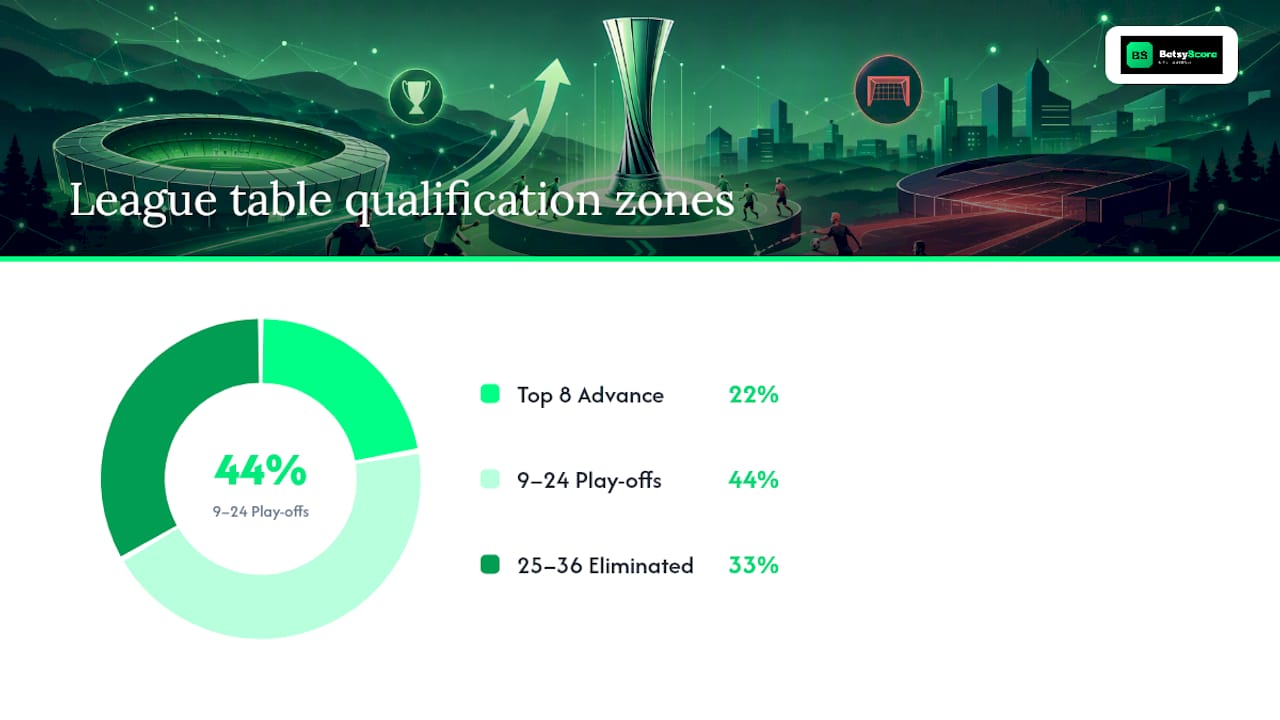
Finish in the top eight of that table and you go straight into the round of 16. Land between 9th and 24th and you get a two-legged play-off for a shot at joining them. Finish 25th or lower, and the season ends when the league phase does.
Pro Tip: If you’re trying to follow the table logic, don’t think of it like the old four-team groups. Think of it more like a single mini-league of 36 teams where your opponents change every year based on seeding, so head-to-head history resets constantly.
That single 36-team table is also why the phrase “Conference League format” trips people up. It’s not a knockout cup from the start, and it’s not a traditional group stage either. It’s a hybrid, and it was built specifically to guarantee more meaningful matches before the business end of the tournament even begins.
Who Qualifies for the Conference League?
Entry mostly comes down to two things: domestic performance and your association’s UEFA coefficient, which ranks all 55 national federations by how their clubs have performed in Europe over the previous five seasons. Better coefficient, better entry round, fewer qualifying hurdles.
Typical entry routes into the qualifying rounds include:
- Domestic cup winners from associations that don’t send their cup champion to the Europa League
- Clubs finishing mid-table or lower in their domestic league standings, particularly from associations ranked outside Europe’s top tier
- Clubs eliminated from Champions League qualifying, who often get funneled down into Conference League qualifying rather than exiting Europe entirely
- Clubs eliminated from Europa League qualifying rounds, following the same drop-down logic
Qualifying itself splits into two parallel tracks: the Champions Path, reserved for domestic champions from lower-ranked associations, and the Main Path, open to cup winners and league-placed clubs. Both paths run through several rounds before merging into a single play-off stage ahead of the league phase.
The coefficient system does more than just decide who enters where. It determines how many qualifying rounds a club has to survive. A team from a top-20 association might enter two rounds from the finish line, while a club from a lower-ranked federation could need to win four or five ties just to reach the play-off round. If coefficients and association rankings interest you, BetsyScore’s breakdown of UEFA rankings explains how those numbers are calculated and why they matter beyond just the Champions League.
Conference League vs. Europa League vs. Champions League
The gap between these three competitions is not just about trophies. It shows up in money, match count, and the caliber of opposition a club faces on a given Thursday or Tuesday night.
- Prestige and finances: Champions League prize money dwarfs the other two competitions, and Europa League payouts sit comfortably above Conference League figures. Sponsorship value and broadcast reach follow the same pecking order.
- Format and match count: All three now use a 36-team league phase, but the caliber of the average matchup differs sharply. A Champions League away trip might mean Munich or Milan; a Conference League away trip could mean a club most fans have never watched play.
- What a win gets you: Champions League and Europa League winners qualify for the following year’s Champions League league phase. A Conference League winner, by contrast, moves up to the following season’s Europa League league phase, a meaningful step up in exposure and revenue for a club that may never have sniffed European football’s upper tiers before.
That last point is the whole reason the Conference League exists in a competitive sense. It’s not just a consolation bracket. It’s a genuine ladder rung, with a real prize at the top that changes a club’s trajectory for the following season.
Why UEFA Created the Conference League in 2021 and Renamed It in 2024
UEFA approved the competition as an addition to its existing club competition structure, and it kicked off with its inaugural season in 2021/22. The thinking was straightforward: hundreds of clubs across smaller and mid-sized leagues had almost no realistic path to a European night, and UEFA wanted a tournament that gave them one.
For its first three seasons, the competition ran under the name “UEFA Europa Conference League,” a mouthful that tied it visually and verbally to its more established sibling. That changed in 2024, when UEFA rebranded it to simply the UEFA Conference League, dropping “Europa” from the name entirely, according to Wikipedia’s overview of the competition. The move was about identity as much as anything: UEFA wanted the tournament to stand on its own, both commercially and in how fans perceived it, rather than being read as a watered-down Europa League.
The rebrand coincided with the broader restructuring that also expanded the Champions League and Europa League to 36-team league phases, so 2024 marked a genuine reset for how BetsyScore’s Conference League hub and every other football outlet had to talk about the competition. UEFA’s stated goals throughout have stayed consistent: broader inclusion for clubs outside the traditional “Big Five” leagues, more competitive matches at the group stage, and a stronger commercial footprint for a competition that used to be an afterthought on the football calendar.
What Winning the Conference League Actually Gets You
Lift the trophy and the reward is concrete, not symbolic. The winning club automatically qualifies for the following season’s Europa League league phase, a genuine step up in prize money, broadcast exposure, and the quality of opposition it will face. The one exception: if the winner has already qualified for the Europa League or Champions League through its domestic league that season, the Conference League spot passes down to another club via UEFA’s access list rules.
The trophy itself is a statement piece. It stands 57.5 centimeters tall and weighs 11 kilograms, a detail that surprises fans who assume a “third tier” trophy would be modest by comparison.
Beyond the silverware, every run through the competition, win or lose, feeds into a club’s UEFA coefficient. That number determines future seeding, qualifying byes, and even how many rounds a club has to survive to reach Europe next time. For a club used to fighting relegation rather than continental nights, a solid Conference League campaign can reshape its financial planning for years.
Recent Winners and Records That Matter
The competition’s short history has already produced some memorable champions, and the trophy has traveled to clubs from several different footballing cultures rather than settling with one dominant nation.
- 2022: Roma, the competition’s inaugural winner, beat Feyenoord in the first-ever final
- 2023: West Ham United won the trophy, the club’s first major European silverware in decades
- 2025: Chelsea claimed the title
- 2026: Crystal Palace lifted the trophy
That spread, an Italian giant, an English club ending a long wait, and two more Premier League sides in consecutive seasons, shows how competitive the tournament has become even in its short existence. No single nation or league has managed to dominate it outright, which is arguably a sign UEFA’s inclusion goals are working as intended.
When and Where to Watch Conference League Matches
Conference League fixtures follow a predictable rhythm once you know the pattern. League phase and knockout matches are scheduled almost exclusively for Thursday nights, split between two kickoff windows: 18:45 CET and 21:00 CET, according to UEFA’s official site. That two-slot system lets broadcasters cover multiple matches on the same night without direct clashes.
The final breaks from the Thursday pattern and gets its own showcase date, typically slotted between the Europa League and Champions League finals in late May or early June. UEFA has already confirmed that the 2026/27 season kicks off in July 2026 and concludes with the final at Beşiktaş Park on June 2, 2027.
For fixture lists and official bracket updates, UEFA’s own competition pages remain the definitive source. If you want to follow matches as they happen, BetsyScore’s Conference League page tracks live scores, lineups, and stats in real time, which matters most during the league phase when several matches kick off in the same window.
How Betsyscore Tracks Every Conference League Matchday
Following 36 teams across eight matchdays, plus qualifying rounds and knockout play-offs, is a lot to track by memory. Betsyscore builds its coverage around live scores that refresh in seconds, paired with AI-powered match predictions built from expected goals, recent form, and head-to-head history, so a Conference League clash between two unfamiliar clubs comes with real context instead of a blank scoreline.

The platform’s momentum read shows which side is controlling a match minute by minute, useful in a competition where underdog performances and late surges are common given the wide range of club quality involved. Betsyscore’s coverage extends well past the Conference League too, spanning the Champions League, Premier League, La Liga, Bundesliga, Serie A, and more than 200 competitions worldwide, alongside detailed content on how UEFA’s ranking system shapes qualification paths for clubs across the continent.
Where to Verify These Facts
For fixture schedules, official format rules, and season-by-season updates, UEFA’s Conference League page remains the definitive primary source. Wikipedia’s entry on the competition offers a clean historical timeline covering the 2021 launch through the 2024 rebrand. For the trophy’s physical specifications and a recap of recent finals, Crystal Palace FC’s club article confirms both the dimensions and the list of recent champions.
The Conference League Deserves More Credit Than It Gets
Most casual fans still treat the Conference League as a joke tier, a competition for clubs that couldn’t cut it elsewhere. That reading misses what the format was actually built to do. UEFA didn’t create a watered-down Europa League. It created a genuine second chance system, one where a club eliminated from Champions League qualifying doesn’t just vanish from Europe for the season, it drops into a competition with real stakes and a real trophy.
The conventional take also underestimates how unpredictable the football gets. With clubs pulled from such a wide range of leagues and playing styles, later rounds routinely produce results nobody saw coming, and that unpredictability is arguably more entertaining than another lopsided Champions League group match. If you’re new to following it, prioritize the knockout play-off round in February. That’s when the league phase’s middle tier gets separated from the pretenders, and it usually delivers the tournament’s most competitive football before the final even comes into view.
— Aria
Sources
- Uefa
- UEFA Conference League — Wikipedia
- The Conference League trophy: everything you need to know | Crystal Palace FC
FAQ
What Is the Point of the UEFA Conference League?
It gives clubs from smaller and mid-ranked UEFA associations a realistic path into European football, offering revenue, exposure, and coefficient points that were previously reserved for a narrower group of elite clubs.
Who Qualifies for the UEFA Conference League?
No club enters the league phase directly. Entry comes through qualifying rounds via domestic cup wins, league placement, or coefficient-based access, plus teams dropping down after elimination from Champions League or Europa League qualifying.
What Is the Difference Between the Europa League and the Conference League?
The Europa League sits one tier above the Conference League in prestige, prize money, and average club quality, though both now share a 36-team league phase format and Thursday night fixtures.
What Happens if You Win the UEFA Conference League?
The winning club automatically qualifies for the following season’s Europa League league phase, unless it has already qualified for the Europa League or Champions League through its domestic league, in which case the spot passes to another club.