Tempo in Football: Measure the Shifts Opponents Force

Tempo is the speed and rhythm of play, measured in both ball movement and player movement, and it is relational: one team’s tempo exists only in relation to the other’s. It shapes transitions, chance creation, and player workload in ways that show up directly in match data. Understanding it means understanding how matches are actually won, not just how they are watched.
TL;DR:
- A one minute rolling average at or above 15 kilometers per hour identifies the match’s peak demand, which full match averages can obscure.
- Teams that attack faster than their opponents generate more shots per match, while patient circulation can draw a press forward before switching into space.
- Immediately after peak intensity, total distance falls 48%, high speed running drops 93%, and sprint distance declines 97%, so plan recovery around that minute.
- Presses and defensive traps can force sudden tempo shifts, so coaches should train players to recognize opponent triggers, not only execute their planned pace.
Table of Contents
- 1. What tempo looks like on the field
- 2. Who really controls the tempo on the pitch
- 3. How coaches and analysts measure tempo
- 4. What the data shows about tempo’s real effects
- 5. Drills and in-game rules that change tempo
- 6. Watching tempo shift live with momentum and win-probability data
- 7. Tempo is a conversation, not a setting
- See tempo swings as they happen
- FAQ
- Sources
1. What tempo looks like on the field
Tempo shows up in a few distinct forms, and conflating them is where most confusion starts. Ball speed refers to how quickly possession moves between players and zones. Player rhythm describes the pattern of movement off the ball, runs, rotations, pressing triggers. Team pacing is the broader in-game cadence a side chooses to adopt over a half or a match.
A few recognizable match moments make this concrete:
- A quick counterattack after a turnover, where three or four passes cover sixty meters in under ten seconds.
- A no-huddle offensive structure borrowed from American football, applied in soccer as rapid restarts that deny the opponent time to reset.
- A patient build-up phase designed to draw the opposing press forward before switching play.
Tempo, rhythm, pace, and motion get used interchangeably in commentary, but they are not the same thing. Pace usually refers to raw speed of movement. Rhythm is the pattern or cadence of actions. Tempo is the combination: how fast and how structured the play is at a given moment, measured against what the opponent is doing.
2. Who really controls the tempo on the pitch
The common assumption is that the team in possession dictates tempo. The reality is closer to a dialogue. Out-of-possession actions, specifically pressing triggers and defensive traps, force tempo increases just as often as they come from attacking intent.
- A high press can compress the time a possession team has on the ball, pushing them into faster, less considered actions.
- A deliberate defensive trap, where a team invites a pass into a crowded zone, can spike tempo the instant the ball is won back.
- Tactical analysis from UEFA on the Arsenal plan against Paris showed how structural stability, occupying vertical and horizontal lines, let a team raise tempo safely because passing lanes and backward options stayed open under pressure.
For coaches, the implication is practical: players need preparation for tempo shifts that the opponent imposes, not just the ones the game plan calls for. Treating tempo as something only your own team controls leaves a side flat-footed the moment an opponent’s press changes the rhythm of the game.
3. How coaches and analysts measure tempo
Tempo stops being a vague impression once it is quantified, and the tools for doing that range from simple counting to rolling statistical windows.
- Passes per minute counts the raw frequency of ball actions in a given spell of play.
- Seconds per action tracks the average time between touches, a direct read on how quickly a team is moving the ball.
- Meters per second toward goal measures directional progress, distinguishing fast circulation from fast penetration.
- Rolling high-intensity windows, often one to five minutes long, capture peak physical output better than a full-match average.
- Attacking pace versus general pace separates how fast a team moves in the final third from how fast it moves overall.
- Momentum indices built from event data combine several of the above into a single minute-by-minute signal.
A one-minute rolling-average peak at or above 15 kilometers per hour, known as MDP k, marks the most demanding passage of play in a match, and it is followed by steep physical decline the very next minute. Research published in BMC Sports Science, Medicine and Rehabilitation recommends these short rolling windows specifically because they expose peaks that match-long averages smooth over.
Which metric to use depends on what data is available and what the coaching staff actually needs. A club without tracking technology can still log passes per minute from video. A club with GPS vests can build rolling-window profiles for individual players.
4. What the data shows about tempo’s real effects
Tempo is not just a style preference. It has measurable consequences for both chance creation and player output, and the two findings pull in different directions.
- A causal-inference study of pace of play in soccer found that teams playing at a higher attacking pace than their opponent generate noticeably more shots per match, even after controlling for other factors through propensity-score methods.
- The same MDP k research found that in the minute immediately after a peak-intensity passage, total distance covered drops by 48%, high-speed running falls by 93%, and sprint distance collapses by 97%.
That one-minute post-peak collapse in high-speed running is one of the sharpest physical declines documented in elite match data. It means tempo is a resource with a cost: pushing the pace creates more attacking opportunities, but it draws down physical output almost immediately afterward. A side that attacks the window right after its own peak, or the opponent’s, is attacking when legs are emptiest. Coaches who treat tempo purely as an attacking weapon, without planning for the recovery minute that follows, are leaving a predictable vulnerability open.
5. Drills and in-game rules that change tempo
Training tempo recognition and tempo control works best as a progression, moving from simple patterns to game-realistic chaos.
- Rhythmic passing circuits establish a baseline sense of pace in a low-pressure, repetitive setting.
- Constrained small-sided games, limited touches or defined passing sequences, force players to feel tempo changes under light pressure.
- Full-space transition drills replicate match conditions, where tempo shifts are triggered by turnovers rather than by a coach’s whistle.
In-game rules reinforce the same instincts. Limited-touch restrictions in training push faster decision-making. Press and no-press cues teach players to recognize when the opponent is about to force a tempo spike. Reward systems for quick transitions or patient circulation, extra points in small-sided games, build habit around deliberate pacing rather than default speed.
Game management matters just as much as training. Substitution timing around known post-peak recovery windows, tactical shape adjustments to protect a tiring unit, and planned recovery after a high-intensity spell all turn tempo from something that happens to a team into something a team manages.
Pro Tip: Log the minute of your team’s highest-intensity spell in training sessions, then watch for the same post-peak dip described in match research, it shows up in practice, too.
For a structured way to carry this into match day, a match analysis checklist built around these same principles gives coaches a repeatable post-match review process.
6. Watching tempo shift live with momentum and win-probability data
Tempo swings are hard to see in real time unless they are visualized. A minute-by-minute momentum readout, the kind we build at BetsyScore, shows which side is on top at any given moment, and those swings tend to line up closely with the tempo changes described in match analysis: a press that forces turnovers, a build-up phase that slows the game down, a late-game surge.
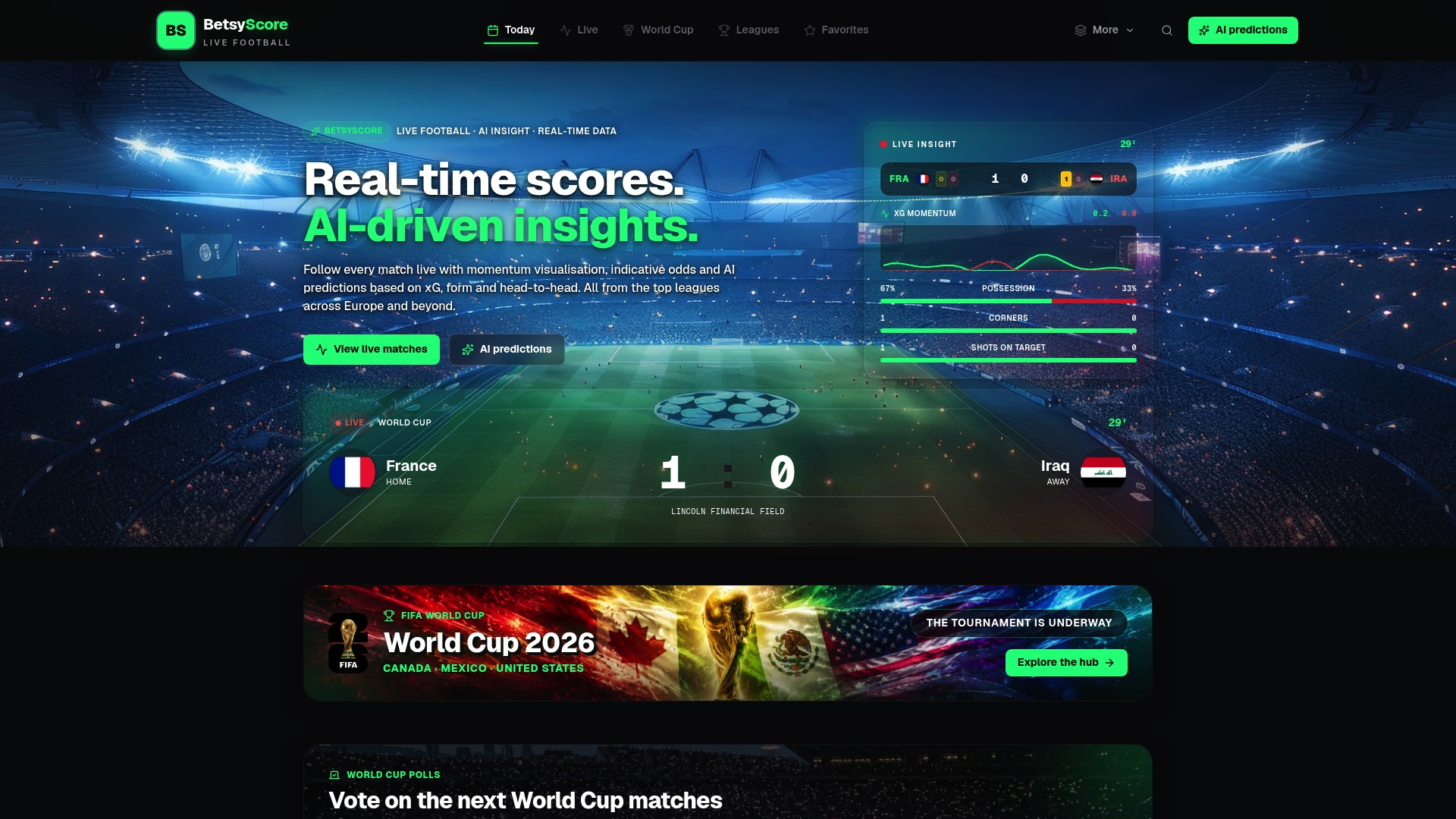
That momentum view can be paired with AI-powered win-probability shifts built from expected goals, recent form, and head-to-head data, so a sudden tempo-driven chance often shows up as a visible swing in both signals at once. Coaches can use this during a match as a quick sanity check, fans can use it to follow the game more closely, and anyone reviewing afterward can use it to confirm what actually happened when the pace changed.
7. Tempo is a conversation, not a setting

Tempo is never one team’s decision alone. It is co-created, shaped by pressing triggers, defensive traps, and the push and pull between two game plans every minute of a match. Coaches who train only their own preferred pace are training half the picture.
The teams that handle tempo best are the ones that recognize it, trigger it deliberately, and plan recovery around it rather than treating speed as a constant. Data turns tempo from a commentary cliché into something a staff can actually coach.
— Aria
See tempo swings as they happen
We built BetsyScore around real-time scores, minute-by-minute momentum readouts, and AI win-probability shifts, the kind of signals that make tempo visible as it changes rather than something you only notice after the fact. Whether you are coaching, playing, or just following along, our live scores and momentum tracking page lets you watch tempo swings unfold match by match.

FAQ
What does tempo mean in football?
Tempo refers to the speed and rhythm of play, covering both how fast the ball moves and how fast players move, measured relative to what the opposing team is doing. It directly affects how quickly chances develop and how much physical output each spell of play demands.
What is tempo control in football?
Tempo control is the deliberate management of match pace, speeding play up to exploit space or slowing it down to conserve energy and draw an opponent out of position. Structural stability, such as occupying passing lanes on multiple lines, lets teams raise tempo without losing the ball cheaply.
What is an example of a tempo?
A fast tempo example is a counterattack that moves the ball sixty meters in a handful of passes right after winning possession. A slow tempo example is a patient build-up phase where a team circulates the ball across the back line to draw the opponent’s press forward before switching to space.
What does tempo mean in slang?
Outside of tactical analysis, “tempo” in casual football talk often just means how fast or intense a game feels to watch, without reference to specific metrics. In coaching and analytics contexts, though, it carries the more precise, measurable meaning described throughout this article.
Sources
- Physical, tactical and technical performance of the most demanding passages of kinematic activity in elite soccer | BMC Sports Science, Medicine and Rehabilitation
- A Causal Investigation of Pace of Play in Soccer
- Uefa