Premier League: Format, Rules, Clubs and Records Explained

The Premier League is the top tier of England’s football pyramid, where 20 clubs compete each season to become English champions. They play 380 matches between August and May, three points go to a winner, and the club with the most points lifts the trophy. This guide covers how the league works, who is in it for 2026/27, how Europe and relegation are decided, where it came from, and how to follow every match with live data.
TL;DR
- The Premier League is England’s highest league: 20 clubs, each playing every other club home and away, for 380 matches a season from August to May.
- A win is worth three points, a draw one and a defeat none. Ties are broken by goal difference, then goals scored, then head-to-head results.
- The bottom three clubs drop to the Championship. Top finishers qualify for the UEFA Champions League, Europa League and Conference League.
- The league began on August 15, 1992 with 22 clubs and has had 20 since 1995/96.
- BetsyScore tracks the league with live scores, line-ups, xG, momentum charts and AI match predictions, free to use.
Table of Contents
- What the Premier League is
- The 2026/27 clubs
- How a season is structured
- How points and the table work
- How a club wins the title
- European qualification
- Promotion and relegation
- A short history
- Records that define the league
- How to read a Premier League match with data
- Where BetsyScore fits
- Our view: why the Premier League rewards data
- Following the Premier League as a fan in the US
- FAQ
- Sources
What the Premier League is
The Premier League is a professional association football league and the highest level of the English football league system. It sits above the Championship and the lower divisions of the pyramid, and its official explainer describes it as the top tier of English football.
The competition is run by a company, not by the national federation. According to its About page, the Premier League organizes the competition, maintains its Rule Book and controls centralized broadcast and commercial rights. It is a private company limited by shares. Its shareholders are the 20 member clubs and The FA, which holds a special share.
For American readers, the most useful difference from domestic sports is the structure. There is no draft, no salary cap in the league’s explainer, no playoffs for the title and no conferences. Every club plays every other club twice, and the table decides everything.
The 2026/27 clubs
The Premier League’s official beginner guide lists the 20 clubs for 2026/27:
| Clubs (alphabetical) | ||
|---|---|---|
| AFC Bournemouth | Arsenal | Aston Villa |
| Brentford | Brighton & Hove Albion | Chelsea |
| Coventry City | Crystal Palace | Everton |
| Fulham | Hull City | Ipswich Town |
| Leeds United | Liverpool | Manchester City |
| Manchester United | Newcastle United | Nottingham Forest |
| Sunderland | Tottenham Hotspur |
The membership changes every year because of promotion and relegation, so a list from a few seasons ago will be out of date. Coventry City, Hull City, Ipswich Town and Sunderland are among the clubs in the 2026/27 field.
How a season is structured
Twenty teams play from August to May. The official explainer says every club plays every other club home and away, which gives 380 matches in total. Each club therefore plays 38 games: 19 at home and 19 away.

The schedule is split into matchweeks. Fixtures within a matchweek are spread across the weekend and sometimes midweek, with kick-off times that differ by broadcaster. Because the league is played in England, many matches start in the morning or midday in the United States. The Premier League’s matchweek pages list fixtures, local kick-off times, live scores, match centers, league tables and live blogs.
The number of clubs has not always been 20. The league’s guide says the first three seasons had 22 clubs, and the competition has had 20 clubs since the 1995/96 season.
How points and the table work
The points system is simple and the same all season:
- A win earns three points.
- A draw earns one point.
- A defeat earns none.
That is the official rules explanation. Over 38 matches, a club can earn at most 114 points.
Tiebreakers
Clubs are ordered by points first. When two or more clubs are level, the league’s guide applies these criteria in order:
- Goal difference (goals scored minus goals conceded).
- Goals scored.
- Points in the matches between the tied clubs.
- Away goals in the matches between the tied clubs.
Goal difference matters more than many new fans expect. A club that wins 5-0 gains five on goal difference, while a 1-0 win gains one. Over a season, that can separate positions. For a deeper walk-through with worked examples, see our guide on how the Premier League points system works.
The live standings and form guide are on the league’s official table page. On BetsyScore, the league table sits beside top scorers, transfers and club pages for the same competition.
How a club wins the title
There is no final. The club with the most points at the end of the season wins the Premier League. A title race can therefore be decided before the last day, when a leader’s lead is larger than the points left to play, or it can go to the final matchweek.
A title chase is also a probability problem. A club on 70 points with five games left is in a very different position depending on who it still has to play and how many goals each side has been creating. Expected goals (xG), recent form and head-to-head records all help describe that. Our Premier League win probability page follows title chances as the season moves, and the 2026-27 season preview covers the contenders and our predictions.
European qualification
League position decides who plays in Europe. According to the league’s guide, success in the Premier League can lead to qualification for the UEFA Champions League, UEFA Europa League and UEFA Conference League.
The usual pattern is that the top four qualify for the next season’s Champions League. The number can change. The official explainer notes that England earned a fifth place in 2025/26 through a European Performance Spot. That extra place came because English clubs’ European results put the country in UEFA’s top two association club coefficient rankings.
Domestic cup winners can also affect Europa League and Conference League places, so the lower European spots can move down the table depending on who wins the cups. Always check the league’s current qualification page for the exact allocation in a given season.
If you follow Europe as well, our guides to Champions League standings and tiebreakers and the UEFA Conference League format explain what the qualified clubs play for.

Promotion and relegation
The Premier League is an open league. The bottom three clubs are relegated to the Championship. They are replaced by the Championship’s top two finishers and the winner of the end-of-season playoffs, as set out in the official explainer.
That system is the main reason the bottom of the table matters as much as the top. A club in 17th place with a game in hand is under more pressure than a club in 8th that cannot reach Europe. The final matchweek often has several clubs fighting to stay up, and goal difference can decide who survives.
A short history
The Premier League’s history is recent compared with English football as a whole. The official history records these steps:
- July 17, 1991: the Founder Members Agreement was signed, establishing the basic principles for the new competition.
- February 20, 1992: 22 First Division clubs resigned from the Football League.
- May 27, 1992: the Premier League was established as a limited company.
- August 15, 1992: the first season began with 22 clubs.
After 1994/95, four clubs were relegated and two promoted, reducing the league to 20 clubs, according to the league’s explainer.
For the list of champions, see our page on Premier League winners by club since 1992. For individual scoring, the all-time top scorers page ranks the leading goalscorers, and our wider football records hub collects winners and statistics across competitions.
Records that define the league
Two single-season marks from 2017/18 show how high the standard can go. BBC Sport reported that Manchester City’s campaign set records of 100 points, 32 wins, 106 goals and a 19-point title margin. The same report said Mohamed Salah’s 32 goals for Liverpool set the record for goals by an individual in a 38-game Premier League season at that time.
Records can be broken, so check a current records page before quoting one as the standing mark. Our records section is built for that kind of lookup.
How to read a Premier League match with data
A scoreline tells you who won. It does not tell you who deserved to. These are the main measures fans and analysts use, and each one is available on a BetsyScore match page:
- Expected goals (xG): the quality of chances each side created. A team with 2.4 xG and one goal was probably unlucky. A team with 0.4 xG and two goals was probably lucky.
- Shot maps: where each shot was taken from, which shows whether a side is working the ball into the box or shooting from distance.
- Heatmaps and average positions: where players spent the match, which shows tactical shape, such as a high defensive line or an overloaded wing.
- Momentum chart: a minute-by-minute view of which side was on top, useful for seeing when a match turned.
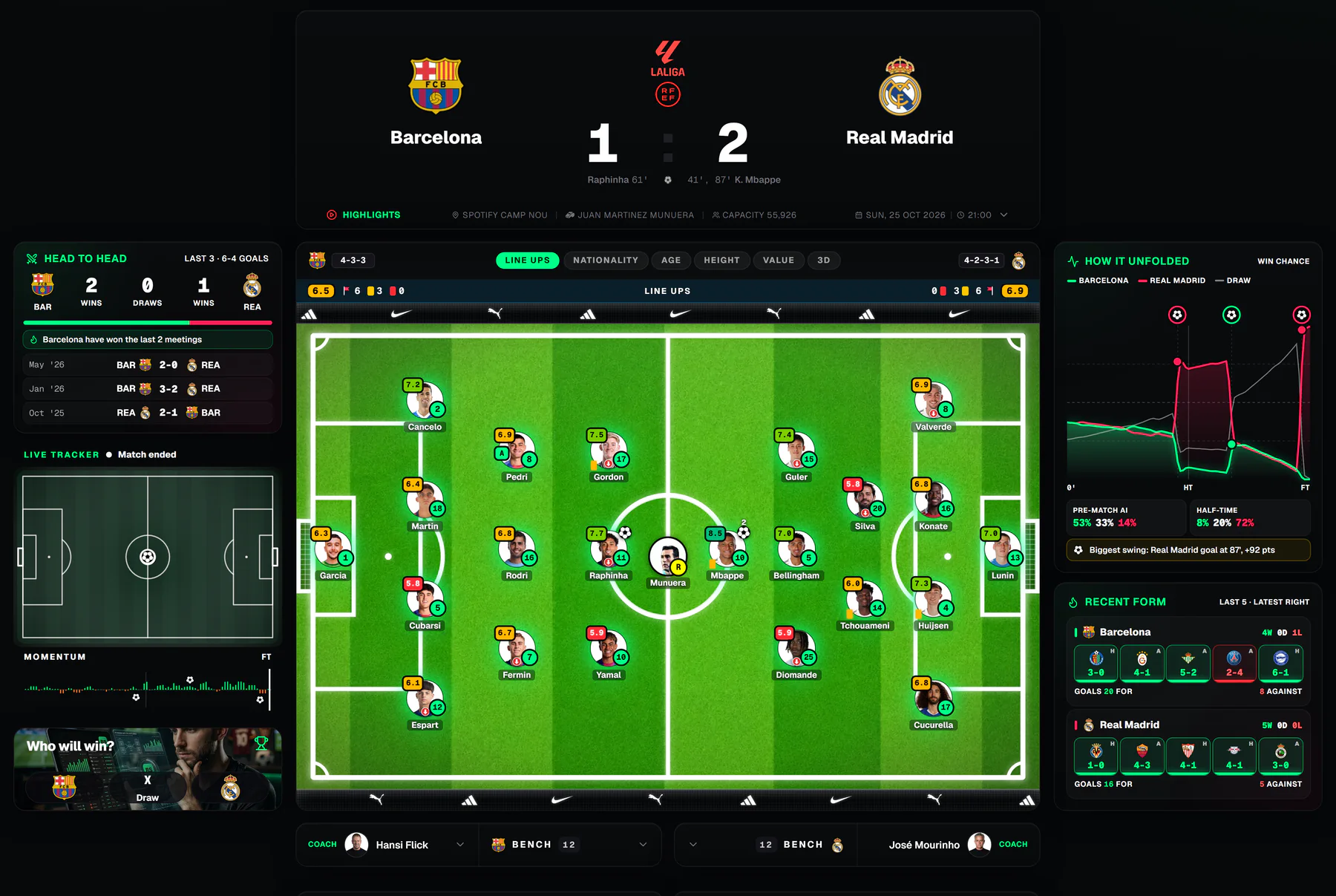
- Line-ups on a pitch: formation and player ratings in one view.
Together, these turn a match from a result into a story with evidence. They are most useful for the Premier League because the gaps between clubs can be small and matches are decided by details.
Where BetsyScore fits
BetsyScore is a free football platform. Live scores update every few seconds. Each match page brings together line-ups on a pitch with player profiles and ratings, expected goals, shot maps, heatmaps, average positions, a momentum chart and a live match tracker for selected leagues. Coverage spans more than 300 competitions worldwide, including the Premier League, the UEFA Champions League, La Liga, the Bundesliga, Serie A, Ligue 1 and the Eredivisie.
Before kick-off, we publish AI match predictions based on expected goals, recent form and head-to-head records, with a public prediction record that includes the misses. After the final whistle, you get match events, team statistics, player impact and highlights.
BetsyScore is not a bookmaker and does not take bets.
To see what is on right now, open live scores. For previews, the AI predictions page lists upcoming matches, and the predicted scorelines for today cover every match on the day. Past meetings between two clubs are in the head-to-head records.
Our view: why the Premier League rewards data
The Premier League is the most closely watched league in the world, and it is also one of the most evenly argued. A single result can hide a lot. When we built BetsyScore, we wanted a fan to see at a glance not only the score but how it happened.
That is why each match page shows expected goals, shot maps and a momentum chart next to the line-ups. A fan who sees that a side led on xG for 70 minutes and still lost understands the match differently from one who sees only the final score.
The same thinking applies to predictions. Our AI match predictions are based on expected goals, recent form and head-to-head records, and our public prediction record includes the misses. A prediction is a probability, not a promise, and we think a fan is better served by seeing the whole record than by a highlight reel of correct calls.
Football is better when more people can read it. That is the reason BetsyScore is free and data-first.
Aria
Following the Premier League as a fan in the US
A few habits make the season easier to follow from abroad:
- Check local kick-off times. The league’s matchweek pages show kick-offs in your local time, which matters because many fixtures fall in the morning in the United States.
- Use the table with context. A club’s position is the result of points, then goal difference, then goals scored, so look at all three when clubs are level.
- Watch the bottom three and the European places. Relegation and qualification are decided by position, so matches between clubs in those zones carry extra weight.
- Follow the form, not only the result. xG and momentum charts show whether a run of wins is built on strong performances.
- Compare leagues. The structures differ. Our guides to the La Liga table and the Eredivisie show how other competitions handle standings and formats.
FAQ
How many teams are in the Premier League?
There are 20 teams. Each plays the other 19 twice, once at home and once away, for 38 matches per club and 380 in the season. The league has had 20 clubs since 1995/96, after starting with 22 in 1992.
How many points do you get for a win in the Premier League?
A win earns three points, a draw one and a defeat none. If clubs finish level on points, goal difference decides, followed by goals scored, then points and away goals in the matches between the tied clubs.
How does relegation work in the Premier League?
The bottom three clubs in the final table go down to the Championship. They are replaced by the Championship’s top two finishers and the winner of the end-of-season playoffs.
Which Premier League clubs qualify for Europe?
The top finishers qualify for the UEFA Champions League, with further places in the Europa League and Conference League. The exact number can change, as it did in 2025/26 when England earned a fifth Champions League place through the European Performance Spot. Domestic cup winners can also shift the lower places.
Is BetsyScore free?
Yes. BetsyScore is a free football platform with live scores, line-ups, expected goals, shot maps, momentum charts and AI match predictions. It is not a bookmaker and does not take bets.
Sources
- Premier League explained
- New to the Premier League? Here’s all you need to know
- Which Premier League clubs have qualified for Europe?
- About the Premier League
- Premier League History, Origins and Creation
- Premier League Table, Standings and Form Guide
- Premier League Matchweek pages
- Premier League stats of the season, BBC Sport