How the Premier League Points System Works
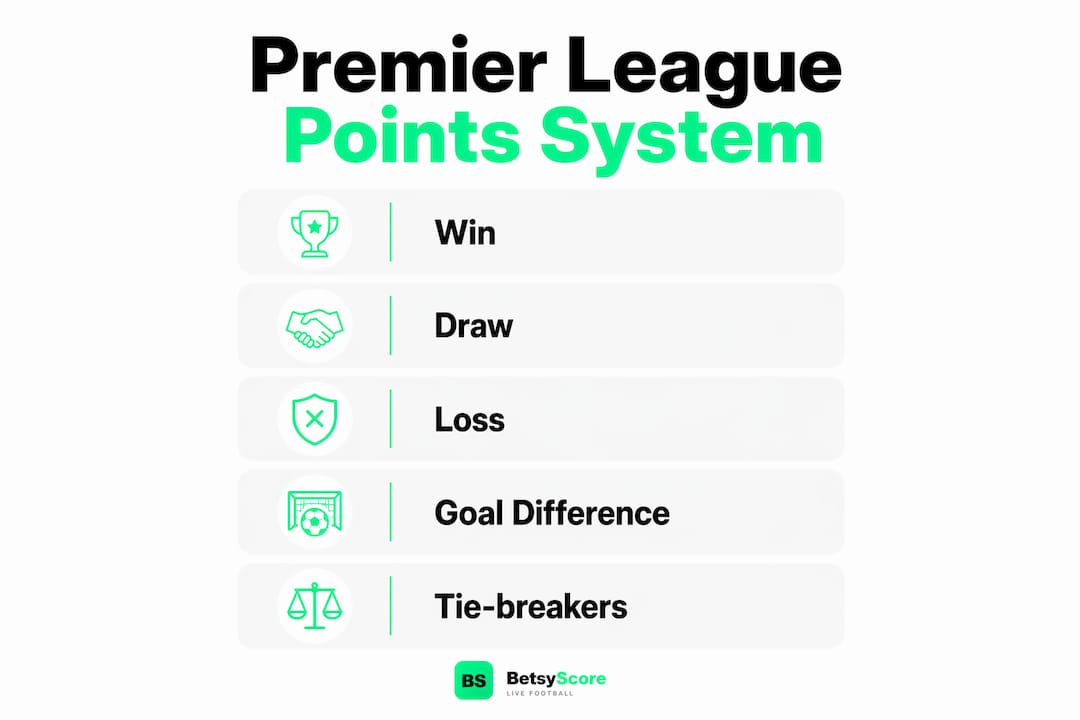
The Premier League points system is defined as a 3-1-0 scoring structure where teams earn 3 points for a win, 1 point for a draw, and 0 points for a loss. Each of the 20 clubs plays 38 matches per season, home and away against every other team. The total points accumulated across those matches determine the final standings, deciding who wins the title, who qualifies for European competition, and who gets relegated. Understanding how the Premier League points system works gives fans a sharper read on every match, every table shift, and every end-of-season drama.
How does the Premier League points system work?
The structure is straightforward. Three points for a win, one for a draw, zero for a loss. Over 38 matches, those numbers stack up fast and separate contenders from the rest of the table.
One detail that surprises many fans: no bonus points exist for scoring more goals. A 5-0 win earns exactly the same 3 points as a 1-0 win. The system is purely outcome-based. That design keeps the standings transparent and easy to follow.

The maximum a team can earn in a full season is 114 points. No club has ever reached that total. Title-winning sides typically finish in the 80s or 90s, which means even champions drop points regularly. That reality keeps the race competitive deep into the season.
Every match carries equal weight in the points column. A win in August counts the same as a win in May. That consistency means early-season results matter far more than fans often realize.
How does the points system affect team strategies and season dynamics?
The 3-point win system was introduced specifically to reward winning and push teams toward attacking football. Before its adoption, a win earned only 2 points, which made a draw nearly as valuable. That old structure encouraged defensive, low-risk play. The shift to 3 points changed the math entirely.
The gap between a win and a draw is now 2 points. The gap between a draw and a loss is just 1 point. That asymmetry pushes managers to chase wins rather than protect draws.
Here is what that looks like in practice:
- A team that wins 20 and draws 10 earns 70 points.
- A team that wins 15 and draws 20 earns 65 points.
- A team that wins 25 and draws 5 earns 80 points.
Five extra wins, even with fewer draws, creates a significant points gap. That math shapes how managers set up tactically, especially in the final 20 minutes of close matches.
The aggregated effect of wins versus draws creates shifting pressure across the season. A run of three consecutive draws feels damaging in a way it never did under the old system. Teams near the relegation zone feel that pressure most acutely.
Pro Tip: Track a team’s win-to-draw ratio alongside their points total. A side with 60 points built mostly on draws is in a more fragile position than one with 60 points built on wins, because draws are harder to sustain under late-season pressure.
What tie-breaker rules decide league rankings when teams share equal points?
Equal points at the end of a season are resolved through a strict tie-breaker hierarchy. The order matters, and fans who understand it read the table very differently.
The tie-breakers apply in this sequence:
- Goal difference (goals scored minus goals conceded across all 38 matches)
- Goals scored (total goals across all 38 matches)
- Head-to-head points (points earned in the two matches between the tied teams)
- Away goals in head-to-head matches (goals scored away from home in those two fixtures)
- Playoff match (a one-off game, used only if the tie affects the title, European qualification, or relegation)
The 2011-12 season is the clearest example of how decisive goal difference can be. Manchester City and Manchester United finished level on points, and City claimed the title on goal difference alone. That single-season example shows why teams push for big wins rather than settling for narrow ones.
The playoff match rule has never been used in Premier League history. All ties have been resolved before reaching that stage. Its existence is more of a safety net than a realistic outcome.
The Premier League’s approach differs from other major European leagues. La Liga and Serie A have historically placed head-to-head results above goal difference as their primary tie-breaker. The Premier League prioritizes goal difference first. That difference has real strategic consequences, which the next section covers in detail.
How do points and tie-breakers influence European qualification and relegation?
Points and tie-breakers shape three critical outcomes every season: the title race, European qualification, and relegation. Each carries enormous financial and sporting consequences.
Points and tie-breakers directly determine which clubs qualify for UEFA competitions and which drop to the Championship. The stakes are not abstract.
- Champions League qualification: The top four clubs earn automatic entry into the UEFA Champions League group stage. The exact points threshold varies by season, but finishing in the top four typically requires 70 or more points in competitive years.
- Europa League qualification: Fifth place earns a Europa League spot. The FA Cup and League Cup winners can also qualify, which sometimes shifts which league positions carry European entry.
- Conference League: Sixth place can earn a UEFA Conference League berth, depending on cup results elsewhere.
- Relegation: The bottom three clubs are automatically relegated to the Championship. Tie-breakers apply here just as they do at the top of the table.
Relegation battles frequently come down to goal difference. A team that finishes 17th with a goal difference of minus 20 survives. A team at minus 30 with the same points drops. That gap can be the difference between Premier League revenue and Championship survival. The role of UEFA rankings in determining European spots adds another layer of complexity for clubs chasing those top positions.
The financial gap between the Premier League and the Championship makes relegation one of the highest-stakes outcomes in world football. Every goal conceded in a 4-0 loss matters, not just for pride but for the final standings calculation.
How does the Premier League points system compare to other major European leagues?
The Premier League uses goal difference as its primary tie-breaker, placing it ahead of head-to-head results. La Liga and Serie A have traditionally used head-to-head records first. That single structural difference changes how teams approach matches against direct rivals.
| League | Primary tie-breaker | Secondary tie-breaker |
|---|---|---|
| Premier League | Goal difference | Goals scored |
| La Liga | Head-to-head points | Head-to-head goal difference |
| Serie A | Head-to-head points | Head-to-head goal difference |
| Bundesliga | Goal difference | Goals scored |
The Premier League’s preference for goal difference pushes teams to perform consistently against all opponents, not just direct rivals. A club cannot afford to lose heavily to a bottom-half team and expect the head-to-head record against a title rival to save them. Every match against every opponent contributes to the goal difference column.
La Liga’s head-to-head approach creates a different dynamic. Two clubs level on points can effectively settle their tie-breaker in their two direct meetings. That structure places enormous weight on those specific fixtures. The Premier League distributes that pressure across all 38 matches instead.
The Bundesliga aligns more closely with the Premier League, using goal difference first. That shared approach reflects a philosophy that consistent performance across the full season should determine rankings, not the outcome of two specific games.
Pro Tip: When following the Premier League standings late in the season, always check goal difference alongside points. Two clubs separated by a single goal in their goal difference column can swap positions with one result.
Key Takeaways
The Premier League points system rewards wins with 3 points, draws with 1, and losses with 0, with goal difference serving as the decisive tie-breaker when clubs finish level.
| Point | Details |
|---|---|
| Core points structure | Teams earn 3 points for a win, 1 for a draw, and 0 for a loss across 38 matches. |
| No bonus points | A 1-0 win earns the same 3 points as a 5-0 win; the system is purely outcome-based. |
| Tie-breaker order | Goal difference comes first, then goals scored, then head-to-head points, then away goals. |
| European and relegation stakes | Top four earn Champions League entry; bottom three are relegated, often decided by goal difference. |
| Premier League vs. other leagues | The Premier League prioritizes goal difference over head-to-head, unlike La Liga and Serie A. |
Why the points system matters more than most fans realize
I have followed the Premier League closely for years, and the single biggest misconception I encounter is that the table is just a scoreboard. Fans treat it as a snapshot. The points system is actually a pressure mechanism that operates across an entire season.
The shift from 2 points to 3 points for a win changed football more than most historical accounts acknowledge. It did not just encourage attacking play in theory. It made defensive, draw-seeking tactics mathematically less viable over a full season. A team that draws 15 matches instead of winning them loses roughly 30 points compared to a team that converts those draws into wins. That gap is almost impossible to recover.
What I find most underappreciated is the goal difference column. Fans notice it when a title race is tight, but they rarely track it proactively. The 2011-12 season should have permanently changed that habit. Manchester City and Manchester United were level on points on the final day. City’s superior goal difference, built across the entire season, decided the championship. That outcome was not a fluke or a technicality. It was the system working exactly as designed.
The tie-breaker hierarchy also reveals something about the Premier League’s philosophy. By placing goal difference above head-to-head results, the league signals that consistent performance against all 19 opponents matters more than winning the specific rivalry fixtures. That is a genuinely different competitive framework from La Liga or Serie A, and it produces a different kind of season-long tension. Understanding how promotion and relegation work in comparable leagues makes that contrast even clearer.
My honest view: fans who track goal difference alongside points watch the table with a completely different level of engagement. The numbers stop being abstract and start telling a story about which clubs are genuinely building something and which are surviving on narrow wins.
— Aria
Betsyscore brings the Premier League table to life
The points system tells you where teams stand. Betsyscore shows you why they got there and where they are headed.

Betsyscore tracks live Premier League scores as they happen, with league tables that update in real time so you always see the current standings and goal difference after every result. The platform also offers AI-powered match predictions built from expected goals, recent form, and head-to-head records, giving you a data-driven view of upcoming fixtures before kickoff. With detailed player profiles, match highlights, and stats across more than 200 competitions, Betsyscore is a complete football data resource for fans who want more than just the final score.
FAQ
How many points does a Premier League win earn?
A win earns 3 points. A draw earns 1 point, and a loss earns 0 points.
What is the first tie-breaker in the Premier League?
Goal difference is the first tie-breaker when two teams finish level on points. It is calculated by subtracting total goals conceded from total goals scored across all 38 matches.
Has a Premier League title ever been decided by goal difference?
Yes. The 2011-12 title was decided by goal difference, with Manchester City finishing above Manchester United after both clubs ended the season on the same points total.
Does the Premier League use head-to-head results as a tie-breaker?
Head-to-head points apply as the third tie-breaker, after goal difference and total goals scored. The Premier League places goal difference ahead of head-to-head results, unlike La Liga and Serie A.
When is a playoff used to decide Premier League standings?
A playoff match is used only if all other tie-breakers fail to separate two clubs and the tie directly affects the title, European qualification, or relegation. No playoff has ever been required in Premier League history.