Match Awards: Why Man of the Match Picks Differ From Live Scores

There isn’t one universal formula. Man of the Match and Player of the Match decisions depend on the competition’s chosen method: a fan vote, a data-driven shortlist, or an expert panel. Across all three models, common factors (goals, assists, saves and overall match impact) shape both the nominations and how fans perceive the winner.
TL;DR:
- The Premier League shortlists each club’s top five players by Fantasy Premier League Bonus Points, then gives fans 15 minutes after full time to vote.
- The Bundesliga locks its six candidate players at the start of the 83rd minute; its scoring assigns 180 points to a goal and 120 to a saved penalty.
- FIFA World Cup fan polls commonly run from the 60th to the 88th minute, so voters may miss late goals, saves, and other decisive contributions.
- Goals and assists attract attention, but compare the award with expected goals, defensive actions, and minute by minute momentum to spot overlooked defenders or substitutes.
Table of Contents
- The three models behind match award decisions
- What counts: the metrics that drive nominations
- How the Premier League, Bundesliga and World Cup each run it
- Why award choices spark debate
- How live scoring indices build a more objective shortlist
- Treat the award as one signal, not the final word
- Compare the official pick with live match data
- FAQ
- Sources
The three models behind match award decisions
Every competition picks one of three basic approaches, and knowing which one applies changes how we read the result. Fan-voted awards open a window right after the whistle and ask the public to choose from a short list, while data-driven systems build that shortlist automatically from live performance scores. Expert or panel selections put the decision in the hands of broadcasters, sponsors or technical staff instead of the crowd.
- Fan vote: supporters choose from a shortlist through an official app or website within a fixed window after full time, as the Premier League’s voting process demonstrates.
- Data-driven nomination: a live scoring engine assigns point values to on-field actions throughout the match and ranks players automatically, a method detailed on the Bundesliga’s nomination page.
- Expert or panel pick: a broadcaster, sponsor representative or technical delegate makes the final call, often based on tactical influence rather than a single standout moment.
The method matters because each rewards different kinds of performances. A fan vote often favors high-profile players, while a data-driven shortlist can highlight less visible but consistently effective contributors.
What counts: the metrics that drive nominations
Most award decisions, regardless of model, draw on a shared pool of match actions. Goals, assists, penalties scored or saved, and clean sheets remain the most visible primary contributions, and they carry the heaviest weight in almost every scoring system. Beyond these headline numbers, contextual stats round out the picture: expected goals (xG), goal-creating actions, key passes, successful duels, interceptions and clearances all help separate a lucky finish from a genuinely dominant display.
Timing and impact matter as much as raw totals. A goal in the 89th minute that decides the match often outweighs an equivalent goal scored when the result was already settled, and a substitute who shifts momentum in 20 minutes can outscore a starter who played the full 90 without incident.
- Attacking output: goals, assists, successful dribbles and shots on target.
- Defensive output: clean sheets, interceptions, clearances and duels won.
- Game-state impact: winning plays, momentum swings and substitute contributions late in the match.
Position changes how these numbers should be read. A goalkeeper’s clean sheet and a string of saves carry a different weight than a striker’s brace, yet both can justify the same award if the context fits.
Nomination lists in data-driven systems are built from weighted action scores rather than raw counts. The Bundesliga’s live scoring model assigns point values to specific actions, which means a well-timed penalty save can outscore a tap-in goal once weighting is applied.
How the Premier League, Bundesliga and World Cup each run it
The three biggest stages in football use three different procedures, and the differences explain why the same performance might win an award in one competition and miss the shortlist in another.
- Premier League: the shortlist comes from the top five players per club based on Fantasy Premier League Bonus Points, and fan voting opens immediately after full time and lasts 15 minutes.
- Bundesliga: a live player-scoring model tracks every action in real time, and the candidate list of six players locks at the start of the 83rd minute, with weighted values such as a goal worth +180 points and a saved penalty worth +120.
- FIFA World Cup: selection shifted from a technical study group to online fan polls starting in 2010, with voting windows commonly running between the 60th and 88th minute of the match.
These procedural differences are not cosmetic. Locking a Bundesliga shortlist at the 83rd minute means a stoppage-time hero can be excluded entirely, while a World Cup fan poll that closes before full time means the voting public never sees the final ten minutes at all.
Why award choices spark debate
Short voting windows and dramatic moments can skew results away from what some analysts might select. Star players often attract votes due to name recognition, sometimes overshadowing equally valuable but less conspicuous performances.
- Popularity bias: recognizable names attract votes independent of the actual performance in that match.
- Highlight bias: a dramatic late goal or save can overshadow 90 minutes of consistent, low-visibility work.
- Positional bias: scorers and attackers are nominated more often than defenders or deep-lying midfielders.
- Timing bias: votes that open and close during the match, as seen in World Cup polling, can miss late-game contributions entirely.
The Premier League’s own 15-minute window compounds this: fans vote on first impressions right after the final whistle, before slower-burn performances get the attention they deserve.
How live scoring indices build a more objective shortlist
Data-driven systems try to solve the bias problem by converting every action into a point value as it happens. The Bundesliga’s model assigns weighted scores (a goal worth +180, a saved penalty worth +120) and locks the candidate pool at a fixed minute, which keeps the shortlist tied to measurable output rather than crowd sentiment. Negative actions, including cards and errors, pull scores down, so a flashy but careless performance does not automatically rise to the top.
An MPI-style index, or match performance index, extends this idea by normalizing scores across positions. That normalization lets a goalkeeper’s saves register on the same scale as a striker’s goal, which analysis of traditional match awards suggests often get overlooked when scoring events dominate the conversation.
- Live action weights assign point values to goals, assists, saves, duels and defensive actions as they happen.
- Minute adjustments and cutoff times keep late drama from distorting a shortlist built earlier in the match.
- Momentum tracking can flag a substitute or a defender whose contribution never shows up in a simple stat line.
Pro Tip: Check minute-by-minute stats alongside the final score to catch defensive interventions or substitute impact that a simple goals-and-assists tally misses.
Treat the award as one signal, not the final word

Every Man of the Match decision is a snapshot shaped by one competition’s rules and one night’s fan behavior, not a verdict on who played the best. We find it more useful to cross-check the official pick against a performance index, expected goals data and a minute-by-minute momentum read before forming a final opinion.
Watching how a competition nominates and votes, whether through Fantasy points, a locked-in scoring cutoff, or an open fan poll, tells us as much about the award as the winner’s name does.
— Aria
Compare the official pick with live match data
Live scores, win-probability numbers, and a minute-by-minute momentum read give us a practical way to double-check any Man of the Match decision. Instead of accepting a fan vote or a locked shortlist at face value, we can pull up the same match on BetsyScore’s live dashboard and see which player’s actions actually swung the momentum needle.
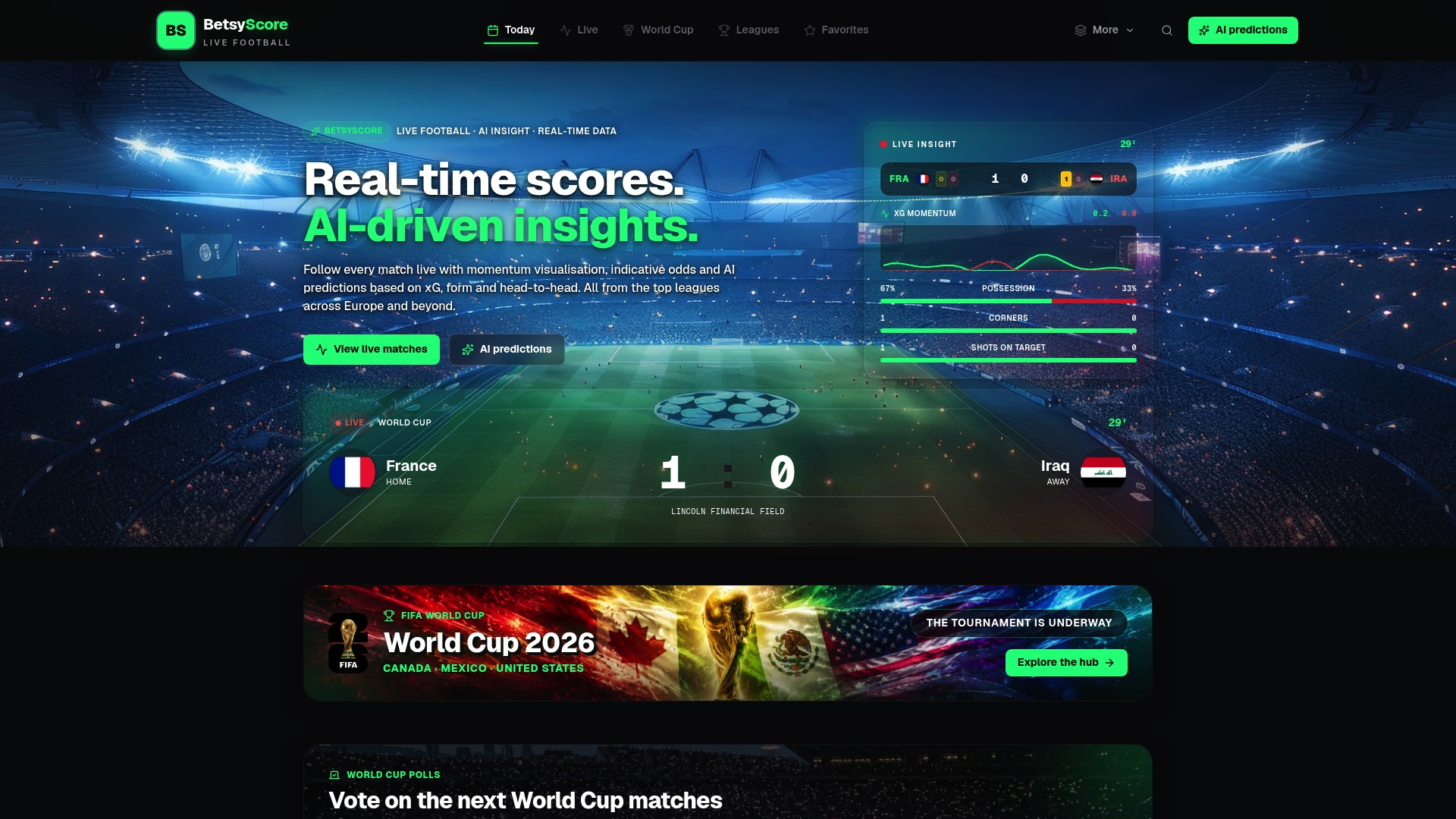
A simple habit works well here: after full time, compare the official award with our AI predictions and momentum timeline to spot a defender or substitute whose impact never made the highlight reel.
| What we check | What it shows |
|---|---|
| Live score updates | Goals, cards and substitutions as they happen, refreshed every few seconds |
| AI win-probability | How much a single play shifted the match outcome |
| Momentum read | Which side controlled each phase of the game, minute by minute |
| Player profiles | Season-long context for judging whether a performance was a one-off or a pattern |
We cover more than 200 competitions, including the FIFA World Cup 2026, the Premier League, Bundesliga and beyond, so this cross-check works the same way no matter which league’s award you are weighing.
FAQ
What do Premier League men of the match get?
The Premier League’s Player of the Match award is a recognition decided by fan vote rather than a cash prize, with the shortlist drawn from the top five players per club based on Fantasy Premier League Bonus Points. Voting opens immediately after full time and runs for 15 minutes.
Who got the Man of the Match and man of the series?
Man of the Match honors a single game, while Man of the Series recognizes the standout performer across an entire tournament or series, and the two are judged by different criteria entirely. Specific winners vary by competition and date, so checking the relevant official competition page gives the accurate, current answer.
Who gives the Man of the Match?
It depends on the competition: the Premier League relies on a public fan vote, the Bundesliga uses a live data-scoring model to generate and lock a shortlist, and the FIFA World Cup has used online fan polls since 2010 after earlier relying on a technical study group. Some broadcasters and sponsors also run their own panel-based selections.
Do fans vote for the Man of the Match?
Yes, in several major competitions fans vote directly, including the Premier League, where voting opens right after the final whistle and lasts 15 minutes, and the FIFA World Cup, where online polls have decided the award since 2010. Other competitions, like the Bundesliga, use automated data scoring instead of a public vote.
Sources
- Player of the Match explained – Premier League
- How Bundesliga nominates Man of the Match – Bundesliga
- Explained: How the World Cup Player of the Match award is given – NYT
- Have man-of-the-match awards always gone to the best performer? – ESPN