How Live Scores Work: A Fan's Tech Guide
Live scores are real-time match event updates delivered to fans’ devices through a chain of event capture, data verification, backend processing, and streaming delivery that operates in milliseconds. Understanding how live scores work reveals a sophisticated system built to handle everything from a Premier League goal to a red card in a Champions League knockout match. The technology behind real-time score tracking combines event-driven architectures, Redis caching, and WebSocket or Server-Sent Event protocols to push verified data to millions of fans nearly instantly. Betsyscore uses this same class of infrastructure to refresh scores every few seconds across more than 200 competitions worldwide.
How do live scores work from stadium to screen?
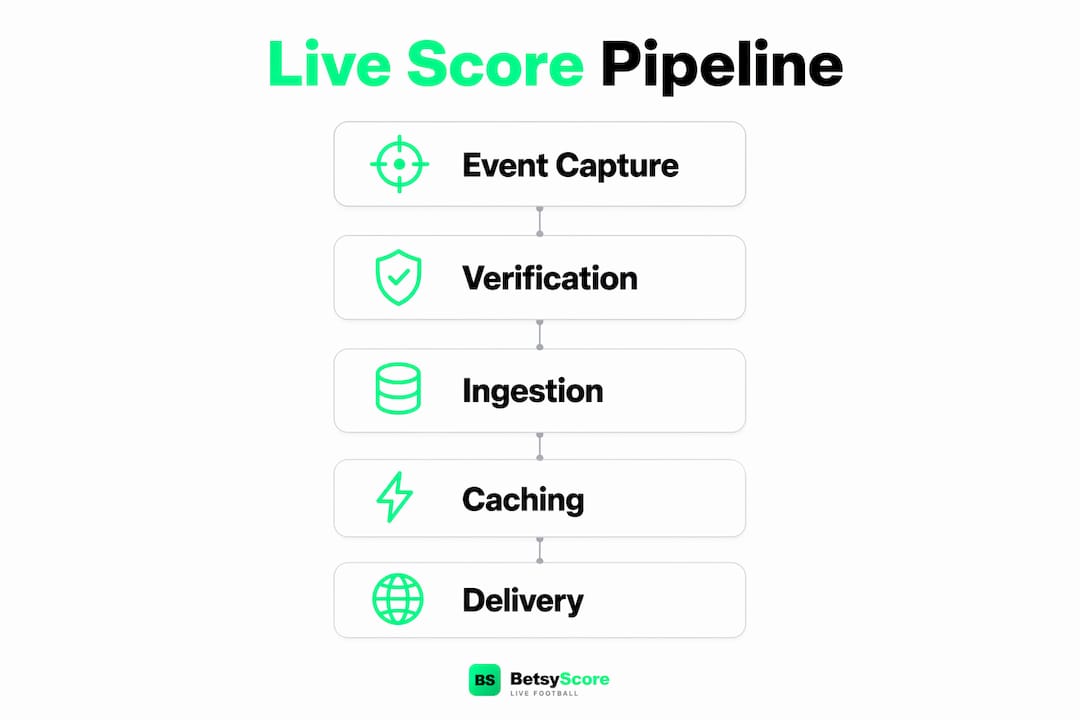
Live scoring systems move data through five distinct stages before a score appears on your device. Each stage has a specific job, and a failure at any point creates the lag or error fans occasionally notice.
-
Event capture. Trained operators at the stadium log match events in real time using dedicated input tools. Official match officials, scouts, and automated player-tracking systems all feed data into the pipeline simultaneously. This redundancy is intentional.
-
Verification. A verification engine cross-checks inputs from multiple sources. If two feeds agree that a goal was scored at minute 67, the event passes. If they conflict, the system delays the update or flags it for manual review.
-
Backend ingestion. Verified events enter a message queue and update the central match state. Technologies like streaming SQL materialize live views that refresh automatically as each event arrives, eliminating the need for repeated polling.
-
Caching. The updated match state is written to a Redis cache keyed by match ID. This means thousands of simultaneous requests hit the cache rather than the database, keeping the origin server stable under heavy load.
-
Client delivery. The final update is pushed to fans via WebSockets or Server-Sent Events. Polling-based systems can introduce up to 15 seconds of latency. Event-driven architectures with streaming SQL achieve millisecond-level updates instead.
Pro Tip: If a score on your screen seems frozen, your connection may have dropped from the live stream and fallen back to a polling cycle. Refreshing the page forces a reconnection to the event stream.
How do live score systems ensure accuracy in real time?

Accuracy is the hardest problem in live scoring, not speed. Speed is a solved engineering challenge. Accuracy requires judgment.
Top live score platforms use multiple simultaneous data sources and high-quality verification engines to prevent incorrect scores from reaching fans. When two sources disagree on an event, the system does not guess. It delays the update or flags it for manual review rather than risk publishing wrong information.
The verification engine compares timestamps, match context, and event sequences. A goal reported at minute 89 with no prior shot on target in the feed is a candidate for review. A substitution logged before the match clock reaches 45 minutes raises a similar flag.
“Systems delay updates or flag them for manual review when sources disagree, prioritizing accuracy over raw speed.”
This tradeoff explains the occasional visible lag fans notice on live score pages. A two-second delay on a goal is not a system failure. It is the verification engine doing its job. The alternative, publishing an unverified score, creates the kind of error that damages fan trust permanently.
- Multiple source feeds reduce the chance that a single operator error reaches the output.
- Timestamp cross-referencing catches events logged out of sequence.
- Match context checks flag events that contradict the known game state.
- Manual review queues handle conflicts that automated logic cannot resolve.
- Delayed publishing is the default safe behavior when confidence is below threshold.
What challenges do live score platforms face at scale?
The hardest scaling problem in live scoring is called the “fan-out” problem. A single goal event must be delivered to millions of concurrent fans within one to two seconds. That is not a simple broadcast. It is a precision distribution challenge.
Redis pub/sub channels keyed by match ID solve the core fan-out problem. When a goal is confirmed, the backend publishes one message to the match channel. Every subscriber, meaning every connected fan, receives it simultaneously without the server processing individual requests. That architecture separates message production from message consumption cleanly.
Content delivery networks (CDNs) handle the remaining load. CDNs cache score page loads with a short time-to-live, often around five seconds, so the vast majority of requests never reach the origin server at all. During a Champions League final, this caching layer is the difference between a stable platform and a crashed one.
The choice of delivery protocol also matters at scale. SSE uses standard HTTP and works well through proxies and firewalls, making it the preferred protocol for live score streams in many modern systems. WebSockets offer bidirectional communication but add complexity to load balancing and proxy configuration.
| Protocol | Best for | Key advantage | Key limitation |
|---|---|---|---|
| Server-Sent Events (SSE) | Live score streams | Simple HTTP, auto-reconnect | One-way only |
| WebSockets | Chat, interactive apps | Bidirectional | Complex load balancing |
| Long polling | Restricted networks | Works behind firewalls | Higher latency |
Pro Tip: Fans on corporate or restricted networks may notice slower updates. Those environments often block WebSocket connections, forcing the platform to fall back to long polling, which adds noticeable delay.
How do fans read and use live score data effectively?
Live score pages act as summary tools that support match understanding rather than replace watching the game. A fan who cannot watch a Serie A or La Liga match live can still follow the shape of the contest through the data on screen.
The core elements on any live score page each carry specific meaning:
- Scoreline and match clock. The most basic output. The clock tells you how much time remains for a comeback or a defensive hold.
- Event feed. Goals, yellow and red cards, and substitutions logged in chronological order. This feed is the narrative of the match.
- Team stats. Possession percentage, shots on target, and corners give context that the scoreline alone cannot provide.
- Expected goals (xG). An estimate of shot quality based on location, angle, and game situation. xG functions as guidance rather than absolute proof of which team deserved to win.
- Momentum indicators. Some platforms cluster events within three to five minute windows to show which team is pressing. Multiple corners or fouls in a short interval can predict a performance shift before a goal actually occurs.
The most common misconception fans hold is that a high xG score guarantees a result. It does not. xG measures opportunity quality, not outcome. A team can generate an xG of 2.4 and still lose 1-0 if their finishing is poor and the opponent scores from their only shot. Reading xG alongside the event feed and possession stats gives a far more accurate picture of the match.
Betsyscore presents these metrics together on its live match pages, pairing the scoreline with a momentum read that updates minute by minute so fans can see which side is controlling the game in real time.
Key Takeaways
Live scores work because event-driven architectures, Redis caching, and SSE streaming combine to capture, verify, and deliver match data to millions of fans in milliseconds.
| Point | Details |
|---|---|
| Five-stage pipeline | Event capture, verification, ingestion, caching, and delivery each play a distinct role. |
| Accuracy over speed | Verification engines delay or flag conflicting data rather than publish incorrect scores. |
| Fan-out solved by Redis | Redis pub/sub channels distribute a single update to millions simultaneously without overloading servers. |
| SSE preferred for scores | Server-Sent Events handle live score delivery better than WebSockets due to simpler load balancing. |
| xG is context, not verdict | Expected goals measures shot quality and works best when read alongside possession and event data. |
Live scores have gotten faster, but the hard part is still accuracy
The engineering community has largely solved the speed problem in live scoring. Event-driven pipelines and streaming SQL can push a goal notification to your phone within seconds of the ball crossing the line. What I find genuinely underappreciated is how much invisible work goes into making sure that notification is correct.
I have watched platforms publish incorrect scores during high-traffic matches, usually because a single operator error slipped through a verification layer that was under load. The damage to fan trust is immediate and disproportionate. Fans remember a wrong score far longer than they notice a two-second delay on a correct one.
The next meaningful shift in live scoring will not come from faster delivery. It will come from smarter event interpretation. Streaming databases that apply SQL logic to live event sequences can already detect momentum shifts before they produce goals. AI-driven systems that weight recent form, head-to-head records, and in-match xG together are moving from prediction tools into live commentary layers. Betsyscore already applies this approach with its AI match predictions, building win-probability percentages from expected goals and real-time match data.
The fan experience is also changing. Static scoreboards are giving way to interactive feeds where event clustering shows pressure building in real time. Fans who understand what they are reading, not just the score but the xG, the momentum window, and the substitution timing, get substantially more from a live score page than fans who only watch the number change.
The platforms that will lead this space are the ones that treat accuracy and interpretability as first-order problems, not afterthoughts to speed.
— Aria
Betsyscore brings live football data together in one place
Fans who want the full picture of a match in real time need more than a scoreline. They need verified data, fast delivery, and context that makes the numbers meaningful.
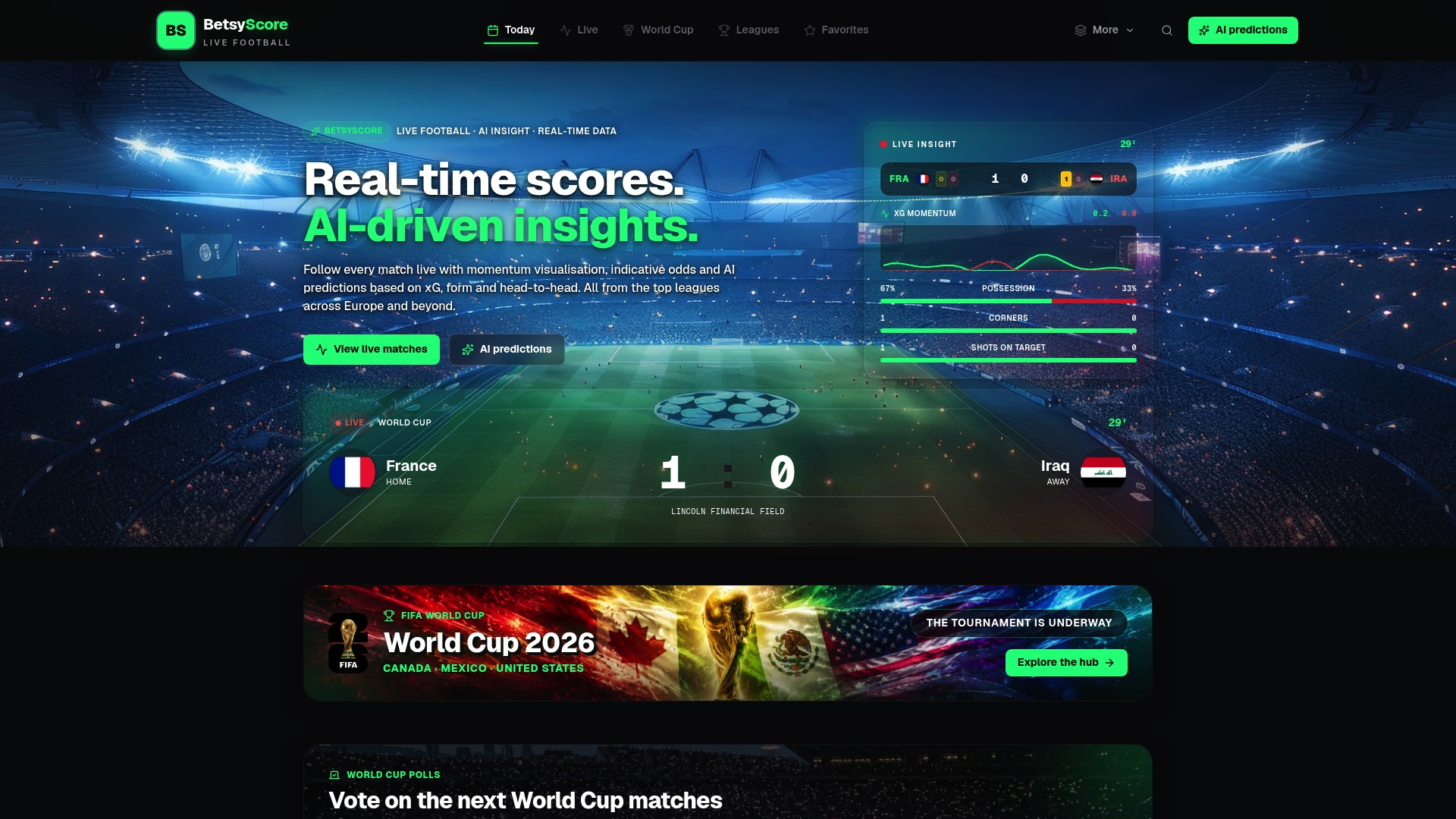
Betsyscore delivers live football scores that refresh every few seconds across the Premier League, La Liga, Bundesliga, Serie A, the Champions League, the FIFA World Cup 2026, and more than 200 competitions worldwide. Alongside the live score, Betsyscore’s AI prediction engine calculates win-probability percentages built from expected goals, recent form, and head-to-head records. A momentum indicator updates minute by minute to show which side is controlling the match. Whether you are tracking a World Cup 2026 group stage result or following a midweek Serie A fixture, Betsyscore gives you the data to follow every match with confidence.
FAQ
What is live scoring in football?
Live scoring is the real-time delivery of match events, including goals, cards, and substitutions, to fans’ devices as they happen. The process involves event capture at the stadium, verification across multiple data feeds, and streaming delivery via protocols like SSE or WebSockets.
Why do live scores sometimes show a delay?
Delays occur when verification engines detect conflicting data from multiple sources and hold the update for review. This is a deliberate accuracy measure, not a technical failure.
What is the difference between WebSockets and SSE for live scores?
SSE uses standard HTTP, supports automatic reconnection, and is simpler to load balance, making it the preferred choice for live score delivery. WebSockets offer bidirectional communication but add complexity that live score streams do not require.
What does xG mean on a live score page?
xG, or expected goals, is a measure of shot quality based on location and game context. It functions as guidance about which team created better chances, not as a definitive indicator of who deserved to win.
How do live score platforms handle millions of users at once?
Platforms use Redis pub/sub channels to distribute a single match update to all subscribers simultaneously, combined with CDN caching to absorb the majority of page load requests without hitting the origin server.