Football Pitch Dimensions and Markings Explained
The Laws of the Game set exact measurements for every line on a soccer field: the goal area extends 5.5 m (6 yd) from each post, the penalty area extends 16.5 m (18 yd), the penalty mark sits 11 m (12 yd) from the goal center, and the centre circle has a 9.15 m (10 yd) radius. Line width cannot exceed 12 cm (5 in). FIFA’s recommended pitch size for top-level play is 105 m × 68 m (115 yd × 74 yd), though IFAB’s Law 1 permits a range rather than a single fixed size.
One rule underpins everything else: a line is part of the area it encloses, not a boundary drawn around it. When you measure a pitch, you measure from the outside edge of the paint, because the goalkeeper’s foot on the penalty area line is still inside the box, and a ball resting on the goal line is still in play.
Before marking anything, confirm the rectangle is square by checking both diagonals, then lay out the halfway line and centre mark first since every other measurement radiates from that reference point.
| Marking | Metric | Imperial |
|---|---|---|
| Goal (inside posts) | 7.32 m wide × 2.44 m high | 8 yd × 8 ft |
| Goal area | 5.5 m from post | 6 yd |
| Penalty area | 16.5 m from post | 18 yd |
| Penalty mark | 11 m from goal center | 12 yd |
| Centre circle radius | 9.15 m | 10 yd |
| Max line width | 12 cm | 5 in |
| FIFA recommended pitch | 105 m × 68 m | 115 yd × 74 yd |
- Start with the centre mark and halfway line.
- Square the rectangle before marking any box.
- Measure every distance from the outside edge of the line, never the middle.
Key Takeaways
Precise pitch markings work because they translate fixed legal distances into visible lines that referees, players, and grounds crews can all measure and trust identically.
| Point | Details |
|---|---|
| Lines belong to the area | Measurements are taken from the outside edge of a painted line, not its center. |
| Core measurements are fixed | Goal area 5.5 m, penalty area 16.5 m, penalty mark 11 m, centre circle 9.15 m. |
| Pitch size has a range, not one number | Non-international pitches run 90 to 120 m long; FIFA recommends 105 m × 68 m. |
| Line width is capped, not fixed | Maximum 12 cm, with 5 to 6 cm common in professional practice. |
| Youth pitches scale down | Formats like 5v5, 7v7, and 9v9 use proportionally smaller pitches and goals. |
Table of Contents
- Football Pitch Dimensions and Markings Explained: The Basics of Law 1
- Full-Size Pitch Dimensions: Permitted Ranges and the FIFA Standard
- Goals and the Goal Area: Dimensions Behind the Six-Yard Box
- Penalty Area, Penalty Mark and the Arc: How the ‘D’ Is Measured
- Halfway Line, Centre Mark and Centre Circle: Kickoff and Offside Rules
- Corner Arcs and Corner Flags: Measurements and Placement
- Line Width, Color and Marking Materials
- What Football Pitch Markings Mean in Play
- Youth and Small-Sided Pitch Sizes by Age Group
- Pitch Surroundings, Safety Equipment and Goal Anchoring
- Why Pitch Sizes Vary Across Competitions
- How to Mark a Pitch Step by Step
- Author Note: Why Precise Marking Matters
- Sources
- FAQ
Football Pitch Dimensions and Markings Explained: The Basics of Law 1
Every soccer field has a shared vocabulary. The touchlines are the two long boundary lines on either side of the field. The goal lines are the shorter lines at each end, running through the goals themselves. The halfway line splits the field into two equal halves, and the centre mark sits at its midpoint, marking where kickoffs begin.
The field of play must be rectangular, and IFAB’s Law 1 states plainly that lines belong to the areas they enclose. That single sentence resolves a huge share of marginal calls: a ball that has any part touching the goal line has not gone out, and a defender standing with a boot on the penalty area’s edge is still, technically, inside the box.
Law 1 also limits what can appear on the field. Only the lines it specifies are permitted: touchlines, goal lines, halfway line, centre circle, penalty areas, goal areas, corner arcs, and the penalty arc. Anything else, including lines for other sports painted on a shared surface, must be a clearly different color so players and officials never confuse them.
- Touchline: the long side boundary.
- Goal line: the short end boundary, running through the goal.
- Halfway line: divides the pitch into two equal halves.
- Centre mark: the exact midpoint, used for kickoffs.
- Only Law 1 markings belong on the field of play.
Full-Size Pitch Dimensions: Permitted Ranges and the FIFA Standard
Soccer field dimensions aren’t fixed to one number. Law 1 sets a permitted range, and the range tightens for international fixtures.
For non-international matches, the touchline (length) must run between 90 m and 120 m (100 to 130 yd), and the goal line (width) between 45 m and 90 m (50 to 100 yd). International matches narrow that band considerably: length between 100 m and 110 m (110 to 120 yd), and width between 64 m and 75 m (70 to 80 yd).
FIFA’s own recommendation for professional and high-level competition sits at 105 m × 68 m (115 yd × 74 yd), a figure that falls comfortably within both ranges and has become the de facto benchmark most top-flight stadiums build toward, as noted in FIFA’s stadium guidelines.
| Match type | Length (touchline) | Width (goal line) |
|---|---|---|
| Non-international | 90–120 m (100–130 yd) | 45–90 m (50–100 yd) |
| International | 100–110 m (110–120 yd) | 64–75 m (70–80 yd) |
| FIFA recommended | 105 m (115 yd) | 68 m (74 yd) |
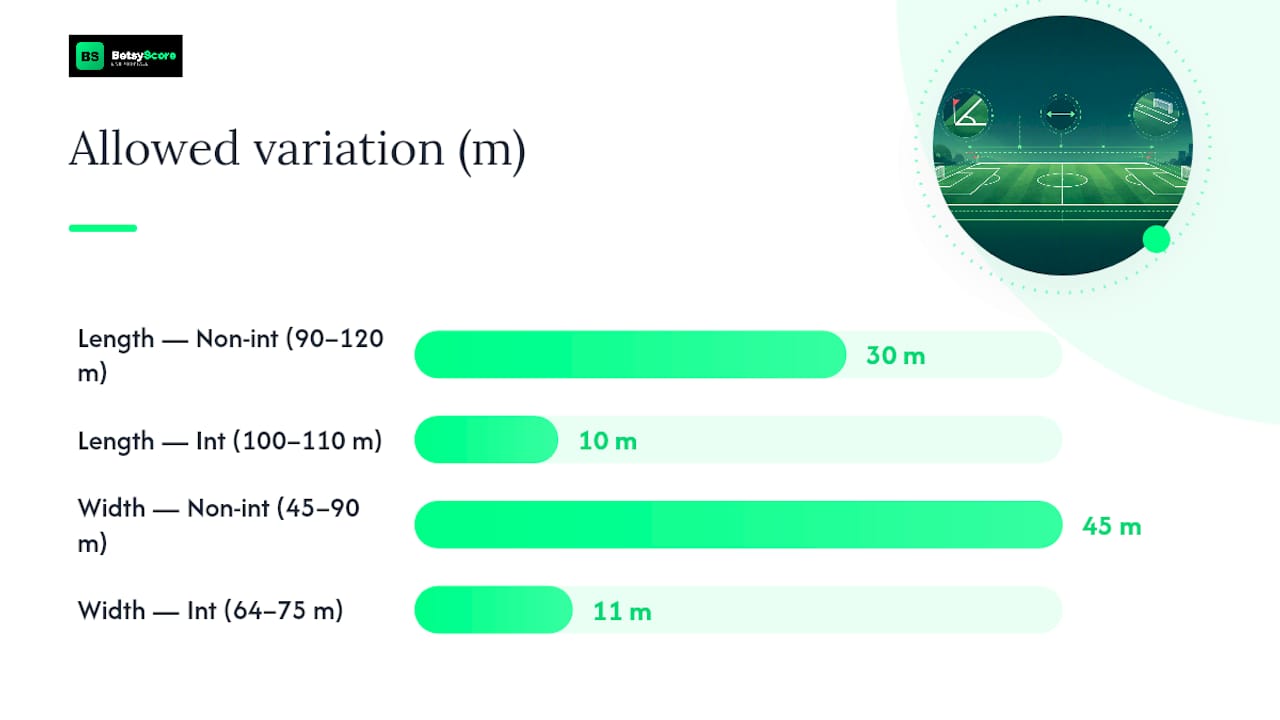
A competition organizer, whether that’s a national federation or a regional youth league, has the authority to fix a single size within the permitted range for every venue it controls. That’s why two professional stadiums in the same league can have slightly different pitch sizes and both be fully compliant.
Goals and the Goal Area: Dimensions Behind the Six-Yard Box
The goal frame itself is fixed, with no permitted range. The distance between the inside edges of the goalposts is 7.32 m (8 yd), and the underside of the crossbar sits 2.44 m (8 ft) above the ground. Both posts and the crossbar must be the same width, not exceeding 12 cm, and that width should match the width of the lines used elsewhere on the pitch.
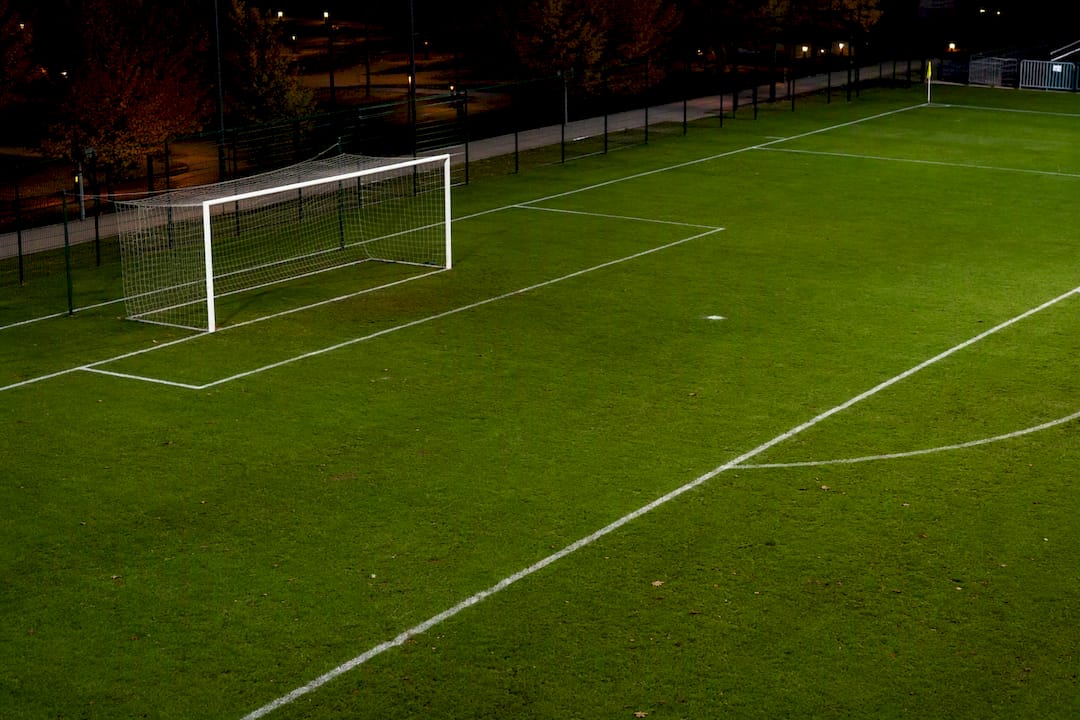
The goal area, universally known as the six-yard box, is drawn by measuring 5.5 m (6 yd) from the inside of each goalpost along the goal line, then extending those two points 5.5 m into the field of play and joining them with a line parallel to the goal line.
That small rectangle governs two everyday restarts. Every goal kick must be taken from any point within the goal area on the side nearer to where the ball went out. Any free kick awarded to the defending team inside the goal area can be taken from anywhere within that area, which is why goalkeepers often set up short passes from a corner of the box rather than dead center.
| Element | Measurement |
|---|---|
| Goal width (inside posts) | 7.32 m (8 yd) |
| Crossbar height | 2.44 m (8 ft) |
| Goal area from post | 5.5 m (6 yd) |
| Goal area depth into pitch | 5.5 m (6 yd) |
Penalty Area, Penalty Mark and the Arc: How the ‘D’ Is Measured
The penalty area, or eighteen-yard box, follows the same construction logic as the goal area but at triple the distance. Measure 16.5 m (18 yd) from the inside of each goalpost along the goal line, extend those points 16.5 m into the field, and connect them with a line running parallel to the goal line. The result is a rectangle roughly 40.3 m wide by 16.5 m deep on a standard pitch.
The penalty mark sits 11 m (12 yd) from the midpoint between the goalposts, measured perpendicular to the goal line, as confirmed in The FA’s Law 1 documentation. This is the single most consequential dot on the entire pitch.
The penalty arc, the “D” that gives the shape its nickname, is drawn using a radius of 9.15 m (10 yd) from the penalty mark itself, per IFAB’s field-of-play specification. Only the portion of that circle outside the penalty area is actually painted, since the rest falls inside the box already.
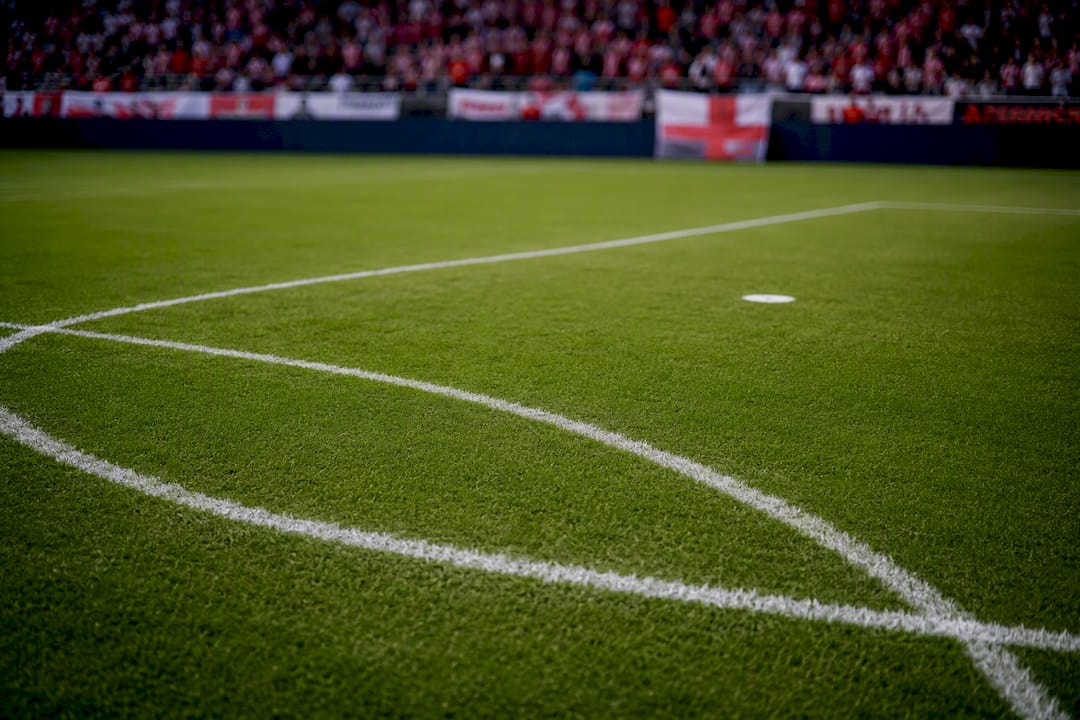
That arc exists for one reason: enforcing distance. During a penalty kick, every player other than the kicker and the goalkeeper must stay outside the penalty area, outside the arc, and behind the penalty mark until the ball is struck. Without the arc, referees would have no visual reference for the required 9.15 m gap.
| Element | Measurement |
|---|---|
| Penalty area from post | 16.5 m (18 yd) |
| Penalty area depth into pitch | 16.5 m (18 yd) |
| Penalty mark distance | 11 m (12 yd) |
| Penalty arc radius | 9.15 m (10 yd) |
Halfway Line, Centre Mark and Centre Circle: Kickoff and Offside Rules
The centre circle has a radius of 9.15 m (10 yd), drawn from the centre mark at the pitch’s exact midpoint. That figure isn’t arbitrary. It’s the same radius used for the penalty arc, which means groundskeepers marking a pitch only need to master one measurement technique to handle both features.
The circle’s job is straightforward: during a kickoff, every player from the team not taking the kick must stay outside the circle until the ball is in play. That 9.15 m buffer gives the kicking team a genuine window to build an attack without an opponent standing on top of the ball.
The halfway line carries a second, less obvious function tied to offside. A player cannot be judged offside anywhere in their own half of the field. The halfway line is the literal dividing point that referees and assistant referees use to apply that rule, which is why attackers dropping deep to collect the ball can never be caught offside no matter how far the last defender has pushed forward.
- Centre circle radius: 9.15 m (10 yd) from the centre mark.
- Kickoff requires all opposing players outside the circle.
- No offside offense can occur in a player’s own half.
- The ball must move forward at kickoff before any other player touches it.
Corner Arcs and Corner Flags: Measurements and Placement
Every corner of the pitch carries a quarter circle with a 1 m (1 yd) radius, drawn entirely inside the field of play from the corner point. It looks tiny compared to the penalty arc, but it serves the identical purpose: giving the referee a visible line for where the ball must be placed on a corner kick.
Flagposts stand at each of the four corners, a minimum of 1.5 m tall, with a non-pointed top for safety. Law 1 also permits, though doesn’t require, optional flagposts at each end of the halfway line, positioned at least 1 m outside the touchline.
- Corner arc radius: 1 m (1 yd), drawn inside the pitch.
- Flagpost height: minimum 1.5 m, no pointed tops.
- Optional flags at halfway line intersections, at least 1 m off the touchline.
- Corner arcs, like the centre circle, help referees enforce required distances during set pieces.
Line Width, Color and Marking Materials
Law 1 caps line width at 12 cm (5 in), but it sets no minimum, which surprises a lot of newcomers to groundskeeping. In practice, most professional crews paint lines to a width that stays clearly visible from the stands and on broadcast cameras without wasting paint or affecting ball roll.
Pro Tip: Keep every line on the pitch the same width, including the goal line where it meets the posts. A goal line thinner than the posts themselves creates an awkward visual mismatch that referees notice immediately during pre-match inspections.
Natural turf pitches typically use water-based line paint designed to withstand mowing and weather. Artificial turf allows for a wider range of approved marking materials, including inlaid lines baked into the surface itself. When a pitch is shared with another sport, IFAB requires that non-soccer lines use a distinctly different color so players never mistake one sport’s boundary for another’s.
- Maximum line width: 12 cm (5 in), no minimum specified.
- All lines on the pitch must share the same width.
- Common professional practice: 5 to 6 cm for visibility and durability.
- Shared-surface markings for other sports must use a clearly different color.
What Football Pitch Markings Mean in Play
Every line on the field triggers a specific outcome the moment the ball crosses it or a foul occurs near it. Understanding those connections turns an abstract diagram into a working knowledge of the game itself.
- Ball fully crosses the touchline: throw-in awarded to the opposing team, taken from the exact spot it exited.
- Ball fully crosses the goal line without a goal, last touched by an attacker: goal kick, taken from anywhere in the goal area.
- Ball fully crosses the goal line without a goal, last touched by a defender: corner kick, taken from the corner arc on that side.
- Ball fully crosses the goal line between the posts and under the bar: goal, provided no other offense occurred.
- A defending foul inside the penalty area: penalty kick, taken from the penalty mark.
The phrase “fully crosses” matters as much as any measurement in this guide. A ball resting on the goal line, even by a few centimeters, has not gone out and a goal has not been scored unless the whole ball has passed beyond the outer edge of the line.
- A goalkeeper handling the ball outside the penalty area is treated as an outfield player and can be sent off for a professional foul.
- A foul by the defending team just outside the penalty area produces a direct free kick, not a penalty, even by inches.
- Offside can never be called from a throw-in.
Youth and Small-Sided Pitch Sizes by Age Group
Full-size dimensions don’t belong on a field of eight-year-olds, and most national associations publish age-scaled guidance for exactly that reason. The figures below reflect common practice across youth soccer programs, though local competitions set their own binding rules.
| Age group / format | Typical pitch size |
|---|---|
| U7/U8 (5v5) | Around 27 m × 18 m |
| U9/U10 (7v7) | Around 64 m × 45 m |
| U11/U12 (9v9) | Around 64 m × 45 m |
| Older youth (11v11, youth) | Scaled toward 90 × 45 m minimum |
| U18/senior | Full Law 1 range, 90–120 × 45–90 m |
Small-sided formats scale the goal and penalty areas down proportionally too. A 7v7 pitch typically uses smaller goals, often around 4 m wide, paired with a shrunk penalty area that keeps the same visual relationship to the goal as a full-size pitch. Nine-a-side setups sit between the two, often using regulation-height goals at reduced width.
Treat every figure in this table as practical guidance rather than binding law. Your regional federation or league, whether that’s a school district association or a national youth body, publishes the official sizes that actually govern your competition, and those numbers can vary by region even within the same age bracket.
Pitch Surroundings, Safety Equipment and Goal Anchoring
A compliant pitch doesn’t end at the touchline. FIFA’s stadium guidelines recommend a minimum run-off distance of 2 m beyond every boundary line at a bare minimum, with larger stadiums pushing that clearance to 4 or 5 m before any advertising boards begin, protecting players who chase a ball at full speed near the edge of play.
Team benches sit well clear of the action, typically 5 to 8 m back from the touchline, positioned so substitutes and coaching staff have a clear sightline without encroaching on the technical area. Warm-up zones behind each goal, often sized around 3 m × 30 m for a small group of players, keep substitutes moving without interfering with goal kicks or corner routines.
Goal anchoring deserves more attention than it gets. Unsecured goals are a recurring cause of serious injury when they tip forward, so every goal frame needs to be fixed to the ground regardless of whether it’s a permanent installation or a portable unit brought in for a youth match.
Pro Tip: Walk the perimeter before kickoff and check that every goal is anchored, every board is clear of the run-off zone, and emergency access gates aren’t blocked by equipment or spectators.
- A minimum run-off of several meters beyond all boundary lines is recommended, with larger stadiums providing more clearance for player safety.
- Benches are positioned several meters back from the touchline to provide clear sightlines and maintain safety.
- Warm-up areas: roughly 3 m × 30 m behind each goal.
- Goals must always be anchored, portable or permanent.
Why Pitch Sizes Vary Across Competitions
There’s no single mandated soccer field size, and that’s a deliberate design choice rather than an oversight. Allowing a range lets the sport adapt to venues ranging from a cramped municipal stadium to a sprawling modern arena, while keeping every match within bounds that preserve fair, recognizable play.
Size differences carry real tactical weight. A wider pitch opens space for wingers and stretches a defense horizontally, while a narrower one compresses play and rewards teams built around pressing and quick transitions. Managers who study an opponent’s home ground dimensions before a trip aren’t being paranoid. They’re accounting for a variable that genuinely shifts how a match unfolds.
Pro Tip: If you’re comparing tactical setups across leagues, check listed stadium dimensions first. A team that dominates on a wide pitch can look completely different on a narrower one just two matchdays later.
Stadium architects also weigh broadcast sightlines, drainage, and turf maintenance costs when settling on a final size within the permitted range, which is part of why so many new builds converge on FIFA’s 105 m × 68 m recommendation rather than experimenting elsewhere in the band.
How to Mark a Pitch Step by Step
Laying out a compliant pitch is a sequence, not a scramble. Skip a step and every downstream measurement compounds the error.
- Establish the halfway line and centre mark first, since every other measurement references this line.
- Square the rectangle by measuring both diagonals and adjusting corners until they match exactly.
- Mark the touchlines and goal lines at your chosen dimension within the permitted Law 1 range.
- Measure the goal area 5.5 m from each post and 5.5 m into the field.
- Measure the penalty area 16.5 m from each post and 16.5 m into the field.
- Place the penalty mark 11 m from the goal center, then use a radius rope from that point to draw the penalty arc at 9.15 m.
- Use the same radius rope from the centre mark to draw the centre circle at 9.15 m.
- Mark the four corner arcs at a 1 m radius and set flagposts.
Grounds crews rely on a short list of tools for this: a long measuring tape or surveyor’s wheel, marker paint or chalk, stakes for reference points, and a radius rope or string for the arcs and circles.
Pro Tip: Always measure from the outside edge of where the line will be painted, not the centerline of the tape. Forgetting to account for paint width is the single most common error that pushes a finished pitch out of compliance.
Before match day, walk every line with a tape measure one final time and confirm the diagonals still match. Paint shifts slightly as it dries, and a small drift compounds fast across a 105 m pitch.
Author Note: Why Precise Marking Matters
A few centimeters of paint decide more than people assume. A penalty arc drawn short by half a meter lets a defender creep closer than the Laws allow. A goal line painted at the wrong width makes a photo finish at the line genuinely harder for an official to call. None of that is theoretical. It shows up in real matches, at every level, whenever measurement discipline slips.
I’d encourage anyone marking a pitch, whether for a Sunday league fixture or a professional venue, to treat this guide as a working reference and still confirm final numbers against your competition’s own rulebook. Laws get amended, competitions add local variations, and the governing document always wins.
Sources
For the full legal text, consult IFAB’s Law 1 on the field of play, the definitive rulebook every soccer competition worldwide is built on. The FA’s Law 1 documentation offers the same standard translated for English competitions specifically. FIFA’s stadium technical guidelines cover surrounding areas, run-off distances, and stadium design beyond the pitch itself.
For live match context once you understand the field a game is played on, Betsyscore tracks scores, lineups, and momentum shifts across more than 200 competitions in real time.
- Law 1 - The field of play (The FA)
- Law 1 - The field of play | IFAB
- 5.3 Pitch dimensions and surrounding areas | FIFA Publications
- Footballrules
FAQ
What do all the markings on a football pitch mean?
Each marking defines a functional zone: the goal area governs goal kicks, the penalty area governs penalty kicks and goalkeeper handling, the centre circle enforces kickoff distance, and corner arcs mark where corner kicks are taken.
What are the dimensions and markings of a football pitch?
Key figures include a goal area of 5.5 m (6 yd), a penalty area of 16.5 m (18 yd), a penalty mark 11 m (12 yd) from goal center, a centre circle radius of 9.15 m (10 yd), and a maximum line width of 12 cm (5 in), all within a pitch typically sized at FIFA’s recommended 105 m × 68 m.
Why is there no standard football pitch size?
IFAB’s Law 1 sets a permitted range instead of one fixed size so the sport can be played across stadiums of different shapes and constraints, while FIFA’s 105 m × 68 m figure serves as the common benchmark most professional venues target.
Are college and NFL fields the same size?
No. Those are gridiron football fields governed by entirely separate rulebooks with fixed dimensions, and they share no measurement standards with soccer pitches under IFAB’s Laws of the Game.