48 Teams, 12 Groups: FIFA's World Cup 2026 Draw and BetsyScore Odds

The 2026 draw sorted 48 teams into 12 groups of four, using four seeding pots with the three host nations locked into fixed positions and six pot-4 slots held as playoff placeholders. FIFA’s draw management computer enforced confederation limits in real time, and the ceremony ran on December 5, 2025, at the John F. Kennedy Center in Washington, D.C., with stadium assignments and kickoff times following 24 hours later.
TL;DR:
- The draw process enforced strict confederation limits, resulting in four groups with two European teams and one group with a third team’s placement influenced by playoff outcomes.
- The fixed-position grid method shortened the ceremony and determined each team’s exact placement inside their group, based on a prepublished allocation grid.
- Pot 4 included six playoff placeholders, which were only replaced by confirmed teams after the inter-confederation playoffs concluded in March 2026, affecting group composition.
- Match scheduling and stadium assignments were finalized only 24 hours after the draw, with host nation venues pre-assigned before the ceremony.
- AI predictions now adjust win probabilities and expected goals instantly once group draws are confirmed, reflecting the impact of group composition on team prospects.
Table of Contents
- Pots and Seeding: Who Landed in Pots 1 Through 4
- The Draw Sequence: Hosts First, Then Pots 2 Through 4
- Confederation Rules and the Computer That Enforces Them
- How Group Slots Set Up the Knockout Bracket
- What the Draw Reveals Now vs. What Comes Later
- Reading the “Random” Placements Like an Insider
- What the Draw Does to Win Probabilities and Group Odds
- What Stood Out Most About This Draw
- Track Every Group Shift With BetsyScore
- Sources
- FAQ
Pots and Seeding: Who Landed in Pots 1 Through 4
Pot 1 held the three co-hosts, Mexico, Canada, and the United States, alongside the nine highest-ranked qualified teams by the FIFA ranking snapshot used for seeding. That combination determined the entire shape of the draw before a single ball dropped, because everything downstream depends on which teams anchor each group.
Pots 2 and 3 filled with the next two bands of ranked teams, twelve per pot, following the standard World Cup seeding logic that has governed World Cup qualifying tiers for decades. Pot 4 is where 2026 gets unusual: it carried six placeholder slots reserved for teams still fighting through inter-confederation playoffs.
- Pot 1: hosts plus the nine top-ranked qualified teams
- Pots 2 and 3: ranked qualifiers in descending order, twelve teams each
- Pot 4: six confirmed teams and six playoff placeholders, the identities of which were resolved only after the playoffs concluded in March 2026
Until those playoff results came in, six groups carried a genuine unknown. Fans knew the pot, the confederation rules that would apply to that slot, and nothing else.
The Draw Sequence: Hosts First, Then Pots 2 Through 4
The ceremony followed a fixed order rather than a free-for-all, and that order is worth knowing if you want to follow next time without confusion.
- Mexico dropped into A1, Canada into B1, and the United States into D1, using colored balls that visually marked host status before the drawing even began.
- Officials emptied the rest of Pot 1, assigning each remaining team to the next open group in sequence.
- Pot 2 emptied completely, then Pot 3, then Pot 4, in that strict order.
- For every team outside Pot 1, the group letter came from the draw, but the position inside that group, second, third, or fourth, came from a prepublished allocation grid rather than a second round of ball-drawing.
That fixed-position grid is a genuine change from older World Cup draws, and it’s the detail that trips up fans watching for the first time. The official procedures spell out exactly which position each pot occupies inside a group, which shortens the ceremony considerably since there’s no second layer of suspense once a team’s group letter is known.
Confederation Rules and the Computer That Enforces Them
Every group needs at least one UEFA team and generally no more than one team from any other confederation. UEFA is the lone exception because Europe qualified so many nations that strict one-per-group parity was never realistic.

The practical result: four groups end up with two European sides instead of one, a direct consequence of Europe’s qualification volume rather than a random quirk. The official seeding rules lay out this exception explicitly, and it shapes nearly every group’s final composition.
Deadlocks happen when a legal slot runs out before a pot empties. Picture Pot 4 late in the process: two placeholder teams remain, both destined to come from confederations that already have two representatives in every group except one. Only one legal home exists. FIFA’s draw management computer tracks every constraint live and blocks any ball from dropping into a group that would break the rules, redirecting it to the next legal slot instead.
- No more than one team per confederation per group, except UEFA
- Every group holds at least one UEFA team
- Four groups carry two UEFA teams apiece
- The draw computer vetoes any pairing that would violate these limits before it’s finalized
How Group Slots Set Up the Knockout Bracket
The 12 groups don’t just decide who plays whom in the group stage. They also lock in which quadrant of the bracket a team enters for the Round of 32 and beyond, which means the draw is really deciding two tournaments at once: the groups and the road to the final.
FIFA built one extra layer of protection into that structure for 2026. Spain and Argentina were placed into opposite bracket pathways, and France and England received the same separation. If all four win their groups, none of them can meet before the semifinals.
- The bracket splits into quadrants tied directly to group letters
- Group winners and runners-up follow predetermined paths into the Round of 32
- The top-four separation only applies if those teams actually top their groups
- A team that finishes second can still run into a rival “protected” opponent much earlier
That protection is conditional, not guaranteed. Finish second in your group instead of first, and the whole shielded pathway disappears.
What the Draw Reveals Now vs. What Comes Later
The draw itself only settles group membership and the broad bracket pathway. Match-by-match scheduling, specific stadiums, and kickoff times were not part of the ceremony.
FIFA published the full venue and kickoff schedule 24 hours after the Final Draw, on December 6, 2025. Host-nation groups were the exception. Since Mexico, Canada, and the United States already had cities and stadiums tied to their group slots in advance, those venue details existed before the rest of the schedule dropped.
- Draw day settles group letters and bracket pathway only
- Full stadium and kickoff schedule arrived 24 hours later
- Host-nation matches were pre-assigned to specific venues before the ceremony
Reading the “Random” Placements Like an Insider
Some groups will look lopsided the moment the schedule locks in, and it’s tempting to write that off as pure luck. Often it isn’t. When a placement looks strange, check whether a confederation constraint or a pot-4 playoff resolution forced that outcome rather than a coin flip.
BBC’s draw analysis points out that deadlock scenarios tied to Pot 4 playoff slots can produce placements that look arbitrary but were actually the only legal option left on the board.
- Watch for groups with two UEFA teams, that’s the built-in exception, not an anomaly
- Note which pot-4 slots were still playoff placeholders when the draw happened
- A team landing in an unexpected group late in the ceremony often signals a forced legal placement, not chance
Pro Tip: If a group looks unusually top-heavy or unbalanced, check the pot-4 slot first. Playoff placeholders resolved months after the draw are the most common source of what looks like an uneven group.
What the Draw Does to Win Probabilities and Group Odds
A group’s composition changes a team’s realistic path to the knockout rounds instantly, and that shift shows up in the numbers before a ball is kicked. A heavy favorite drawn into a group with three lower-ranked sides carries a dramatically higher expected-goals output and group-stage win probability than the same team dropped into a genuinely balanced four-team group.
That gap is exactly what AI-driven predictions are built to quantify, translating a group draw into concrete numbers rather than gut feeling.
- AI win probability: recalculates instantly once group opponents are locked in, reflecting the new competitive picture
- Expected goals: shows whether a team’s attacking output should hold up against its specific group opponents
- Head-to-head history: matters more in a “group of death” where two evenly matched sides share a group
- Live momentum: tracks minute-by-minute shifts once matches actually kick off, useful for spotting an upset forming in real time
Group rankings and how tournament results move the global rankings both flow directly from the draw’s structure, so the numbers worth tracking start changing the moment the last ball drops.
What Stood Out Most About This Draw
The 2026 draw balanced fairness and spectacle better than skeptics expected, given how much more complex a 48-team, 12-group format is compared to the old 32-team system. The fixed-position grid trimmed ceremony time, but the draw management computer did the real work, quietly preventing dozens of potential deadlocks the audience never saw.
— Aria
Track Every Group Shift With BetsyScore
This platform is designed for moments when a draw result changes a team’s odds, allowing fans to see that shift immediately rather than waiting for a recap article. Matches tied to the tournament update frequently, with momentum tracking that shows which side controls a group match minute by minute.
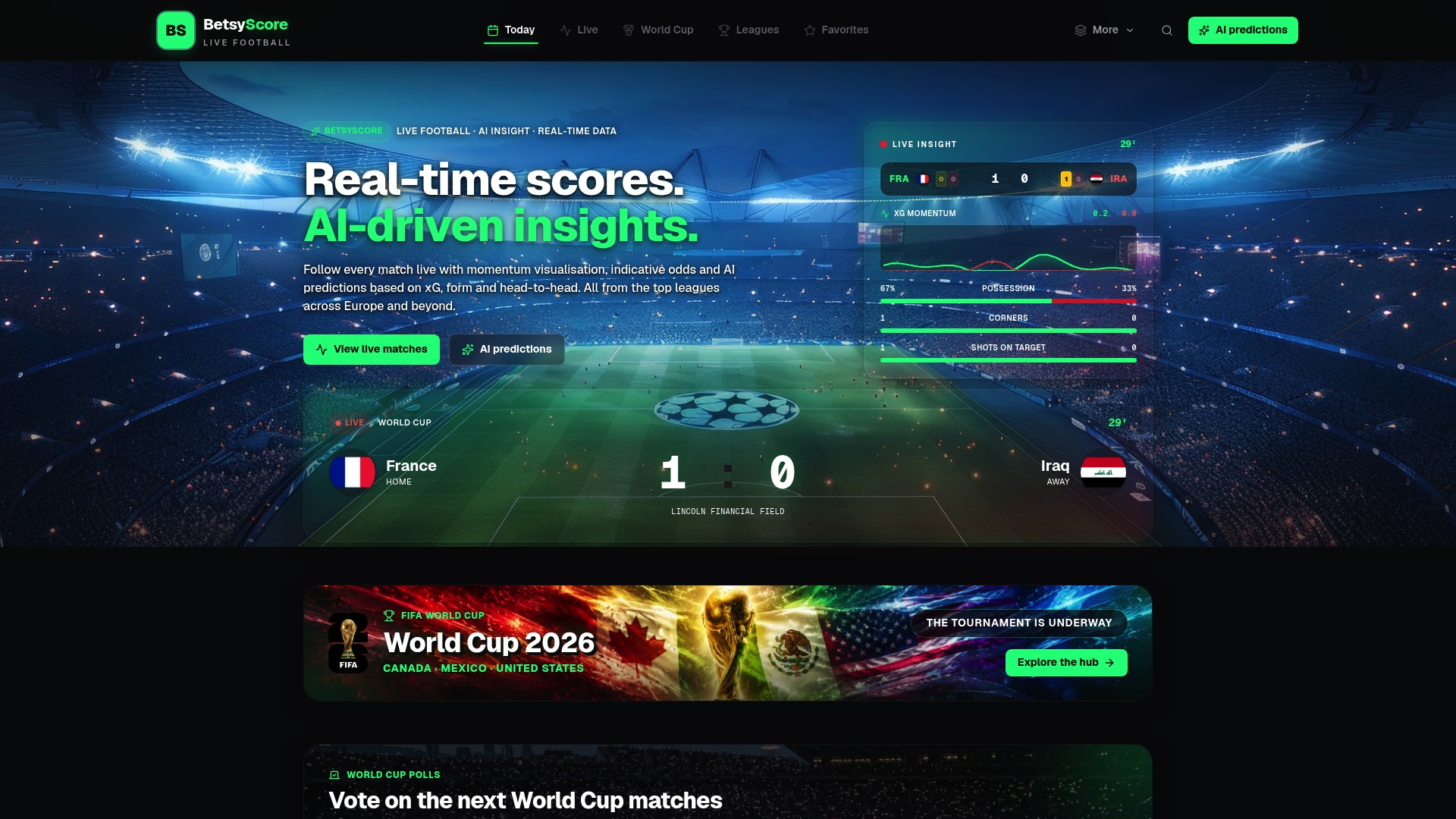
Head to BetsyScore Live for scores that refresh every few seconds across every group, or check AI Predictions to see how win probabilities move once fixtures and form data update. The World Cup 2026 hub keeps every group, standing, and prediction in one place, so you can follow your team’s path from the group stage straight through the bracket without hunting across a dozen sites.
Sources
- Draw Procedures for the FIFA World Cup 2026
- Procedures for the FIFA World Cup 2026 Final Draw revealed
- The World Cup draw is here - this is how it will work - BBC Sport
FAQ
How does the World Cup ticket draw relate to the group draw?
The group draw and ticket sales operate separately. The group draw determines which teams share a group and where those matches take place, while ticket allocation follows FIFA’s own sales windows tied to confirmed match schedules.
What does it mean if a team gets a tough draw?
A tough draw usually means a team landed in a group with one or more higher-ranked or historically strong opponents from the same pot tier, or ended up in one of the four groups carrying two UEFA sides. It raises the difficulty of advancing but doesn’t change the number of teams that move on from each group.
How does the World Cup bracket work after the group stage?
Group winners and runners-up advance into a Round of 32 bracket built from quadrants set during the draw, alongside the eight best third-placed teams determined by FIFA’s tie-breaker criteria. The top four ranked teams were placed in separate quadrants, so they can only meet in the semifinals or final if each wins its group.
What exactly is the World Cup draw deciding?
The draw decides which 12 groups of four teams will play each other in the group stage and which bracket pathway each team follows if it advances. It does not set specific match dates, kickoff times, or stadiums, those details followed 24 hours after the ceremony.
Why were six teams still unknown at the time of the draw?
Six slots in Pot 4 were reserved for teams still competing in inter-confederation playoffs when the draw took place. Those placeholder slots were filled with confirmed teams only after the playoffs concluded in March 2026.