What Is a Hat Trick in Football: Definition, Types & Records
A hat trick in football is when one player scores three goals in a single match. The goals do not need to be consecutive, and they can come at any point during regulation time or extra time. Goals scored in a penalty shootout are excluded from the tally.
Three quick points to keep in mind before going further:
- Any three goals by the same player in one match qualify, regardless of order or method.
- Penalty kicks taken during the run of play count the same as any other goal.
- Types vary: a natural hat trick and a perfect hat trick each carry additional criteria explained below.
Table of Contents
- What is a hat trick in football, exactly? Types and variations
- Where did the phrase “hat trick” come from?
- Which goals actually count toward a hat trick?
- Famous hat tricks and records worth knowing
- How rare are hat tricks in professional football?
- Related terms fans should know
- Key Takeaways
- Why hat tricks reveal more than just a scoreline
- Useful sources for further reading
- FAQ
What is a hat trick in football, exactly? Types and variations
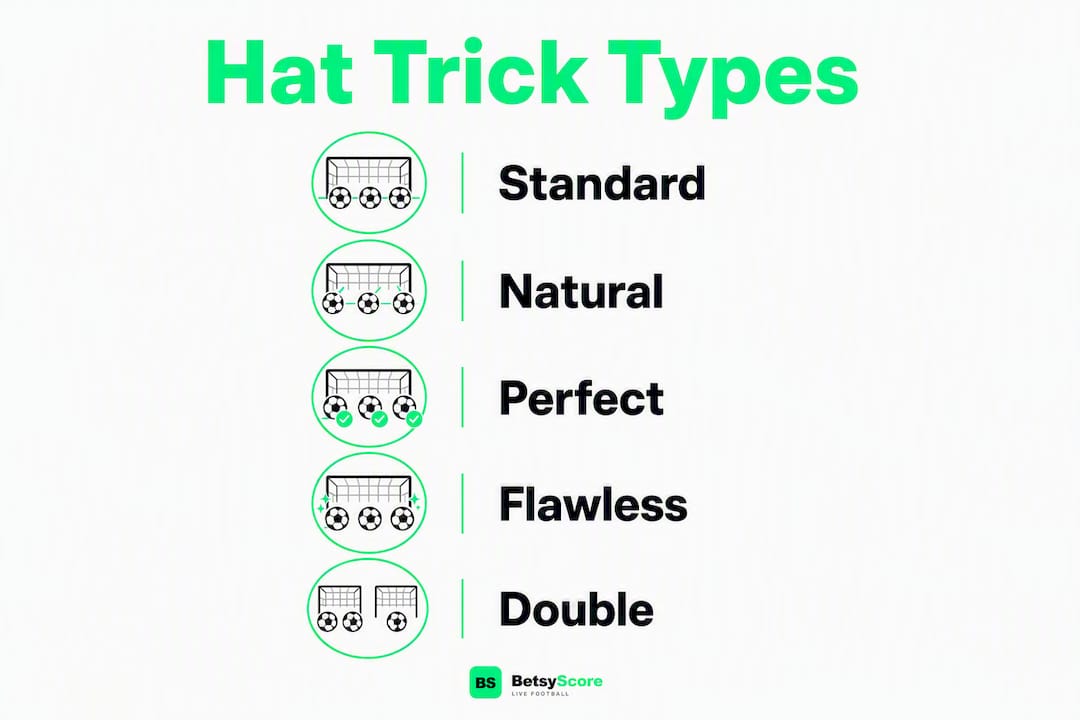
Not all hat tricks are equal in the eyes of commentators and record-keepers. The standard version simply requires three goals in one match. Beyond that, three recognized variations carry specific criteria.
A natural hat trick means three consecutive goals from the same player with no other scorer in between. Purists treat this as the more demanding version because it reflects sustained attacking dominance during a continuous run of play rather than three scattered goals across 90 minutes.

A perfect hat trick requires one goal with the right foot, one with the left foot, and one with a header. The combination demands technical versatility that even elite forwards rarely demonstrate in a single match, which makes it genuinely uncommon at the top level.
A flawless hat trick is a less standardized term sometimes applied when a player scores three goals and their team wins 3–0, meaning every goal was decisive. Usage varies by broadcaster and region.
A double hat trick refers to six goals by one player in a single match, a feat confined almost entirely to lower-division or amateur football.
Pro Tip: When a commentator says a player is “on a hat trick,” it means that player has already scored twice and is one goal away. The phrase signals anticipation, not achievement.
Where did the phrase “hat trick” come from?
The term has nothing to do with football originally. It comes from cricket in the 1850s.
That cricket origin in the 1850s) established the phrase in British sporting vocabulary. The reward of a hat symbolized public recognition of an exceptional individual feat. Over the following decades, the term migrated into other sports as a shorthand for any three-part achievement by one person in one contest. Association football adopted it as the sport grew in popularity across England and then globally, and by the 20th century it was standard in match reports and broadcast commentary worldwide.
Which goals actually count toward a hat trick?
The general rule is straightforward, but a few edge cases come up regularly.
- Regulation and extra time: Goals scored in the 90 minutes plus any added extra time all count toward a player’s hat trick tally.
- Penalty kicks in open play: A penalty converted during the match counts the same as any other goal. There is no distinction in official records.
- Penalty shootouts: Shootout goals are excluded) from individual goal tallies entirely. A player who scores three times in a shootout has not scored a hat trick.
- Own goals: A goal credited as an own goal against the opposing team never counts for the player who last touched the ball. Own goals are recorded separately.
- Substitutes: A player who comes on as a substitute can score a hat trick during their time on the pitch. Conversely, a player substituted off keeps any goals scored before leaving, but goals scored after their exit by teammates do not affect their personal tally.
One practical example: if a match goes to extra time and a player scores twice in regulation and once in the 95th minute, that is a confirmed hat trick. The extra-time goal counts fully.
Famous hat tricks and records worth knowing
A handful of hat tricks stand out in the historical record for their context, timing, or the player involved.
Bert Patenaude, 1930 World Cup: The American forward is credited with the first hat trick in World Cup history, scored against Paraguay at the inaugural tournament in Uruguay.
Pelé, 1958 World Cup: Pelé scored a hat trick in the 1958 World Cup semifinal against France at age 17, making him the youngest player to score a World Cup hat trick. Guinness World Records also recognized Pelé as the footballer with the most hat tricks in official matches, with 92 recorded.
Lionel Messi, 2026 World Cup: Messi became the oldest player to score a World Cup hat trick at the 2026 tournament, adding another historic milestone to a career already defined by all-time scoring records.
Josef Bican, career record: According to RSSSF archives, Josef Bican scored 137 hat tricks in official matches for club and country between 1930 and 1957, the highest verified career total on record.
Fastest recorded hat trick: The fastest hat trick in recorded football history stands at 70 seconds, set in a Sunday league match. At the professional level, hat tricks completed within two to three minutes of each other remain extraordinarily rare.
After scoring a hat trick, players traditionally receive the match ball as a keepsake, often signed by teammates and staff. It is one of the sport’s most recognized individual honors.
How rare are hat tricks in professional football?
Scoring even one goal at the professional level is difficult. Three in a single match places a player in a statistical minority for that season.
Stat to know: Across World Cup history, hat tricks have been recorded occasionally throughout the tournament’s long existence.
Historical archives from RSSSF and FIFA confirm that elite players can accumulate multiple hat tricks) across long careers, but the feat remains uncommon within any single season. Even prolific scorers in the Premier League, La Liga, or Champions League typically register one hat trick per season at most, and many seasons pass without one at all.
| Competition | Notable hat-trick context |
|---|---|
| Premier League | Typically a handful per full season across all clubs |
| UEFA Champions League | Rare; multiple per season is exceptional |
| Career record (official matches) | Josef Bican: 137 (RSSSF) |
Betsyscore’s live match data and minute-by-minute momentum readings can show when a player is building toward a multi-goal performance. When expected goals accumulate rapidly and a player already has two goals, the momentum tracker reflects the elevated probability of a third.
Related terms fans should know
Football commentary uses several related terms that new fans encounter regularly.
- Brace: Two goals by the same player in one match. When a player scores a second goal, match reports describe it as a brace. A player with two goals is also described as being “on a hat trick.”
- Haul / poker: Four goals by one player in a single match. “Haul” is common in British English match reports; “poker” appears in Spanish-language commentary.
- Double hat trick: Six goals by one player in one match. Extremely rare at any professional level.
- Golden hat trick: An informal term sometimes used when a player scores three goals and wins the man-of-the-match award, though usage is inconsistent across broadcasters.
- Hat trick in other sports: Ice hockey uses the same term for three goals by one player in one game. Rugby uses it for three tries. The cricket origin means the phrase traveled across multiple sports, though the exact criteria differ by sport.
For the question of why it is called a hat trick, the short answer is the 19th-century cricket tradition of rewarding a bowler with a hat. The full origin story is covered in the history section above.
Key Takeaways
A hat trick in football means one player scoring three goals in a single match, with goals in regulation and extra time counting and penalty shootout goals excluded.
| Point | Details |
|---|---|
| Core definition | Three goals by one player in one match; goals need not be consecutive. |
| What counts | Regulation and extra time goals count; penalty shootout goals do not. |
| Natural vs. perfect | Natural: three consecutive goals; perfect: right foot, left foot, and header. |
| Historical origin | The phrase comes from 1850s cricket, when a hat was awarded for three consecutive wickets. |
| Rarity | Hat tricks have been recorded occasionally throughout the tournament’s long existence. |
Why hat tricks reveal more than just a scoreline
Hat tricks deserve more analytical attention than they typically receive in post-match coverage. Three goals in one match is not simply a volume achievement. It usually signals a specific combination of factors: a player in exceptional form, a defensive structure that failed to adjust, and a match context that allowed repeated high-quality chances.
What makes hat tricks worth tracking on a live platform is the momentum dimension. A player’s second goal in a match often triggers a visible shift in team shape and pressing intensity. Betsyscore’s momentum readings capture exactly that shift, showing which side is controlling territory and chance creation in real time. For fans watching a player approach a potential hat trick, that data adds a layer of context that a simple scoreline cannot.
Useful sources for further reading
- Hat-trick (association football) | Wikipedia): Comprehensive overview of the definition, types, rules, and historical records with RSSSF citations.
- What is a hat trick in football? | Britannica: Concise authoritative definition covering the perfect hat trick, natural hat trick, and World Cup milestones.
- List of footballers who achieved hat-trick records | Wikipedia: Full record tables including career hat-trick totals sourced from RSSSF and Guinness World Records.
- Football terms explained: Why is it called a hat-trick? | Goal.com: Explains the cricket origin, the match-ball tradition, and related commentary terms like “brace.”
- Football Records | Betsyscore: Historical scoring records, tournament leaderboards, and hat-trick-related milestones across major competitions.
- World Cup coverage | Betsyscore: Live and historical World Cup stats, including scoring records and tournament data.
FAQ
What does “hat trick” mean in football?
A hat trick means one player has scored three goals in a single match. The goals do not need to be consecutive and can be scored at any point during regulation time or extra time.
What is 4 goals in football called?
Four goals by one player in a single match is commonly called a haul. The term “poker” is also used, particularly in Spanish-language commentary.
What is a golden hat trick?
A golden hat trick is an informal term used by some commentators when a player scores three goals and is also named man of the match. The phrase has no standardized official definition and usage varies by broadcaster.
Why do they call it a hat trick?
The phrase originates from 1850s cricket, when H. H. Stephenson took three consecutive wickets and spectators collected money to buy him a hat as a reward. The term later spread to football and other sports.
What is a hat trick in the NFL?
The NFL does not use the term “hat trick” as an official statistical category. In American football, the phrase is occasionally used informally to describe three touchdowns by one player in a game, but it carries no standardized meaning in that sport.