Golden Boot Meaning in Football: Rules, Awards and Winners

The Golden Boot is the award given to the top goalscorer in a football competition or season. Across different competitions, the rules for deciding the winner vary in important ways.
- Primary metric: Goals scored in official tournament or season matches.
- Tiebreakers: At the FIFA World Cup, assists come first, then fewer minutes played. Domestic leagues often allow shared awards.
- Excluded goals: Penalty shootout goals do not count toward any official Golden Boot tally.
- Three main versions: The FIFA adidas Golden Boot (World Cup), the European Golden Shoe (cross-league, points-weighted), and domestic-league awards such as the Premier League Golden Boot.
- Notable holders: Kylian Mbappé won the adidas Golden Boot at FIFA World Cup 2026; Lionel Messi holds the record for European Golden Shoe wins with six.
Table of Contents
- How the Golden Boot is decided across competitions
- How the FIFA World Cup Golden Boot works
- How the European Golden Shoe works and why raw goals aren’t enough
- How domestic leagues award the Golden Boot
- The history of the Golden Boot: from Golden Shoe to Golden Boot
- Notable recent winners and what they receive
- How to follow a Golden Boot race live on Betsyscore
- Controversies and debates around the Golden Boot
- Key Takeaways
- Why the Golden Boot matters more than a simple goal count
- Authoritative sources for Golden Boot rules and winners
- FAQ
How the Golden Boot is decided across competitions
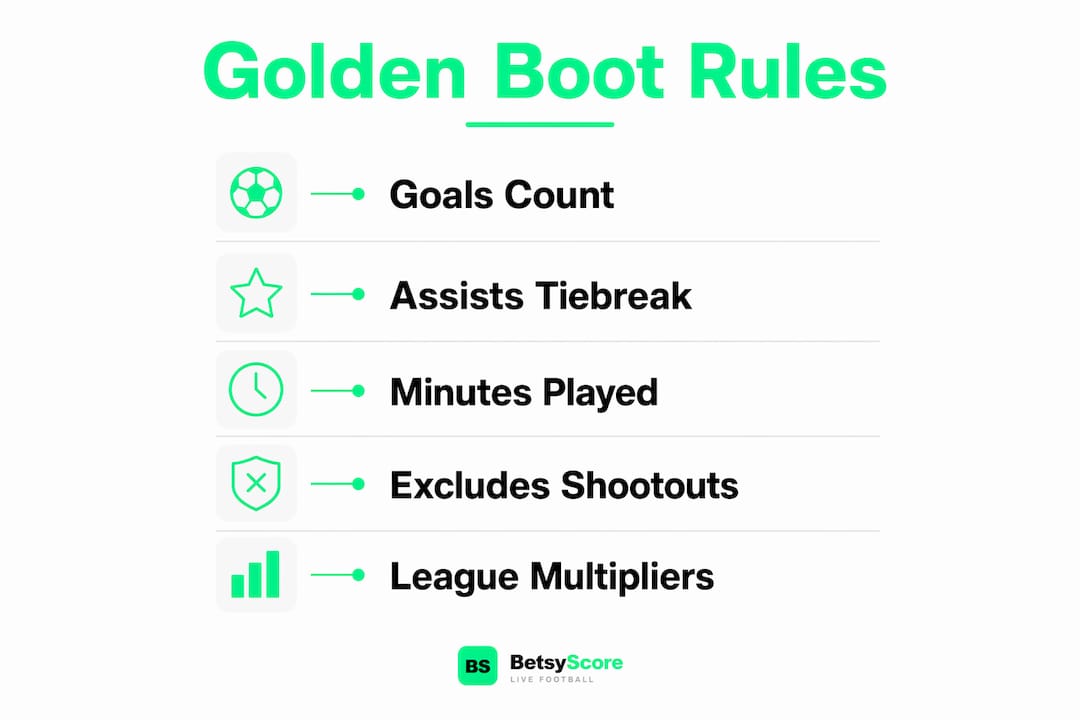
Goals are always the primary metric, but the rules for counting them and resolving ties differ by competition. The table below maps the three main formats.
| Format | Scope | Primary metric | Tiebreaker(s) | Frequency / Awarding body |
|---|---|---|---|---|
| Single tournament | One tournament (e.g., World Cup) | Goals in all matches | Assists, then fewer minutes played | Every 4 years / FIFA |
| Domestic season | One league season | League goals only | Shared award (most leagues) | Annual / domestic league |
| Cross-league (European) | All European top divisions | Points (goals × multiplier) | Higher multiplier league | Annual / European Sports Media |
Common tiebreaker approaches across competitions:
- Assists (World Cup: determined by the FIFA Technical Study Group)
- Fewer minutes played (rewards scoring efficiency)
- Shared award (Premier League and many domestic leagues)
- Points weighting (European Golden Shoe only)
Pro Tip: When following a tight Golden Boot race, check assists and minutes played alongside goals. In a World Cup, two players level on goals can be separated by a single assist or even by minutes on the pitch.
How the FIFA World Cup Golden Boot works
FIFA awards the adidas Golden Boot to the player with the most goals across all World Cup matches, from the group stage through the final. If two or more players finish level on goals, the tiebreakers apply in this exact order:
- Most assists (as determined by the FIFA Technical Study Group)
- Fewer total minutes played
That second tiebreaker rewards efficiency. A player who scores the same number of goals in less playing time ranks higher, which can matter enormously in a closely contested race.
Penalty shootout goals are explicitly excluded from the tally. A hat-trick in a shootout counts for nothing in the Golden Boot standings, a rule that surprises many casual fans who track goals informally.
How a tie would be resolved — example:
- Player A: 6 goals, 3 assists, 540 minutes played
- Player B: 6 goals, 3 assists, 510 minutes played
- Result: Player B wins by fewer minutes played.
Kylian Mbappé won the adidas Golden Boot at FIFA World Cup 2026 with the tournament’s highest goal total, the highest total in the tournament. FIFA confirmed him as the award winner, making it one of the standout individual achievements of the competition.
Pro Tip: Penalty shootout goals are the most common source of miscounts in casual Golden Boot tracking. Always cross-reference with the official FIFA leaderboard for an accurate tally.
How the European Golden Shoe works and why raw goals aren’t enough
The European Golden Shoe, also called the European Golden Boot, is awarded each season by European Sports Media to the top scorer across all European top-division leagues. Because leagues vary widely in quality, the award uses a points-weighting system rather than raw goal totals.
Goals are multiplied by a coefficient based on the league’s UEFA ranking:
- Top 5 leagues (by UEFA coefficients): goals × 2
- Leagues ranked 6–22: goals × 1.5
- Leagues ranked 23 and below: goals × 1
The practical effect is significant. A player scoring 25 goals in the Premier League earns 50 points. A player scoring 30 goals in a lower-ranked league earns only 30 points and would not win the award despite a higher raw total.
| Player scenario | Goals | League multiplier | Points total |
|---|---|---|---|
| Player in top-5 league | 25 | ×2 | 50 |
| Player in mid-tier league | 30 | ×1.5 | — |
| Player in lower league | — | ×1 | — |
Lionel Messi has won the European Golden Shoe a record six times, more than any other player in history. The trophy itself is a sculpture of a football boot. Unlike the World Cup award, this one is purely season-based and spans every European top division simultaneously.
How domestic leagues award the Golden Boot
Domestic leagues follow the simplest model: the player with the most goals in that league season wins. The Premier League Golden Boot is the most prominent example, awarded annually to the leading scorer in England’s top flight.
Key features of the domestic-league approach:
- Ties result in shared awards. Multiple players can hold the Golden Boot in the same season if they finish level on goals.
- Only league goals count. Goals in domestic cups, European competition, or other tournaments do not factor in.
- No formal assists or minutes tiebreaker. Unlike the World Cup, most domestic leagues do not use assists or minutes to separate tied players.
Recent Premier League Golden Boot winners include Erling Haaland, who currently holds the award for a third time. Thierry Henry and Mohamed Salah each hold four Premier League Golden Boot awards, the most in the competition’s history.
The Premier League Golden Boot has carried several sponsor names over the years, from the Carling Golden Boot in the 1990s to the Castrol Golden Boot and, since 2026, the Coca-Cola Golden Boot. Winners are also traditionally given £1,000 per goal scored to donate to a charity of their choice, per Premier League records.

The history of the Golden Boot: from Golden Shoe to Golden Boot
The World Cup top-scorer award has a longer history than many fans realize, and the name change explains why older references use a different term.
- 1930: Top scorer at the first World Cup was recognized informally, but no official award existed.
- 1966: The Golden Boot concept gained wider recognition at the England World Cup.
- 1982: The award was formally introduced as the Golden Shoe, with Paolo Rossi of Italy winning it after his six goals drove Italy to the title.
- 2010: FIFA renamed the award the Golden Boot, which is the name used today.
The European version has its own parallel history. Originally called the Soulier d’Or (French for Golden Shoe) and launched in the 1967–68 season, it was presented by L’Équipe newspaper before European Sports Media took over from the 1996–97 season and introduced the points-weighting system.
The rename from Golden Shoe to Golden Boot in 2010 matters when reading historical records. Any pre-2010 reference to the “World Cup Golden Shoe” and any post-2010 reference to the “adidas Golden Boot” describe the same award under different names.
Notable recent winners and what they receive
The Golden Boot carries significant prestige, and the list of recent winners spans the sport’s biggest names.
Recent winners across major competitions:
- FIFA World Cup 2026: Kylian Mbappé (adidas Golden Boot, 10 goals)
- FIFA World Cup 2022: Kylian Mbappé (8 goals)
- European Golden Shoe (all-time record): Lionel Messi (6 awards)
- Premier League (most wins): Thierry Henry, Mohamed Salah (4 awards each)
- Premier League (current holder): Erling Haaland (3rd win)
What winners receive depends on the competition. At the World Cup, FIFA presents the adidas Golden Boot trophy along with widespread media recognition. For the Premier League, winners receive the physical trophy and, by tradition, a charitable donation fund of £1,000 per goal scored. The European Golden Shoe trophy is a sculpture of a football boot.
Official FIFA pages confirm the trophy and recognition but do not specify a cash prize for the World Cup award. Claims about financial rewards for the World Cup Golden Boot should be treated with caution unless sourced directly from FIFA.
Winning the award carries clear commercial value. Top scorers typically see increased sponsorship interest, higher transfer valuations, and stronger contract leverage. For players like Mbappé and Messi, the Golden Boot has reinforced their status among the all-time top scorers in the sport’s history.
How to follow a Golden Boot race live on Betsyscore
Tracking a Golden Boot race in real time requires more than a simple goal count. The metrics that matter most:
- Goals (primary ranking metric in all competitions)
- Assists (World Cup tiebreaker, determined by FIFA Technical Study Group)
- Minutes played (second World Cup tiebreaker; fewer minutes ranks higher)
- Expected goals (xG) (indicates whether a player’s scoring rate is sustainable)
- Match-by-match updates (a single game can shift the entire leaderboard)
Betsyscore covers the FIFA World Cup 2026, the Premier League, La Liga, Bundesliga, Serie A, the Champions League, and more than 200 competitions worldwide. The platform’s live leaderboards and AI predictions update in real time, tracking goals, assists, and match stats as they happen. Fans following the World Cup 2026 Golden Boot race can check the dedicated World Cup Golden Boot tracker for up-to-the-minute standings.
When two players are level on goals in a World Cup, the leaderboard order can change without either player scoring. An assist credited to one player, or a substitution that affects minutes played, can shift the ranking. Betsyscore’s live stats surface these changes as they happen.
Pro Tip: Set up match alerts for the players you’re tracking. A goal or assist in the 89th minute can flip the standings before the next day’s coverage catches up.
Controversies and debates around the Golden Boot
The award has generated genuine debate at several points in its history.
The 1966 World Cup and Eusébio: Portugal’s Eusébio finished as the tournament’s top scorer with nine goals, including four in a single match against North Korea. His Golden Boot performance remains one of the most celebrated in the award’s history, though Portugal finished third.
Shared awards and their legitimacy: In domestic leagues, shared Golden Boots are common and accepted. Critics argue that a shared award dilutes the recognition, while others see it as the fairest outcome when players finish level under rules that do not use tiebreakers.
The European Golden Shoe’s weighting system: The league multiplier has drawn criticism when a player in a top-five league wins with fewer raw goals than a player in a lower-ranked league. Supporters of the system argue it reflects competitive context; critics say it penalizes prolific scorers in smaller leagues.
Penalty shootout exclusion: The rule excluding shootout goals is correct under FIFA regulations, but it remains a persistent source of confusion. Fans tracking goals informally often include shootout strikes, leading to inflated unofficial tallies that circulate on social media.
Messi’s six European Golden Shoes: The concentration of the award among a small group of elite players, particularly during Messi’s peak years at Barcelona, has prompted debate about whether the points system inadvertently favors players at the strongest clubs in the strongest leagues.
Key Takeaways
The Golden Boot is the top-goalscorer award in football, with tiebreaker rules and goal-counting methods that differ significantly between the FIFA World Cup, the European Golden Shoe, and domestic leagues.
| Point | Details |
|---|---|
| Core definition | The Golden Boot goes to the player with the most goals in a competition or season. |
| World Cup tiebreakers | FIFA uses assists first, then fewer minutes played, to separate tied players. |
| European Golden Shoe | Goals are multiplied by a league coefficient (top 5 leagues: ×2), so raw totals alone do not decide the winner. |
| Domestic leagues | Most leagues, including the Premier League, allow shared awards and do not apply formal tiebreakers. |
| Shootout goals excluded | Penalty shootout goals are not counted in any official Golden Boot tally. |
Why the Golden Boot matters more than a simple goal count
The Golden Boot is often treated as a straightforward counting exercise, and that framing undersells what the award actually measures. At the World Cup, the tiebreaker structure rewards efficiency, not just volume. A player who scores six goals in 450 minutes ranks above one who scores six in 600 minutes. That distinction shapes how coaches manage substitutions and how players approach late-game situations when they are level with a rival.
The European Golden Shoe’s points system adds another layer. It asks not just how many goals a player scored, but in what context. Messi’s six awards were not simply a product of prolific finishing; they reflected sustained dominance in one of the most competitive leagues in the world, where every goal carries double the weight of one scored in a lower-ranked division.
For fans, the Golden Boot race is one of the few individual narratives that runs the full length of a tournament or season. It gives every match a secondary storyline, and it often shapes how teams set up tactically, particularly when a rival striker is within striking distance of the lead. That tension is what makes the award worth following closely, not just at the final whistle, but minute by minute.
Authoritative sources for Golden Boot rules and winners
For official rules, current standings, and verified winners lists, the following sources are the most reliable:
- FIFA — adidas Golden Boot: Official World Cup rules, tiebreaker criteria, and confirmed winners. The binding source for World Cup Golden Boot decisions.
- Cambridge Dictionary — Golden Boot definition: The standard English-language definition of the term.
- Premier League — Golden Boot: Official season-by-season winners, current standings, and sponsorship history.
- Wikipedia — European Golden Shoe: Comprehensive coverage of the points-weighting system, all-time winners, and league multiplier history.
- Sporting News — World Cup Golden Boot history: Historical timeline including the 1982 introduction and 2010 rename.
Always verify current-season standings directly with the competition organizer, as rules and sponsor names can change between editions.
FAQ
What does “Golden Boot” mean in football?
The Golden Boot is the award given to the player who scores the most goals in a competition or season. The exact rules for deciding the winner vary by competition.
Who won the Golden Boot at the 2026 World Cup?
Kylian Mbappé won the adidas Golden Boot at FIFA World Cup 2026 with 10 goals, as confirmed by FIFA—the highest total in the tournament.
What are the tiebreaker rules for the FIFA World Cup Golden Boot?
If players are level on goals, FIFA uses assists first (determined by the FIFA Technical Study Group), then fewer minutes played to decide the winner.
Can Messi win the Golden Boot again?
Messi holds the record for European Golden Shoe wins with six. Whether he can add to that total depends on his goal output in any given season relative to other European top-division scorers.
What do Golden Boot winners actually receive?
At the World Cup, winners receive the adidas Golden Boot trophy and media recognition; FIFA’s official pages do not specify a cash prize. Premier League winners receive the trophy and, by tradition, £1,000 per goal scored to donate to a charity of their choice.