European Handball Fouls Explained: VAR, Rules & Stats
Under IFAB’s Laws of the Game, a handball offence requires either a deliberate touch with the hand or arm, contact that makes the body “unnaturally bigger,” or an accidental touch that directly leads to a goal or a goal-scoring opportunity. VAR will only intervene when the on-field referee has made a “clear and obvious” error — grey areas stay with the original decision.
Two scenarios illustrate the contrast quickly. A ball deflecting off a player’s own body onto their arm at close range typically does not meet the threshold, because the arm position was natural and the contact unintentional. An arm raised above shoulder height that intercepts a cross in the penalty area is a different matter: the raised position makes the body bigger, and most referees across UEFA competitions will penalize it.
Champions League handball penalty share: 42.3% vs. Premier League: 16.7% — the gap between UEFA’s flagship competition and England’s top flight reflects two different enforcement philosophies, not two different rulebooks.
Table of Contents
- What IFAB’s laws and UEFA guidance actually say about handball
- Competition stats and a notable match example
- How Betsyscore helps you track handball incidents live
- History and origin of handball as a football offence in Europe
- Basic structure of how handball rules work in football
- How UEFA handball enforcement differs from other competitions
- Major UEFA competitions where handball calls matter most
- Key players and officials shaping handball interpretation
- Key Takeaways
- Why the handball debate reveals a deeper problem with VAR
- Betsyscore gives you live VAR flags and handball stats as they happen
- Useful sources and further reading
- FAQ
What IFAB’s laws and UEFA guidance actually say about handball
The IFAB Laws of the Game set out four conditions under which a handball offence is committed:
- The player deliberately touches the ball with the hand or arm.
- The player makes their body unnaturally bigger and the ball contacts the hand or arm.
- The player scores or creates a goal-scoring opportunity directly from a hand or arm touch, even accidentally.
- The hand or arm is above shoulder height when contact occurs (with limited exceptions for goalkeepers).
Changes introduced from the 2021/22 season removed the automatic penalty for an accidental handball that preceded a goal by several phases of play, narrowing the law’s scope. UEFA confirmed those updates ahead of Euro 2020, stressing that the “clear and obvious” VAR threshold applied to the new wording.
UEFA’s Referees Committee chief Roberto Rosetti has reinforced that context matters. His briefings to match officials emphasize player athleticism and natural body movement, so a defender who spreads arms for balance while jumping is judged differently from one who extends an arm toward the ball.
“Not every touch of the ball with the hand or arm is an offence — referees must use their judgement and consider the movement of the player in context.” — UEFA handball briefing guidance
The Premier League’s governing body, PGMOL, has taken a measurably more lenient approach. Stakeholder consultations led to policy choices that raise the threshold before penalizing ball-to-hand contact, which directly explains the lower handball penalty rate in domestic English football compared with UEFA competitions.
Competition stats and a notable match example
The gap between UEFA and domestic enforcement is measurable. Analysis by The Analyst found that 42.3% of penalties in the Champions League were awarded for handball in a recent snapshot, compared with 16.7% in the Premier League. The figures for other major leagues sit between those two points.
| Competition | Handball penalty share |
|---|---|
| UEFA Champions League | 42.3% |
| Premier League | 16.7% |
| UEFA Europa League | Higher than most domestic leagues |
| Serie A | Mid-range |
| La Liga | Mid-range |
| Ligue 1 | Mid-range |
Source: The Analyst. Exact percentages for Europa League, Serie A, La Liga, and Ligue 1 are not publicly listed in the cited analysis; Champions League and Premier League shares are 42.3% and 16.7% respectively.
The Newcastle vs. PSG Champions League match provided a clear illustration of how this plays out. A late penalty decision involving Tino Livramento drew significant debate, with the incident centering on arm position during aerial play. The call followed UEFA’s stricter enforcement standard, and post-match analysis confirmed it reflected the competition’s higher handball penalty rate rather than an outlier decision. The same contact, under PGMOL guidance, might not have been penalized.
BBC Sport’s coverage of VAR handball interventions for Liverpool and Arsenal further illustrated how factual corrections (ball location relative to the penalty area) can be made by VAR alone, while subjective overturns consistently require the referee to review footage at the monitor.
How Betsyscore helps you track handball incidents live
Betsyscore’s live match feed surfaces VAR flags and penalty events in real time, so fans following a Champions League or Premier League match can see handball-related incidents as they are logged, not after the fact.
- Competition-level stats pages: Champions League performance data and domestic league pages let fans compare penalty frequencies across competitions.
To find handball-related events on Betsyscore, open any live match page, scroll to the incident timeline, and filter by “penalty” or “VAR review.” Switching between the Euro Championship page and a domestic league page shows the difference in penalty event frequency across competitions.
Betsyscore tags every VAR review and penalty event with competition context, so fans can see at a glance whether a handball call fits the pattern for that competition or stands out as unusual.
History and origin of handball as a football offence in Europe
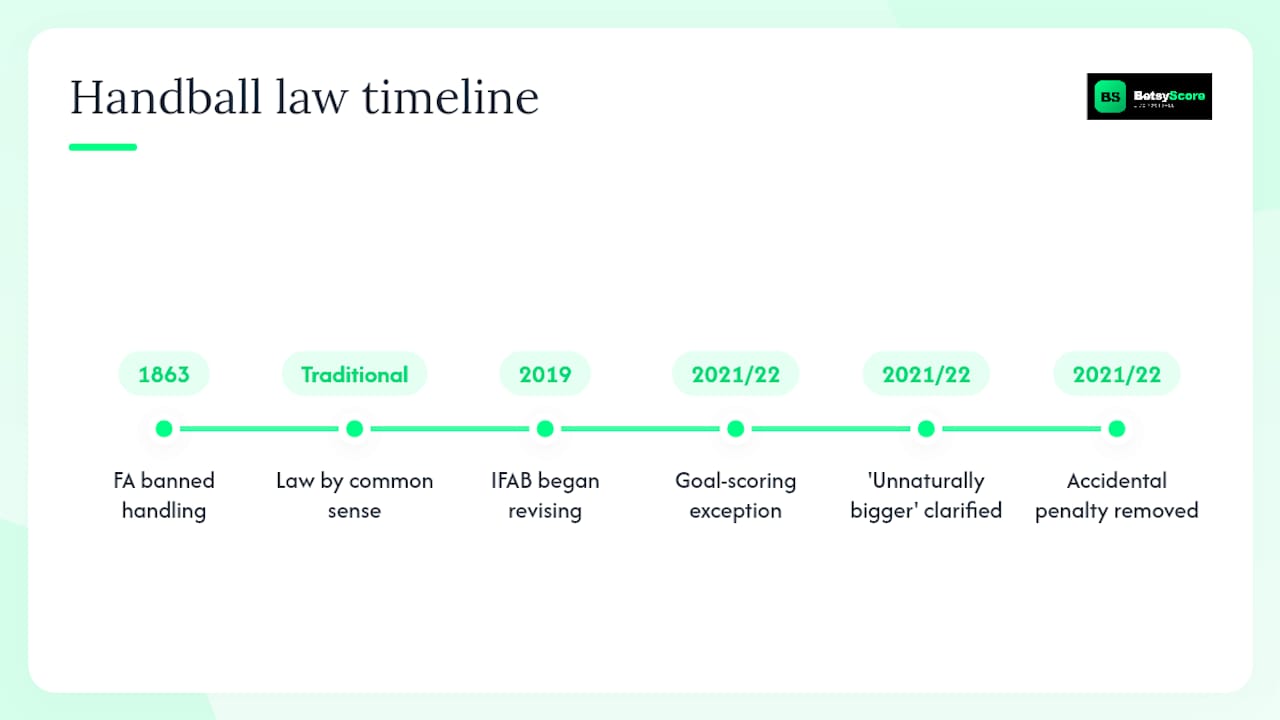
The prohibition on handling the ball is as old as association football itself. The Football Association’s original 1863 rules explicitly banned players from carrying or propelling the ball with the hand, distinguishing the sport from rugby. For most of football’s history, the law was straightforward: deliberate handling was an offence, and referees used common sense to identify it.
The complexity arrived with VAR. When video review made every incident reviewable frame by frame, the question of what counted as “deliberate” or “unnatural” required far more precise language. IFAB began revising the handball law in 2019, with significant updates taking effect from 2021/22. Those changes introduced the goal-scoring exception, clarified the “unnaturally bigger” standard, and removed the automatic penalty for accidental handball preceding a goal by multiple phases.
Basic structure of how handball rules work in football
The handball law applies to all outfield players. Goalkeepers may handle the ball inside their own penalty area, subject to restrictions on back-passes and time limits. For outfield players, the key structural points are:
- The offence applies to the hand and arm up to the shoulder.
- Accidental contact is not automatically an offence unless it directly produces a goal or goal-scoring opportunity.
- The “unnaturally bigger” test asks whether the player’s arm position extended their silhouette beyond what normal movement would require.
- Penalties are awarded for handball offences inside the penalty area; direct free kicks apply outside it.
How UEFA handball enforcement differs from other competitions
The most significant divergence is between UEFA competitions and the Premier League. The Athletic’s analysis confirmed that PGMOL’s stakeholder-driven approach produces a higher threshold for penalizing ball-to-hand contact, while UEFA’s referee briefings from Roberto Rosetti apply the IFAB language more strictly. BVM Sports’ reporting on refereeing standard differences notes that VAR usage rates and intervention patterns also differ between the two systems.
Outside Europe, handball rules follow the same IFAB Laws of the Game in most professional competitions, but enforcement culture varies. American soccer fans watching MLS will find the same written law applied with yet another enforcement philosophy, shaped by local referee development programs rather than UEFA or PGMOL guidance.
Major UEFA competitions where handball calls matter most
Handball decisions carry the most weight in knockout football, where a single penalty can decide a tie. The competitions where enforcement is most consequential:
- UEFA Champions League: — Strictest enforcement, highest handball penalty share.
- Premier League: — PGMOL guidance, more lenient threshold, lowest handball penalty share among major European leagues.
For fans tracking Euro Championship matches, handball calls tend to follow the stricter UEFA standard.
Key players and officials shaping handball interpretation
Roberto Rosetti, UEFA’s chief refereeing officer, is the single most influential figure in how handball rules are applied across European club and international competition. His annual briefings to referees set the tone for Champions League and EURO enforcement. PGMOL’s chief refereeing officer performs the equivalent function for the Premier League, and the divergence between their guidance is the primary reason the 42.3% vs. 16.7% gap exists.
IFAB itself, the body that writes the Laws of the Game, includes representatives from FIFA and the four British football associations. Its annual general meeting approves law changes, and its VAR protocol documents set the procedural framework that all competitions using VAR must follow.
Key Takeaways
VAR can only overturn a handball decision when the on-field referee made a clear and obvious error; subjective calls about arm position or deliberateness require a pitchside review before any change is made.
| Point | Details |
|---|---|
| IFAB handball criteria | Deliberate touch, unnatural body size, or accidental contact directly producing a goal all qualify as offences. |
| VAR intervention threshold | VAR acts only on “clear and obvious” errors; grey-area calls stay with the on-field referee’s original decision. |
| Competition enforcement gap | Champions League handball penalty share is 42.3%, Premier League 16.7%. |
| Slow-motion caution | IFAB protocol requires normal-speed footage to assess deliberateness; slow motion is restricted to factual determinations. |
| Betsyscore live tracking | Betsyscore’s incident timeline flags VAR reviews and penalty events in real time across Champions League, Premier League, and 200+ competitions. |
Why the handball debate reveals a deeper problem with VAR
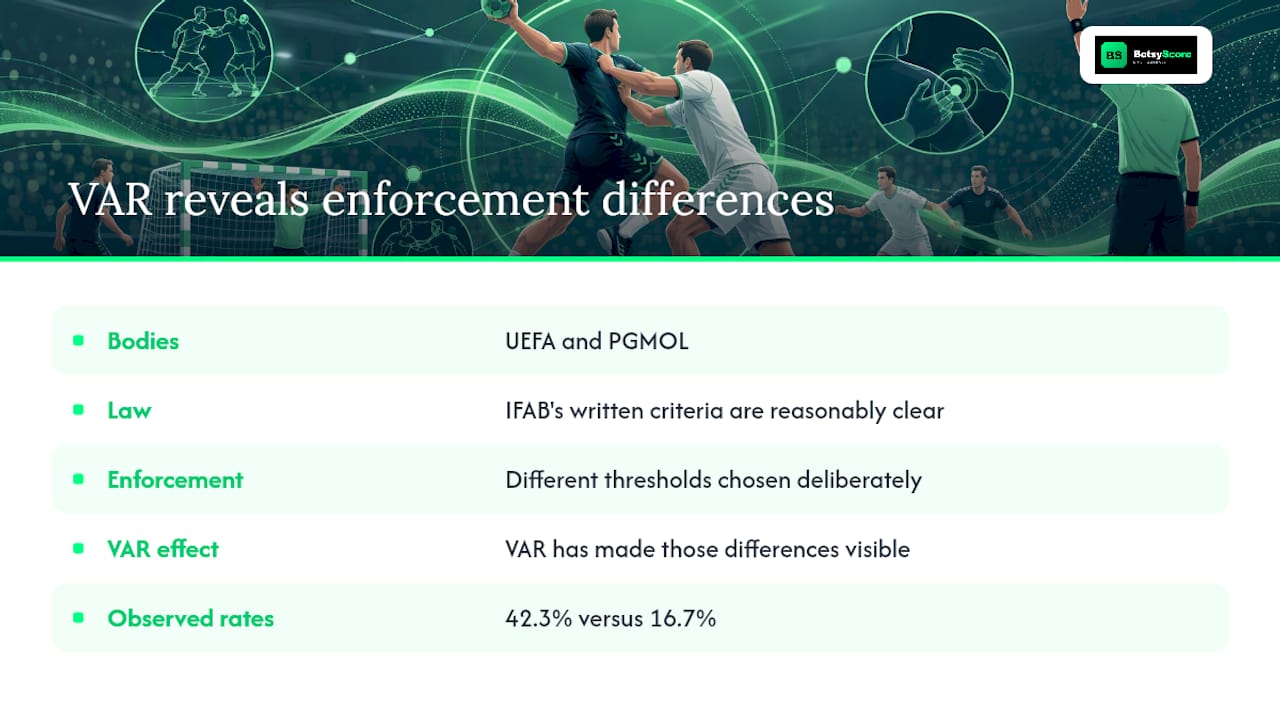
The handball controversy is not really about the law. IFAB’s written criteria are reasonably clear. The problem is that two major refereeing bodies, UEFA and PGMOL, have made deliberate choices to enforce the same law at different thresholds, and VAR has made those differences visible in a way that pre-video football never would have exposed.
Fans watching a Champions League match on Tuesday and a Premier League match on Saturday are not seeing two different laws. They are seeing two different enforcement philosophies, each with institutional backing. That is worth understanding before forming strong opinions about any individual call. The data, 42.3% versus 16.7%, is not a sign that one competition is getting it wrong. It is a sign that “correct” depends on which room the referee was briefed in.
The practical implication for fans is straightforward: judge handball calls in competition context, not in isolation. A call that looks harsh in a Premier League frame may be entirely standard in a Champions League frame, and vice versa. Following live incident data across competitions, rather than relying on social-media clips, gives a much cleaner picture of whether a decision was unusual for its context.
Betsyscore gives you live VAR flags and handball stats as they happen
When a handball review is underway, the last place to get reliable context is a social-media feed. Betsyscore’s live match feed logs every VAR flag, penalty event, and incident timeline update within seconds, with competition context attached so you know immediately whether the call fits the pattern for that competition.

The AI predictions page updates win-probability figures the moment a penalty is awarded or overturned, using expected goals and event data to reflect the real impact on the match. For fans who want to go deeper, competition-level stats pages track penalty frequencies across the Champions League, Premier League, La Liga, Bundesliga, Serie A, Ligue 1, and more than 200 other competitions. Open a live match on Betsyscore, check the incident timeline, and you have the full picture before the broadcast pundit finishes their sentence. You can also explore soccer player props and fan engagement content for additional context around match events.
Useful sources and further reading
- Laws of the Game documents - IFAB
- EURO referees given handball briefing | UEFA.com
- Video Assistant Referee (VAR) protocol - IFAB
- As Newcastle found out, the Champions League is the home of handball penalties - The Analyst
- VAR intervenes on handball penalty for Liverpool and Arsenal - BBC Sport
- Euro 2020 referees to use updated handball law, UEFA confirms - Sky Sports
- Premier League vs Champions League refereeing: Why is it so different? - The Athletic (NYTimes Athletic)
- Premier League vs Champions League refereeing standards explained - BVM Sports
FAQ
What counts as a handball offence under IFAB rules?
A handball offence requires a deliberate touch, contact that makes the body unnaturally bigger, or an accidental touch that directly produces a goal or goal-scoring opportunity. Arm position above shoulder height is treated as unnatural under IFAB’s criteria.
When will VAR overturn a handball decision?
VAR intervenes only when the on-field referee made a clear and obvious error. Subjective calls about arm position or deliberateness require the referee to conduct a pitchside review before any change is made.
Why are there more handball penalties in the Champions League than the Premier League?
The Analyst’s data shows Champions League handball penalties at 42.3% of all penalties and Premier League at 16.7%, reflecting UEFA’s stricter enforcement of IFAB language compared with PGMOL’s stakeholder-influenced, more lenient threshold.
Can VAR change a free kick to a penalty for handball?
Yes, if the handball occurred inside the penalty area. Location is a factual determination, so VAR can correct the restart from free kick to penalty without requiring an on-field review. Deliberateness remains subjective and requires the referee to review footage personally.
How can fans track handball incidents and VAR reviews live?
Betsyscore’s live match feed logs VAR flags and penalty events in real time with competition context, allowing fans to compare handball call frequencies across the Champions League, Premier League, and other competitions as matches unfold.