Indirect Free Kick in Soccer: Rules, Offenses and Signal

An indirect free kick is a restart in which a goal cannot be scored until a second player touches the ball. The kicker may not score directly, and the referee shows the restart is indirect by raising one arm above the head. This guide covers what makes a free kick indirect, which offenses lead to one, where it is taken and what happens when the ball goes straight into a net.
TL;DR
- An indirect free kick needs a touch from another player, on either team, before a goal can count. A direct free kick does not, according to the FIFA Training Centre.
- The referee holds one arm straight up until the ball has touched another player, gone out of play, or it is clear a goal cannot be scored directly, per IFAB Law 13.
- Typical causes: dangerous play, obstruction without contact, dissent, goalkeeper handling offenses and offside.
- If the ball goes directly into the opponents’ goal, the result is a goal kick. If it goes directly into the kicker’s own goal, the result is a corner kick.
Table of Contents
- What makes a free kick indirect
- Offenses that lead to an indirect free kick
- Goalkeeper offenses
- Offside
- How the referee signals an indirect free kick
- Where an indirect free kick is taken
- What the ball and the opponents must do
- Can you score directly from an indirect free kick?
- Direct and indirect free kicks compared
- How teams use indirect free kicks near goal
- Common mistakes and misconceptions
- Our perspective
- Follow the next free kick live
- FAQ
- Sources
What makes a free kick indirect
A free kick is indirect because of the offense that caused it, not because of where it is taken. The Laws of the Game list the offenses that carry an indirect free kick, and everything else punished by a free kick is direct. The practical difference is the scoring condition. From an indirect free kick, the ball must be touched by another player before a goal can be scored. From a direct free kick, the FIFA Training Centre notes, no such touch is required.
In broad terms, direct free kicks punish physical fouls such as kicking, tripping, pushing or handling the ball deliberately. Indirect free kicks punish technical offenses and careless or non-contact conduct. Offenses that involve contact with an opponent are generally direct, while those that obstruct, endanger or interfere without contact are generally indirect.
The other important difference concerns the penalty area. A foul that would earn a direct free kick against a defending team inside its own penalty area is punished with a penalty kick instead. An indirect free kick, by contrast, can be awarded for an offense anywhere on the field, including inside the penalty area. That is why indirect free kicks inside the box, rare as they are, produce some of the most unusual sequences in the game.
Offenses that lead to an indirect free kick
Law 12 sets out the list. According to Law 12 as published by The FA, an indirect free kick is awarded if a player:
- plays in a dangerous manner;
- impedes the progress of an opponent without any contact being made;
- is guilty of dissent or verbal offenses;
- prevents the goalkeeper from releasing the ball from the hands;
- initiates a deliberate trick to circumvent the back-pass Law;
- commits any other offense for which play is stopped to caution or send off a player.
Dangerous play
The Laws of the Game 2025/26 define playing in a dangerous manner as any action that, while trying to play the ball, threatens injury to someone, including the player himself. It also covers preventing a nearby opponent from playing the ball for fear of injury. A scissors kick or bicycle kick is permitted provided it is not dangerous to an opponent. A high boot near a defender’s head, with no contact made, is the classic example.

Obstruction without contact
A player who steps into the path of an opponent without playing the ball, and without touching him, impedes his progress. Because no contact occurs, the sanction is indirect rather than direct. Shielding the ball within playing distance is a different matter and is allowed.
Dissent and verbal offenses
Protesting a decision or using words to distract an opponent can be punished by an indirect free kick, usually together with a caution. Where play is stopped specifically to caution or send off a player for an offense that has no other restart attached, the restart is also indirect. For how cautions work and which offenses lead to bans, see our guide to yellow cards in football.
Interfering with the goalkeeper’s release
A goalkeeper holding the ball in the hands may release it without interference. An attacker who blocks the throw or the kick, or tries to kick the ball out of the keeper’s hands, commits an indirect free kick offense.
Tricks to circumvent the back-pass law
A team may not deliberately pass the ball to its goalkeeper by a trick to get around the rule that bars the keeper from handling a deliberate kick from a team-mate. The classic trick is flicking the ball up with the foot and heading it back. The offender is the player who initiated the trick, and the sanction is indirect.
Goalkeeper offenses
Goalkeepers cause a large share of indirect free kicks in the penalty area. Per Law 12, a goalkeeper concedes one by touching the ball with the hands:
- after releasing it and before another player has touched it; or
- after a team-mate deliberately kicks it to the keeper, or throws it in directly to the keeper.
There is one exception: the keeper has not committed an offense if he clearly kicked, or attempted to kick, the ball to release it into play. Because the offense occurs inside the defending team’s own penalty area, the attacking side receives a free kick very close to goal. The defenders typically line up on the goal line to block it, which leads to the crowded scenes seen in highlight compilations.
Offside
Offside is the other everyday source of indirect free kicks. According to the offside Law as reproduced in the Laws of the Game 2025/26, if an offside offense occurs the referee awards an indirect free kick where the offense took place, even if that is in the offending player’s own half. For the full logic of the rule, read our explainer on what offside is in football. Coaches who build their defensive line around the rule can look at our piece on training an offside trap.
How the referee signals an indirect free kick
The referee raises the arm above the head. According to IFAB Law 13, the signal is kept up until the kick has been taken and the ball touches another player, goes out of play, or it is clear that a goal cannot be scored directly. A direct free kick is signaled differently: the referee points toward the goal being attacked or extends the arm horizontally, without raising it.
A simple memory aid: the vertical arm is shaped like the letter I, for indirect.
The signal matters because Law 13 attaches a consequence to forgetting it. If the referee fails to signal that the kick is indirect and the ball is kicked directly into the goal, the indirect free kick must be retaken. Some referees also say “indirect” aloud so that players and the assistant referees do not misread the situation, a practice recommended on the Dutch Referee Blog.
Where an indirect free kick is taken
The default rule is simple: the kick is taken from the place where the offense occurred. There is one exception, set out in Law 13. When an indirect free kick is awarded to the attacking team for an offense inside the opponents’ goal area, it is taken from the nearest point on the goal area line that runs parallel to the goal line. This keeps the kick from being placed right on the goal line or beside the post.
When the defending team is awarded a free kick in its own goal area, it may take it from anywhere inside that area. Opponents must remain outside the penalty area until the ball is in play.
| Situation | Where the kick is taken |
|---|---|
| Offense anywhere on the field | The place of the offense |
| Offense by the defenders inside their own goal area | Nearest point on the goal area line parallel to the goal line |
| Free kick for the defending team inside its goal area | Anywhere in the goal area |
| Offside | The place of the offside offense, even in the player’s own half |
What the ball and the opponents must do
The same Law 13 sets the conditions for taking the kick:
- The ball must be stationary.
- The kicker must not touch the ball a second time until another player has touched it.
- Until the ball is in play, all opponents must stay at least 9.15 m (10 yards) from the ball. The only exception is a defender standing on his own goal line between the posts.
- For a free kick inside the opponents’ penalty area, opponents must also remain outside the penalty area.
The ball is in play once it is kicked and clearly moves. The kicker’s second touch before any other player touches the ball is an offense of its own and is punished with an indirect free kick to the other team.
Can you score directly from an indirect free kick?
No. A goal requires a touch from a second player first. The consequences depend on where the ball ends up, again according to IFAB Law 13:
| What happens | Restart |
|---|---|
| Ball goes directly into the opponents’ goal | Goal kick |
| Ball goes directly into the kicker’s own goal | Corner kick to the opponents |
| Ball touches another player (either team) and goes in | Goal, as normal |
| Referee failed to signal and the ball goes directly in | Kick is retaken |
The touch can come from anyone. A goalkeeper’s deflection counts as a touch. If the ball is blocked by a defender and ends up in the net, the goal stands. If the goalkeeper touches the ball and it then enters the goal, a goal is awarded, because the ball no longer entered directly. A shot that goes straight in without any touch does not count.
Direct and indirect free kicks compared
| Feature | Direct free kick | Indirect free kick |
|---|---|---|
| Touch needed before a goal | No | Yes, by any other player |
| Referee signal | No raised arm | Arm raised above the head |
| Typical offenses | Kicking, tripping, pushing, deliberate handball | Dangerous play, obstruction, dissent, goalkeeper handling, offside |
| In the offender’s penalty area | Becomes a penalty kick | Stays an indirect free kick |
| Ball goes directly into opponents’ goal | Goal | Goal kick |
The penalty-area distinction is confirmed in the Wikipedia entry on the free kick: a direct free kick cannot be awarded in the offending team’s penalty area, while an indirect free kick may be awarded for an offense anywhere on the field.
How teams use indirect free kicks near goal
A close-range indirect free kick is rarely a shot. It is a short pass or touch followed by a strike. Common set-ups include:
- Touch and shoot. One player rolls the ball a short distance and a team-mate strikes it before the wall can close.
- Chip to the back post. A lofted ball aimed at a runner, allowing a header or a volley.
- Low pass across the line. Used when the defense is packed on the goal line and the keeper’s view is blocked.
Defenders respond by filling the goal line and charging out as soon as the ball is touched. The 9.15 m rule does not apply to a defender on his own goal line between the posts, which is why a full line of defenders can stand there. The tactic is legal, and the kick often ends in a block or a scramble.
When reviewing a match, a shot from an indirect free kick usually appears in the data as a rebound or second-phase chance, not a single attempt. Shot maps and event lists on our match pages help show how these sequences developed, and the live scores page updates while games are in progress.
Common mistakes and misconceptions
- “It cannot be taken inside the box.” It can. Both teams can be awarded an indirect free kick inside the penalty area.
- “The wall must be 10 yards away from a goal-line defender.” No. A defender on his own goal line between the posts is exempt.
- “A touch by a team-mate is required.” The second touch can be from either team, including the goalkeeper.
- “A red card always means a direct free kick.” The restart depends on the offense. A player sent off for dissent, for example, concedes an indirect free kick. The effect of dismissals on a game is covered in our analysis of red card impact.
- “The referee forgot the signal, so play on.” If the kick goes directly in without the signal, the indirect free kick is retaken.
Our perspective
Indirect free kicks are among the least discussed restarts in football statistics, yet they are a clear illustration of how a rule changes the shape of a chance. The same ball, struck from the same spot, is a goal after a direct free kick and a goal kick after an indirect one.
At BetsyScore, we believe the value of match data lies in showing why a moment happened as well as that it happened. Line-ups, shot maps, expected goals and the minute-by-minute momentum chart on each match page let a fan see whether a free kick sequence created pressure or simply ended the attack. Our predictions are built on expected goals, recent form and head-to-head records, and we publish the misses alongside the hits, because a record that hides errors is not a record.
Knowing the Laws makes that data easier to read. A fan who understands why a referee raised an arm can follow the restart, the wall and the set-piece routine as they unfold.
Aria
Follow the next free kick live
BetsyScore is a free football platform with live scores that update every few seconds. Each match page brings together line-ups on a pitch, player ratings, expected goals, shot maps and heatmaps, so you can see what happened after a free kick was awarded. Coverage spans more than 300 competitions, including the Premier League, La Liga, the Bundesliga, Serie A, Ligue 1 and the Champions League. BetsyScore is not a bookmaker and does not take bets.
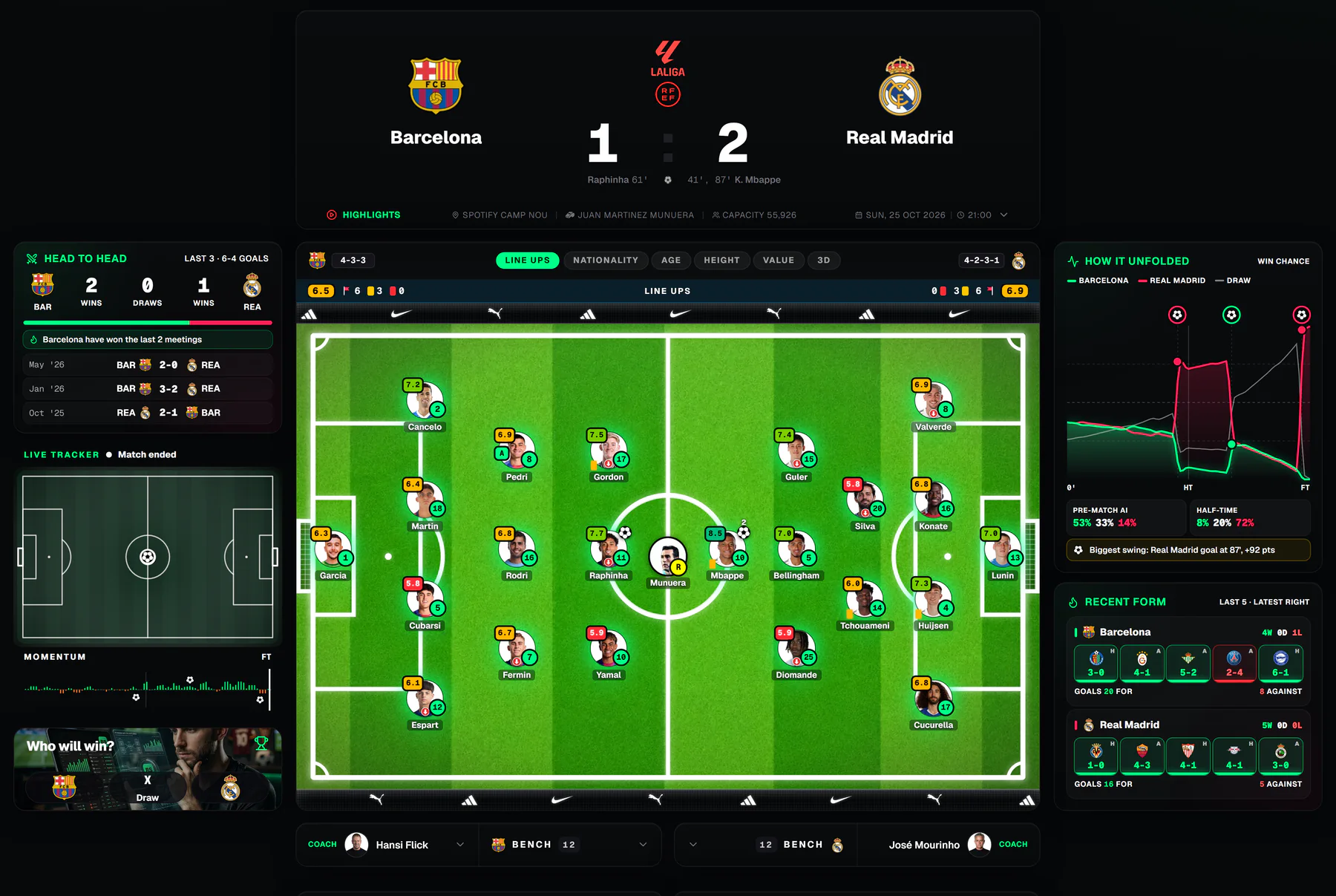
Open the live matches page to follow games in progress, or check AI score predictions for today’s matches before kick-off.
FAQ
What makes a free kick indirect?
The offense does. Dangerous play, obstruction without contact, dissent, interfering with the goalkeeper’s release, a back-pass trick, goalkeeper handling offenses and offside all carry an indirect free kick under Laws 11 and 12. The restart is indirect because a second player must touch the ball before a goal can be scored.
How do you know if a free kick is direct or indirect?
Watch the referee’s arm. An arm raised above the head means indirect, and it stays raised until the ball touches another player or goes out of play, per IFAB Law 13. If the arm is not raised, the kick is direct.
Can you score on an indirect free kick if the goalkeeper touches the ball?
Yes. Once any player, including the goalkeeper, has touched the ball, it is no longer an indirect shot and a goal can count. If the ball goes into the goal with no touch at all, a goal kick is awarded instead.
Are indirect free kicks still in football?
Yes. They remain in the current Laws of the Game 2025/26 and are used for offside, dangerous play, goalkeeper handling offenses and the other offenses listed above.
Sources
- Free kick, FIFA Training Centre
- Law 13, Free Kicks, IFAB
- Law 12, Fouls and Misconduct, The FA
- Laws of the Game 2025/26, IFAB
- Laws of the Game 2025/26, offside, PDF
- Scoring an indirect free kick in opponents’ goal, Dutch Referee Blog
- Free kick (association football), Wikipedia