How International Breaks Affect Leagues: A Fan's Guide
International breaks are FIFA-mandated windows where clubs must release players for national team duty, creating direct and measurable effects on domestic leagues worldwide. Understanding how international breaks affect leagues means looking at scheduling pressure, player fitness, squad depth, and the psychological state of teams returning to action. FIFA mandates player release during official international windows, but leagues are not legally required to pause. Most top leagues choose to pause anyway, prioritizing competitive integrity over continuity.
How do international breaks affect leagues and their scheduling?
Fixture scheduling is the first casualty of every international window. The Premier League, for example, prioritizes the FIFA international match calendar when building its fixture list, aiming to limit home games to just one per club immediately after a break or FA Cup tie. That constraint compresses the schedule before and after each window, creating congested runs of matches that test squad depth and fitness.
Not every league handles this the same way. The Premier League and the Championship typically pause fully during international windows. Lower tiers often continue fixtures during the same period, which creates uneven player availability and competitive challenges, particularly in promotion and relegation battles. A League One club losing two international players while its rivals play on faces a genuine disadvantage.
The congestion effect is real and cumulative. Clubs that enter a break on the back of a heavy fixture run return to an equally demanding schedule. Managers have fewer training days to implement tactical changes, and medical staff face a compressed window to assess returning players.
- The Premier League fixture list is built around FIFA windows from the start of the season.
- Leagues below the top tier in England often play through international breaks.
- Fixture congestion before and after breaks increases injury risk across the squad.
- Some continental leagues pause partially, with cup rounds filling the gap.
Pro Tip: Track fixture density around international windows on league schedules to spot which clubs face the toughest returns. Teams with three matches in seven days post-break are statistically more vulnerable to dropped points.
What is the impact of player absences on club performance?
Player absences during international windows hit clubs differently depending on squad depth and financial resources. A 2026 study found that performance indicators drop less significantly for clubs with deeper financial resources and squad depth. That finding confirms what most fans already suspect: elite clubs absorb international breaks far better than mid-table or lower-league sides.

The injury risk compounds the absence problem. Long-haul travel, time zone shifts, and additional matches all increase the chance of a player returning to their club in worse condition than they left. A striker flying from Europe to South America and back for two World Cup qualifiers may return with accumulated fatigue that takes a week to clear. That week often overlaps with a league fixture.
The table below shows how club resources shape the severity of the impact.
| Club profile | Squad depth | Typical impact of absences |
|---|---|---|
| Elite, resource-rich clubs | Deep rotation options | Minimal drop in performance |
| Mid-table clubs | Moderate depth | Noticeable dip, especially in attack |
| Smaller or lower-league clubs | Limited options | Significant performance decline |
| High-turnover or rebuilding squads | Thin and unsettled | Severe disruption to tactics and results |
“International breaks impact league performance asymmetrically. Clubs with deep, stable squads have more resilience to the disruptions caused by player absences and scheduling changes.” — Squad stability research, 2026
The effects of player absences extend beyond the matchday squad. Coaches lose training time with key players, which interrupts the repetition needed to embed tactical patterns. For clubs with new managers or new signings, that lost time is especially costly.
How do international breaks affect team momentum and tactical preparation?
Momentum is one of the most fragile commodities in football. A team on a five-match winning run enters an international break at peak confidence, then returns two weeks later to a completely different psychological environment. Breaks provide psychological recovery but can simultaneously halt a high-performing team’s winning momentum. The effect cuts both ways.
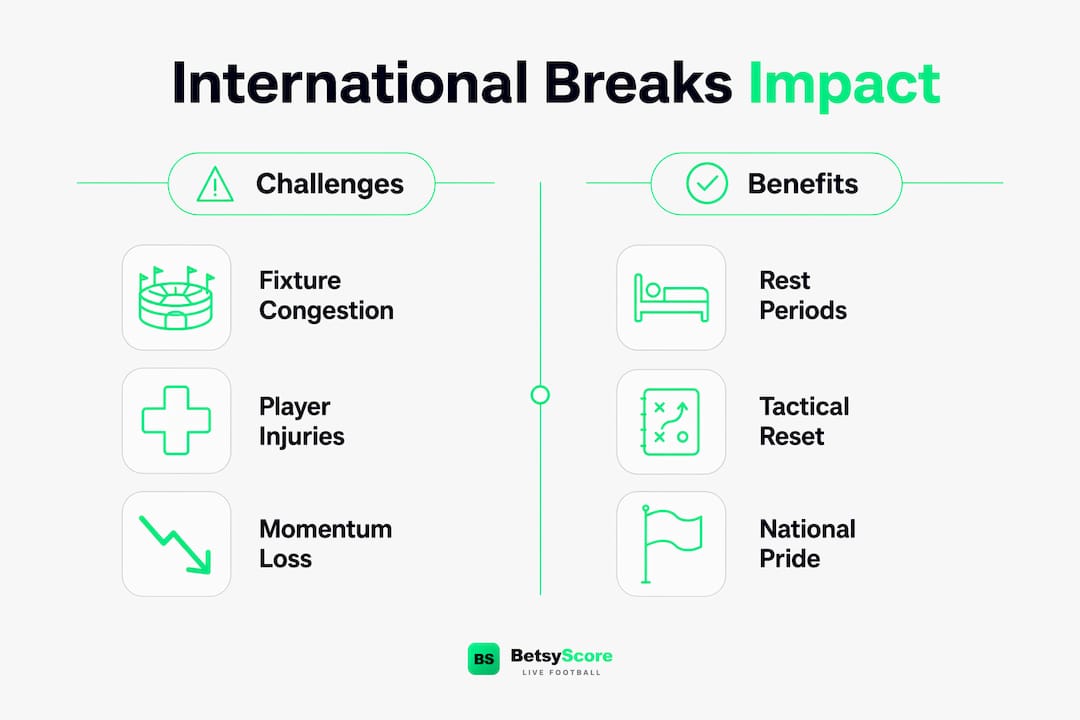
For struggling teams, a break can function as a reset. Managers get time to work on shape, address individual errors, and rebuild confidence away from the pressure of weekly results. International breaks can disproportionately affect teams developing new tactical identities because of interrupted training continuity. Established clubs with cohesive squads absorb the disruption and return focused. Rebuilding sides often return fragmented.
Squad stability is the deciding factor. High-turnover or new-manager teams struggle more with breaks hampering tactical implementation. When a manager has spent three weeks installing a pressing system, a two-week break where half the squad is away resets much of that work.
- Teams on winning runs risk losing rhythm and sharpness during breaks.
- Struggling sides can use the window to reset mentally and tactically.
- New managers lose critical early-season training time to international windows.
- Established squads with settled systems return to form faster post-break.
Pro Tip: Check AI-driven match predictions on Betsyscore after each international window. Win-probability models factor in recent form and squad availability, giving you a sharper read on which teams are likely to struggle in their first game back.
How do different leagues handle international breaks?
Major leagues take noticeably different approaches to international windows, and those differences shape competitive balance across the season. The Premier League and the Championship pause fully, protecting competitive integrity at the top of the English football pyramid. Below those tiers, clubs often play on, creating a two-speed system within the same country.
Women’s football presents a distinct case. The Women’s Super League (WSL) experiences extended breaks that impact momentum and fan engagement more severely than in the men’s game. Newer WSL clubs, still building squad cohesion, find long breaks particularly damaging to consistency. Established clubs with experienced international players return with competitive match sharpness, while developing sides return cold.
La Liga in Spain and the Bundesliga in Germany follow broadly similar pause patterns to the Premier League during FIFA windows, though domestic cup competitions sometimes fill the gap. The UEFA Europa League and continental competitions add another layer of scheduling complexity for clubs competing on multiple fronts. Those clubs return from international breaks with even less recovery time before European fixtures resume.
Fan engagement also shifts during breaks. Audiences accustomed to weekly league action lose their rhythm. Clubs that communicate clearly about returning players and upcoming fixtures retain fan attention better than those that go quiet during the window.
What strategies do clubs use to manage international breaks?
Clubs that handle international breaks well treat them as a planning problem, not just a scheduling inconvenience. The most effective approaches combine medical preparation, squad rotation, and deliberate psychological management.
-
Pre-departure medical protocols. Club medical departments coordinate with coaching staff to create individualized recovery plans before players leave for international duty. Medical advice begins before departure, not after return. This includes travel guidelines, load management targets, and communication channels with national team medical staff.
-
Squad rotation planning. Managers identify which players will miss matches during the break window and plan their rotation accordingly. Clubs in leagues that continue playing during breaks must field competitive squads without their internationals, which accelerates the development of fringe players.
-
Tactical work with non-traveling players. Players not called up for international duty remain at the training ground. Managers use this time for intensive tactical sessions, individual technical work, and fitness conditioning. This group often returns to the squad sharper than those who traveled.
-
Psychological reset protocols. Managers see international breaks as rare windows for mental and physical rest. For players carrying the psychological weight of a poor run of form, the break provides distance from the pressure of weekly results. Managers who structure this period deliberately, rather than leaving players to decompress without direction, see better outcomes on return.
-
Return-to-training monitoring. Players returning from long-haul international duty go through structured reintegration. Rushing a fatigued player into a league fixture within 48 hours of return is a recognized injury risk. Top clubs build a minimum recovery buffer into their planning.
Key Takeaways
International breaks affect domestic leagues through a combination of mandatory player releases, fixture congestion, and uneven squad depth, with resource-rich clubs consistently absorbing the disruption better than smaller sides.
| Point | Details |
|---|---|
| FIFA mandates player release | Clubs must release players for official windows; leagues choose whether to pause. |
| Squad depth determines impact | Resource-rich clubs maintain performance; smaller clubs face significant drops. |
| Momentum cuts both ways | Breaks can halt winning runs or provide a reset for struggling teams. |
| League approaches vary | Premier League pauses fully; lower tiers and some women’s leagues face longer or different disruptions. |
| Medical planning reduces risk | Pre-departure protocols and structured return plans lower injury rates and speed recovery. |
The balancing act nobody fully gets right
I have followed international breaks across multiple seasons and across multiple leagues, and the honest conclusion is this: no club has fully solved the problem. The disruption is structural, not accidental. FIFA’s calendar prioritizes the global game, and domestic leagues absorb the consequences.
What strikes me most is how unevenly the burden falls. A club like Manchester City or Real Madrid loses internationals but retains enough quality to field a competitive side. A Championship club losing three or four key players to international duty is effectively fielding a reserve team. The competitive distortion is real, and it compounds over a full season.
The psychological dimension gets underreported. Managers at the top level describe international breaks as the only genuine rest they get in a relentless calendar. That matters for decision-making quality across a 38-game season. A manager who never gets mental distance from the pressure of results makes worse decisions by march. The break is not just a scheduling gap. It is a cognitive reset that the best managers use deliberately.
The future of international breaks is tied directly to the expanding football calendar, including the FIFA World Cup 2026 and the expanded Club World Cup. More international fixtures mean more windows, more travel, and more pressure on player welfare. The clubs and managers who build systems to absorb that pressure will have a structural advantage over those who treat each break as an isolated inconvenience.
— Aria
Betsyscore keeps you current when leagues restart
Following football through international breaks means tracking which players returned fit, which ones picked up knocks on international duty, and how teams line up for their first game back. That information changes fast, and having it in one place matters.
Betsyscore delivers live scores and AI predictions that refresh every few seconds, covering the Premier League, La Liga, Bundesliga, Serie A, the Champions League, and more than 200 competitions worldwide. The AI prediction models factor in recent form, expected goals, and head-to-head records, including the player availability shifts that international windows create. When leagues restart after a break, Betsyscore gives you the clearest read on which teams are genuinely ready and which ones are still finding their footing. You can also predict World Cup 2026 matches and track how international fixtures ripple back into domestic league performance.
FAQ
Are FIFA international breaks mandatory for clubs?
FIFA mandates that clubs release players for official international windows. Leagues are not required to pause but typically choose to do so to protect competitive balance.
Which clubs are most affected by international breaks?
Smaller clubs with limited squad depth suffer the most. Resource-rich clubs maintain performance levels because they have quality replacements available across the squad.
Do international breaks cause more player injuries?
Long-haul travel, time zone changes, and additional match load increase injury risk for returning internationals. Club medical teams use pre-departure protocols to reduce this risk.
How does the Women’s Super League handle international breaks?
The WSL experiences extended breaks that affect momentum and fan engagement more than in the men’s game. Newer clubs with less squad cohesion are hit hardest by the longer windows.
Can international breaks actually help a team’s performance?
Yes. Teams on poor runs use breaks to reset tactically and mentally. Managers with non-traveling players also run intensive training sessions that can sharpen the squad’s collective performance on return.