Common Champions League Prediction Errors to Avoid
Forecasting Champions League matches is defined by a set of recurring cognitive and statistical mistakes that cost bettors accuracy and money. Common Champions League prediction errors include overweighting recent form, ignoring historical base rates, misreading two-legged tie dynamics, and letting emotions drive stake decisions. These are not random failures. They follow predictable patterns rooted in how bettors process information and how basic statistical models handle low-scoring knockout football. Recognizing each error is the first step toward building forecasts that hold up across a full UCL campaign.
1. Common Champions League prediction errors: overweighting recent form
Overweighting recent form is the single most widespread prediction mistake in Champions League forecasting. Markets overreact to the most visible recent data point, often underrating teams with strong season-long campaigns despite a rough patch in their last two or three matches. A club that dominates its domestic league for eight months but loses a semifinal first leg suddenly looks beatable in the odds. That repricing frequently misrepresents actual team quality.
Season-long metrics tell a more honest story than a five-match window. Expected goals (xG) accumulated over 30-plus league games reflects a squad’s true attacking and defensive capacity far better than a single elimination result. A team that ranks in the top three for xG differential in La Liga or the Bundesliga does not become a weak side because of one bad European night.
- Compare a team’s season-long xG rank against its recent UCL form before adjusting your prediction.
- Check whether a poor recent result came against a specific tactical setup that the next opponent does not replicate.
- Weight league performance more heavily when the UCL sample is small, such as early knockout rounds.
Pro Tip: Build a simple two-column reference sheet for each remaining UCL team: season xG differential in domestic league versus UCL knockout results. The gap between those two columns often reveals where the market has underestimated a side.
2. Why ignoring historical base rates causes repeated forecasting errors

Finals produce fewer goals than regular matches, yet many bettors continue to back overs, mispricing the market in a predictable direction. This is a base rate failure. Bettors anchor to high-scoring group stage games and ignore the structural reality that knockout football, especially finals, is more defensive and cautious than league play.
| Match Type | Typical Goal Pattern | Draw Probability | Favorite Win Rate |
|---|---|---|---|
| UCL Group Stage | Higher scoring, more open | Moderate | Higher |
| UCL Knockout (two legs) | Lower scoring, tactical | Higher | Lower |
| UCL Final (single match) | Fewest goals, most cautious | Highest | Lowest |
| Domestic League Match | Moderate scoring | Moderate | Moderate |
Champions League knockout games are more defensive and cautious than league matches, with motivation and tactical discipline shifting significantly by stage. That structural shift directly affects which betting markets hold value.
Three base rate errors appear repeatedly among bettors:
- Backing over 2.5 goals in UCL finals based on group stage scoring averages.
- Underestimating draw probability in single-elimination legs where a draw advances one side.
- Assuming the pre-tournament favorite wins at the same rate as it does in league play.
Correcting these errors requires nothing more than checking historical UCL final and knockout scoring distributions before placing any totals or result bets.
3. Two-legged tie dynamics and the prediction pitfalls they create
Two-legged knockout ties require viewing matches as 180-minute contests. Ignoring this leads to poor predictions because single-match form assumptions do not apply. A team that wins the first leg 2-0 at home does not approach the second leg with the same attacking intent it shows in a league fixture. It manages the game state. A team trailing 0-2 may press high and take risks that it would never take in a neutral context.
The abolition of the away goals rule in UEFA competitions changed second-leg dynamics further. Before the rule change, an away goal in the first leg carried extra strategic weight. Now, teams calculate purely on aggregate, which affects how they set up defensively in the second leg. Bettors who still apply pre-abolition tactical assumptions are working from an outdated model.
- Evaluate second-leg matchups by aggregate score, not by each team’s standalone form.
- Identify which side needs to score and which side benefits from a draw on aggregate.
- Adjust expected goals projections to account for the likely game state from the opening whistle.
Pro Tip: Before predicting a second leg, write down the exact aggregate scenario each team needs. A team that needs two goals to advance will press differently from one that needs just one. That game-state difference changes xG projections by a meaningful margin.
4. Statistical modeling errors that distort Champions League score predictions
Standard Poisson models underestimate the likelihood of low-scoring draws because they assume goals scored by each team are statistically independent. In practice, Dixon-Coles corrects for slight positive dependence between low goal counts in matches. The result is that a basic Poisson model systematically underprices 0-0 and 1-1 scorelines, which are among the most common outcomes in UCL knockout football.
The Dixon-Coles model adds a dependence parameter called rho that increases the probability of low-scoring draws and decreases the probability of 1-0 and 0–1 outcomes relative to the standard Poisson output. This correction improves practical calibration precisely where bettors most often err. Ignoring it means your scoreline probabilities are wrong in the exact outcomes that appear most frequently in high-stakes UCL matches.
| Model | Handles Low-Score Dependence | 0-0 Probability | 1-1 Probability | Best Use Case |
|---|---|---|---|---|
| Standard Poisson | No | Underestimated | Underestimated | Open, high-scoring matches |
| Dixon-Coles | Yes (via rho parameter) | Corrected upward | Corrected upward | Defensive, knockout matches |
Mixing xG data across betting market contexts without proper conversion misguides wagering strategies. xG applied to a 1X2 market requires different calibration than xG applied to a total or both-teams-to-score market. Bettors who pull a single xG figure and apply it across all markets introduce systematic error into every prediction they make.
Pro Tip: Run your scoreline model twice before a UCL knockout match: once with standard Poisson and once with a Dixon-Coles adjustment. If the gap between 0-0 and 1-1 probabilities is large, the Dixon-Coles output is almost certainly closer to the true distribution.
5. How emotional betting drives Champions League betting mistakes
Chasing losses and adrenaline-driven stake changes cause predictable failure among bettors. The UCL final and late knockout rounds are high-emotion events. A bettor who loses on the first leg often doubles their stake on the second leg to recover, abandoning the analytical process that produced their original prediction. That behavior breaks the connection between forecast quality and bet sizing.
Emotional betting produces three specific errors in Champions League contexts:
- Increasing stake size after a loss to recover quickly, which distorts expected value calculations.
- Backing a favored club based on personal loyalty rather than probability, especially in finals involving historically dominant sides.
- Placing late bets during live matches based on momentum feelings rather than updated statistical data.
Maintaining a fixed staking plan and reviewing responsible gambling practices before each UCL matchday removes the emotional variable from stake decisions. The prediction process and the staking process should be separate. A strong forecast loses its value the moment emotion changes the stake attached to it.
Key takeaways
Avoiding Champions League prediction errors requires correcting for form bias, base rate neglect, two-leg dynamics, model limitations, and emotional stake decisions simultaneously.
| Point | Details |
|---|---|
| Prioritize season-long data | Weight domestic xG and league rank over recent UCL results when assessing team quality. |
| Apply base rates to finals | UCL finals produce fewer goals and more draws than group stage matches; adjust totals bets accordingly. |
| Account for aggregate context | Second-leg predictions must reflect the aggregate score and each team’s specific advancement need. |
| Use Dixon-Coles for scorelines | Standard Poisson underprices 0-0 and 1-1 draws; the Dixon-Coles rho correction fixes this. |
| Separate prediction from staking | Fix your staking plan before matchday and never adjust it based on previous results or emotion. |
What I’ve learned from years of watching UCL predictions go wrong
The most consistent pattern I’ve observed is that bettors who lose over a UCL campaign are not making random errors. They are making the same errors repeatedly, in the same situations, for the same psychological reasons. Overconfidence in recent form peaks around the quarterfinals, when the sample of UCL matches is still small but emotions run high. Base rate neglect peaks at the final, when everyone is focused on the two clubs involved and nobody is checking historical scoring distributions.
The fix is not a better model alone. It is a process that forces you to check the base rate before you check the odds, and to review season-long data before you review last week’s highlights. Statistical rigor and football intuition are not in conflict. Intuition built on a solid data foundation is genuinely useful. Intuition built on recent highlights is just noise dressed up as expertise.
Tracking your own prediction record across a full UCL season is the most underused tool available. When you log every prediction and review it at the end of the campaign, the errors become visible. You stop repeating them because you can see them clearly. That discipline, more than any model upgrade, is what separates forecasters who improve from those who stay stuck.
— Aria
Betsyscore’s tools for sharper Champions League forecasts
Applying the corrections above requires real-time data, and that is exactly what Betsyscore delivers. The platform’s AI-powered predictions generate win-probability percentages built from expected goals, recent form, and head-to-head records, giving you a data-backed starting point before every UCL match.
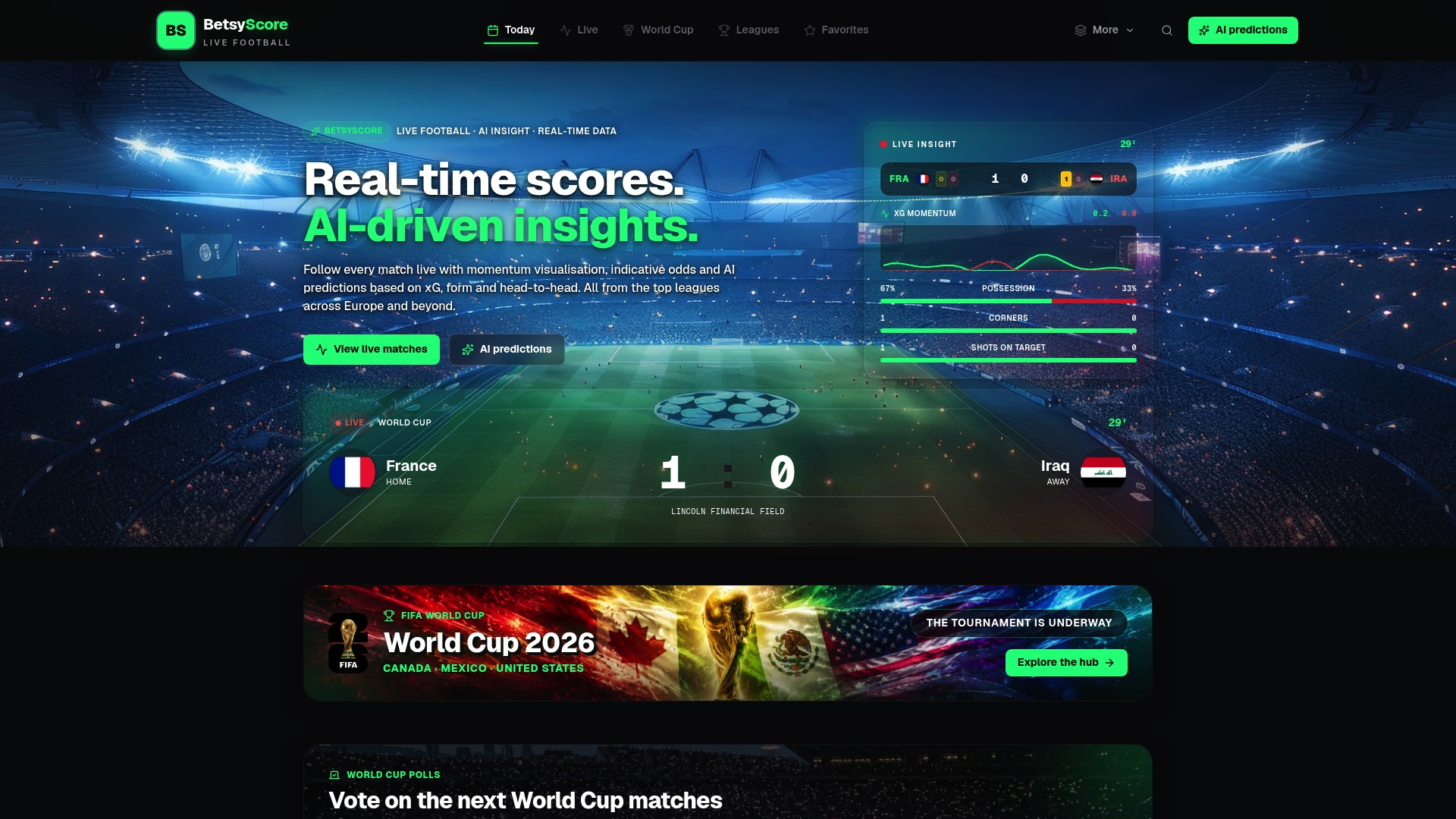
Betsyscore also tracks live match data that refreshes every few seconds, including momentum shifts and in-game stats that update your picture of a match as it unfolds. Coverage includes the Champions League, the Premier League, La Liga, the Bundesliga, Serie A, and more than 200 competitions worldwide. For bettors working to correct the errors covered in this article, having accurate, current data in one place removes a major source of forecasting failure.
FAQ
What is the most common Champions League prediction error?
Overweighting recent form is the most common error. Markets and bettors consistently underrate teams with strong season-long records based on a small sample of recent UCL results.
Why do standard Poisson models fail in UCL knockout matches?
Standard Poisson models assume goals are independent, which causes them to underestimate 0-0 and 1-1 draw probabilities. The Dixon-Coles correction adds a dependence parameter that fixes this bias for low-scoring matches.
How does the abolished away goals rule affect second-leg predictions?
Without the away goals rule, teams calculate purely on aggregate, which changes defensive and attacking tactics in the second leg. Predictions built on pre-abolition tactical assumptions will misread game-state behavior.
How can I reduce emotional betting mistakes in the Champions League?
Fix your staking plan before matchday and never adjust it based on prior results. Reviewing responsible gambling guidelines before high-profile UCL matches helps maintain discipline when emotions run high.
Does xG data apply equally to all betting markets?
No. Expected goals data requires different calibration for 1X2, totals, and both-teams-to-score markets. Applying a single xG figure across all market types introduces systematic error into every prediction.