Champions League Players: Records, Winners and Top Performers

The most decorated Champions League players are Dani Carvajal, Francisco Gento and Luka Modrić, who share the all-time record of six European Cup titles. Cristiano Ronaldo leads the competition in appearances and assists and is its all-time top scorer. Kylian Mbappé and Erling Haaland are now the dominant scorers of the current era. This guide sets out each record, who holds it and how to compare players across eras.
TL;DR
- Carvajal, Gento and Modrić each hold six European Cup titles, the most by any player, according to UEFA’s final records.
- Cristiano Ronaldo holds the records for appearances (187) and assists (42), and has won five titles.
- Mbappé has 73 goals in 101 appearances and Haaland 61 in 60, as of October 2026, per UEFA.
- Khvicha Kvaratskhelia was named the 2025/26 Player of the Season after 10 goals and 6 assists in 16 appearances.
- Raw totals favor modern players because the competition now plays more matches per season, so compare rates as well as totals.
Table of Contents
- Who has won the most Champions League titles?
- All-time Champions League records by player
- The new heavyweights: Mbappé and Haaland
- Leading Champions League players of 2025/26
- How to compare Champions League players fairly
- Our perspective: what the numbers tell us
- Follow Champions League players live
- Other competitions, same comparison method
- Frequently asked questions
- Sources
Who has won the most Champions League titles?
The record for titles is six, and three players share it: Dani Carvajal, Francisco Gento and Luka Modrić. UEFA’s records page lists them jointly at the top of the all-time table for the European Cup and Champions League.
The three belong to different eras. Gento was a member of the Real Madrid side that dominated the first years of the European Cup in the 1950s and 1960s. Modrić and Carvajal won their titles with the same club in the 2010s and 2020s, which shows how Real Madrid’s record 15 titles are spread across generations. For the club-level picture, see our guide to Champions League winners by club and the analysis of which club has won the most Champions Leagues.
Six winners’ medals, but not six finals
Title counts can be measured in two ways: squads won with, and finals played. UEFA notes that Toni Kroos and Nacho were both members of six victorious squads. They are credited with fewer than six winning finals because neither featured in every final match. Any list that says “six-time champion” should be read with this distinction in mind.
Where Ronaldo stands
Cristiano Ronaldo has won five Champions League titles, according to the same UEFA record page. That is one short of the record, but it covers two clubs: Manchester United and Real Madrid. His five titles, together with the individual records below, explain why his name appears in almost every list of the competition’s greatest players.
All-time Champions League records by player
The table below collects the headline individual records. Goal totals for the leaders are tracked on our dedicated page, Champions League all-time top scorers.
| Record | Player | Figure |
|---|---|---|
| Most titles | Carvajal, Gento, Modrić | 6 each |
| Most appearances | Cristiano Ronaldo | 187 |
| Most assists | Cristiano Ronaldo | 42 |
| Most goals | Cristiano Ronaldo | 140 |
| Most goals in one league phase or group stage | Kylian Mbappé | 13 (2025/26) |
The appearance and assist figures come from UEFA’s all-time rankings for matches played and assists. The 13-goal league-phase record is from UEFA’s comparison of Mbappé and Haaland.
Goals
Ronaldo’s 140 goals make him the competition’s all-time leading scorer, with Lionel Messi second. Our Ronaldo goals breakdown covers the top 10 and how the totals are built across Manchester United, Real Madrid and Juventus. For a head-to-head view of the two, the Messi vs Ronaldo comparison sets career statistics and trophies side by side.
Appearances and assists
Ronaldo’s 187 appearances also lead the all-time list, a product of longevity: he played in the competition across nearly two decades. His 42 assists top the assists ranking as well. That combination is unusual for a player best known for scoring, and it is one reason his overall contribution is hard to match.
The new heavyweights: Mbappé and Haaland
UEFA describes Kylian Mbappé and Erling Haaland as the new heavyweights of the competition, a shift it links to the end of the long-standing Messi and Ronaldo era. The numbers explain why. As of October 2026, UEFA lists:
| Player | Goals | Appearances | Goals per appearance |
|---|---|---|---|
| Kylian Mbappé | 73 | 101 | 0.72 |
| Erling Haaland | 61 | 60 | 1.02 |
Goals per appearance is our own calculation from UEFA’s totals. Haaland has scored more than a goal per match across his Champions League career, while Mbappé has the larger total and the record for the most goals in a single league phase or group stage, 13 in 2025/26.
This matters for comparison. Ronaldo needed 183 appearances to reach his goal total according to the commonly cited all-time list, while Haaland has reached 61 in 60. Neither measure is wrong. Totals reward longevity, rates reward efficiency, and a fair ranking of players uses both.

Leading Champions League players of 2025/26
Khvicha Kvaratskhelia was named the 2025/26 UEFA Champions League Player of the Season. UEFA announced the award on 31 May 2026, noting that he finished with 10 goals and 6 assists in 16 appearances. That is 16 goal contributions in 16 matches, a rate that places a winger alongside the traditional top scorers.
Mbappé’s 13-goal league phase in the same season set the group-stage or league-phase record. Between them, Kvaratskhelia’s all-round output and Mbappé’s finishing show the two types of performance voters and statisticians look at: sustained creation and concentrated scoring.
How to compare Champions League players fairly
A ranking of Champions League players depends on the metric chosen. UEFA’s own player statistics cover goals, assists, appearances, goals by season, and the age and number of games at which players reached scoring milestones. Those categories suggest a practical framework.
- Total output. Goals, assists and titles measure career impact. They favor players with long careers at top clubs.
- Rate. Goals per appearance or minutes played show efficiency and help compare players with short careers, such as Haaland, with players who played for twenty years.
- Era. The competition has changed format several times. In the 1990s it added a group phase and more teams, which gave later players more matches and more scoring chances. A raw total from the 1960s and one from the 2010s are not equally easy to reach.
- Role. A defender such as Carvajal is measured by titles and appearances, not goals. A forward is measured by goals and conversion. Cross-position comparisons need position-specific metrics.
- Big-match record. Finals and knockout rounds carry more weight for many analysts than group matches.
The expansion of the format is one reason the all-time scoring lists are dominated by players from the last 25 years. The same logic applies to the title list, where Gento’s six wins came in a pure knockout competition and Modrić’s came in a much larger one.
Our perspective: what the numbers tell us
At BetsyScore, we build win probabilities from expected goals, recent form and head-to-head records, so we think about players as sources of repeatable output rather than as names on a list. From that angle, three points stand out.
First, the all-time tables describe the past, and they change slowly at the top. Ronaldo’s goal, appearance and assist records are far enough ahead that no active player is close on appearances. Goals are the one record where the gap is being narrowed, because Mbappé and Haaland score at a rate the earlier generation rarely matched in the group phase.
Second, title counts say as much about clubs as about players. The three six-time winners, and the squads Kroos and Nacho were part of, all played for one club that has won the competition more than any other. A title list is a team record before it is an individual one.
Third, expected goals is a better guide to what a scorer will do next than last month’s goal count. A forward who creates high-quality chances and has a quiet run is more likely to score soon than the totals suggest. This is the principle behind our match projections, and it is the reason we show probabilities, not just results.
— Aria
Follow Champions League players live
Records are one part of the picture. The other is tonight’s match. BetsyScore shows live scores that refresh every few seconds, with lineups, player profiles and stats for every Champions League fixture, plus a minute-by-minute momentum read of which side is on top. Before kickoff, our AI predictions give win probabilities based on expected goals, form and head-to-head data, and the BTTS predictions cover both-teams-to-score probabilities.
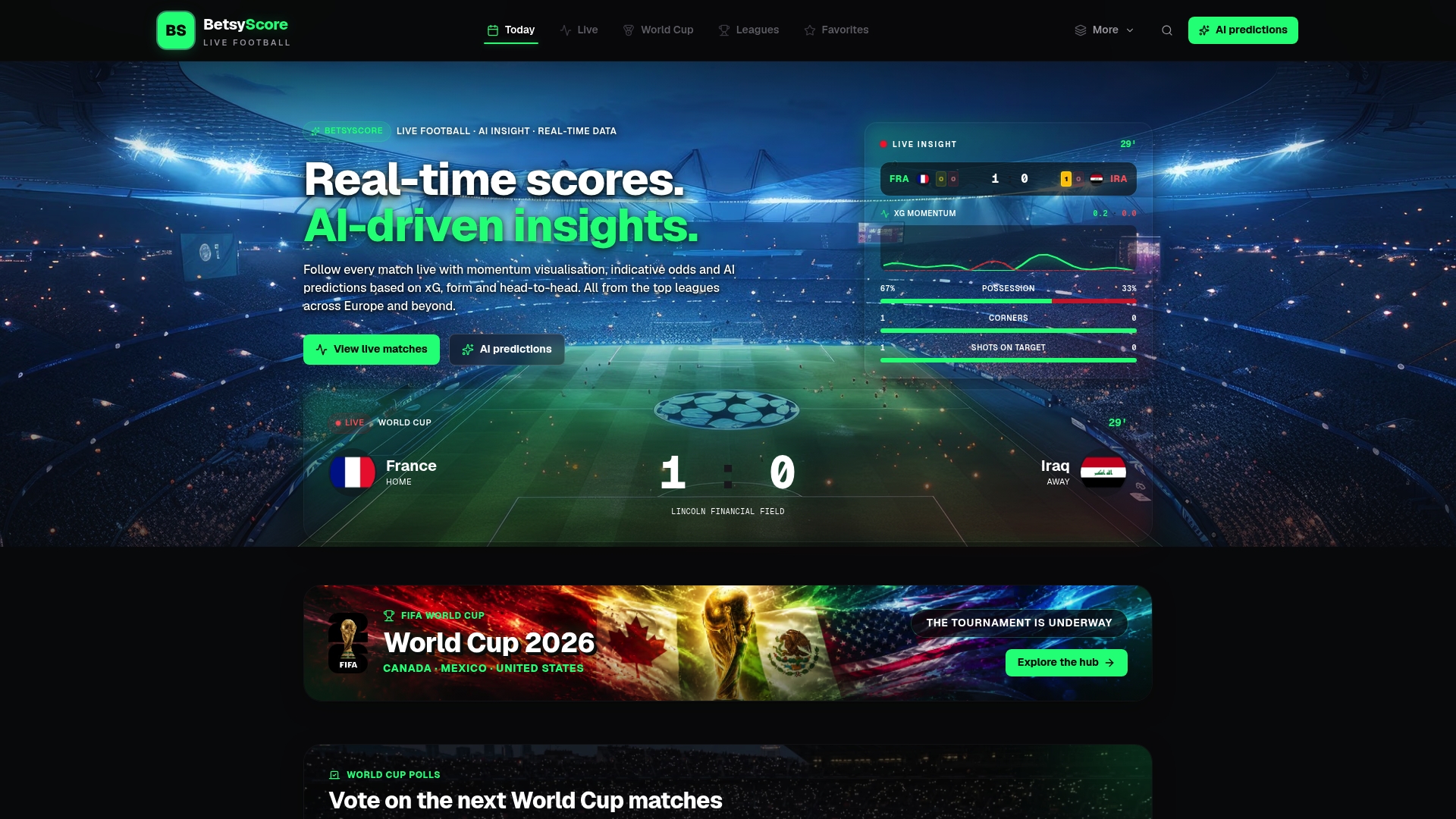
Match pages such as Liverpool 2-1 Atletico Madrid show how a finished match looks with results, lineups and statistics in one place.
Other competitions, same comparison method
The method above applies to other tournaments. Our Europa League top scorers page lists the leaders of UEFA’s second club competition, and the Premier League all-time top scorers table shows how a domestic league compares with European competition. For individual honors, the Ballon d’Or winners list shows which players converted Champions League success into personal awards.
Frequently asked questions
Which player has won the most Champions League titles?
Dani Carvajal, Francisco Gento and Luka Modrić share the record with six titles each, according to UEFA. Toni Kroos and Nacho were also in six winning squads, but they are credited with fewer than six winning finals because they did not play in every one.
How many Champions League titles has Cristiano Ronaldo won?
Ronaldo has won five Champions League titles, per UEFA’s records. He also holds the all-time records for appearances, with 187, and assists, with 42, and he is the competition’s top scorer with 140 goals.
Who is the best active Champions League scorer?
By UEFA’s figures as of October 2026, Kylian Mbappé has 73 goals in 101 appearances and Erling Haaland has 61 goals in 60. Mbappé holds the record for most goals in one league phase or group stage, with 13 in 2025/26.
Who was the Champions League Player of the Season in 2025/26?
Khvicha Kvaratskhelia received the award, announced by UEFA on 31 May 2026. He finished the campaign with 10 goals and 6 assists in 16 appearances.
Why are modern players ahead in the all-time lists?
The competition added a group phase and more teams in the 1990s, so players now have more matches and more chances to score. This is why rates, such as goals per appearance, are a useful complement to career totals.
Sources
- Champions League final records and statistics, UEFA
- All-time player matches played, UEFA Champions League
- All-time player most assists, UEFA Champions League
- Erling Haaland and Kylian Mbappé in the Champions League, UEFA
- Khvicha Kvaratskhelia named 2025/26 Champions League Player of the Season, UEFA