Benefits of Tracking World Cup Lineups in Real Time

Tracking World Cup lineups in real time gives fans, fantasy managers, and media consumers tactical and minutes information the moment it exists, not thirty minutes late on a highlight reel. A confirmed starting XI replaces guesswork with an actual read on formation, player roles, and likely game state, and that shift shows up directly in fantasy captain choices, live betting timing, and how reporters frame a story before kickoff.
Official lineups for top-tier competitions typically post 20 to 40 minutes before kickoff, which is a narrow window where information asymmetry actually matters. Fans who catch it early adjust; fans who don’t are reacting to a match that already started moving without them.
- A surprise omission from the bench can flip a fantasy captain decision in seconds.
- Formation shape (back three vs. back four) resets expected chance volume and which players are live for goals or assists.
- Bench composition previews who comes on and when, which matters for substitution-related markets and props.
Quick fact: roster feeds for major tournaments generally populate in that same 20 to 40 minute pre-kickoff window, and platforms like Betsyscore build live lineup pages around that exact timing so fans aren’t refreshing a static page hoping for an update.
Key Takeaways
Tracking World Cup lineups in real time works because confirmed team news replaces speculation with a concrete tactical and minutes signal that improves fantasy, betting, and reporting decisions.
| Point | Details |
|---|---|
| Timing window matters | Confirmed lineups for top-tier matches typically post 20 to 40 minutes before kickoff. |
| Bench tells its own story | An attacking bench signals late offensive changes; a defensive bench suggests a team protecting a result. |
| Verify before acting | Cross-check any lineup report against a second source before locking a fantasy or betting decision. |
| Absence doesn’t mean injury | Rotation and workload management often explain a benched starter more than fitness does. |
| Betsyscore delivers timestamped feeds | Betsyscore’s live pages publish confirmed World Cup lineups with source attribution and AI-prediction overlays built on top of the confirmed XI. |
Table of Contents
- Why Live Lineups Matter Once the Match Kicks Off
- Who Actually Benefits From Real-Time Lineup Tracking
- Where to Find Trustworthy Minute-by-Minute Lineups
- A Matchday Workflow for Following Live Lineups
- Common Pitfalls When Reading Live Lineups
- Why Betsyscore Prioritizes Live Lineups
- Get World Cup Lineups the Moment They’re Confirmed
- Sources
- FAQ
Why Live Lineups Matter Once the Match Kicks Off
A confirmed lineup turns speculation into a usable tactical signal. Once the sheet is out, you’re no longer guessing whether a manager plays cautious or aggressive. You’re reading actual intent: who starts, in what shape, and what that formation is built to do.
Formation choice tells you more than most fans give it credit for. A back three usually signals a team planning to control possession through wide overloads, while a flat back four often points toward a more direct, transition-based approach. Those shapes change which positions are likely to produce shots, assists, and cards, well before the first whistle blows.

Bench composition is its own layer of information. An attacking bench (extra forwards, pacey wide players) hints at a manager planning to chase a game late. A bench stacked with defensive midfielders and center backs suggests a team planning to protect a lead or manage a draw. Substitute patterns often predict exactly this kind of in-game shift.
Consider a few real scenarios:
- A country’s first-choice striker is left out entirely, with a wide forward shifted centrally instead. That single change alters expected goal distribution and probably shifts your captain pick.
- A creative number 10 is benched in favor of a defensive-minded midfielder. That’s a signal the manager expects a tighter, low-event match, which matters for total-goals betting lines.
- A young winger starts over an established veteran. That’s often a fitness or tactical matchup decision worth checking against recent minutes played.
Confirmed lineups shift the game from guesswork to interpretation, and the opening ten minutes of play usually either validate or challenge what that lineup suggested.
That’s the real practical takeaway: check the lineup, form a read, then watch the first ten minutes to confirm it. Lineups aren’t a final answer. They’re the best available clue right up until the ball is kicked.
Who Actually Benefits From Real-Time Lineup Tracking
Three groups get the most out of minute-by-minute lineup data: fantasy managers, live bettors, and content creators covering the match as it happens. Each group uses the same raw information differently.
Fantasy managers live and die by minutes. A confirmed starter with a full 90 planned is worth more than a bench player who might get 20 minutes. Reading the starting XI for playing-time signals shapes captain selection, bench-boost timing, and last-minute transfer decisions before the deadline locks.
Live bettors react to lineup news inside a tight window before odds adjust. A star forward dropping to the bench moves goalscorer markets almost instantly, and a defensive reshuffle changes over/under lines for the match total. Reading a lineup quickly creates a real edge for props and in-play bets, though it never guarantees an outcome.

Content creators and reporters use confirmed lineups as the opening angle for match coverage. A surprising team selection is a story in itself, and having it minute-accurate lets a reporter frame the narrative before a rival outlet does.
Here’s a simple breakdown of what each group checks first:
- Fantasy managers scan for injury replacements and confirmed starting forwards.
- Bettors scan for absences from expected scorers and shifts in defensive shape.
- Reporters scan for surprises worth a headline, then verify with a second source before publishing.
Where to Find Trustworthy Minute-by-Minute Lineups
Stick to official federation channels, accredited team reporters, and real-time data platforms that timestamp every update. Anything without a clear source attribution should be treated as a rumor until confirmed.
Your realistic options break down like this:
- Official team and federation announcements carry the highest trust but sometimes post later than independent feeds.
- Accredited reporters and press officers often break news minutes earlier, tied to a named, checkable source.
- Real-time sports data platforms, including Betsyscore’s live match pages, pull from accredited feeds and typically publish confirmed lineups inside that 20 to 40 minute pre-kickoff window, along with substitutes and formation.
- Social media scoops move fast but carry the highest risk of being wrong or premature.
Before you act on any lineup post, run a quick check: is it timestamped, does it name a specific source (team account, accredited reporter, or data provider), and does a second source confirm it? If any of those three is missing, wait five minutes before treating it as fact.
Pro Tip: Set two separate alerts, not one. The first should fire when the confirmed lineup first posts (usually 45 to 30 minutes out), and the second should catch late changes inside the final 20 to 15 minutes, when illness or a last-second fitness call can still flip a name on the sheet.
Betsyscore’s guide to following live soccer lineups walks through setting up that exact alert structure for tournament play.
A Matchday Workflow for Following Live Lineups
Here’s a workflow that works whether you’re setting a fantasy lineup, placing a live bet, or writing a pre-match post: check the confirmed XI, verify the bench, set your alerts, then lock decisions only after that first check clears.
- 60 to 45 minutes before kickoff: check for team news, expected fitness updates, and any rotation hints from training reports.
- 45 to 30 minutes before kickoff: confirmed lineups typically post in this window for top-tier matches. Read formation, then scan the bench for tactical intent.
- 30 to 15 minutes before kickoff: cross-check the lineup against a second source. Lock fantasy transfers and finalize any bet decisions tied to starting selections.
- Kickoff to 10 minutes in: watch actual shape and pressing patterns to confirm or revise your pre-match read.
Latency matters more than most fans realize. A refresh-based app checking every few minutes will always lag behind a feed built on real-time data or WebSocket connections, where the gap between an on-pitch event and your screen is seconds, not minutes. Set your match app to its fastest refresh setting and enable push notifications rather than relying on manual checks.
Pro Tip: Pair every lineup change with one quick stat, usually expected goals or recent minutes played, before deciding it matters. A backup striker starting means little on its own; a backup striker starting who’s outscored the regular starter on expected goals over his last five appearances is worth acting on.
Common Pitfalls When Reading Live Lineups
Lineups reduce uncertainty, but they never guarantee an outcome, and misreading one can lead to a bad fantasy call or a rushed bet. A few mistakes show up constantly.
- Trusting unverified social media scoops that lack a named source or timestamp.
- Assuming a benched star is injured, when rotation, workload management, or travel is often the real reason.
- Confusing position with role. A player listed as a winger might be deployed as an auxiliary wing back, which changes his output entirely.
- Acting on stale feeds where a timestamp is missing or minutes old, especially across time zones during a global tournament.
A named starter isn’t a guarantee of minutes or role. Read the formation line, not just the name, and treat any single unconfirmed report as a lead to verify, not a fact to act on.
If you’re using lineup information for betting or public reporting, attribute your source and hold off publishing anything unverified. A wrong scoop damages credibility faster than a slow one ever will.
Why Betsyscore Prioritizes Live Lineups
Live lineups sit at the center of how we build coverage at Betsyscore, because a confirmed XI is the fastest signal we have for powering everything downstream, from AI-driven win-probability models to minute-by-minute momentum visuals. Every lineup update on our live pages carries a timestamp and source attribution, whether that’s a team announcement or an accredited reporter, because a lineup you can’t verify isn’t useful to anyone making a real decision.
Get World Cup Lineups the Moment They’re Confirmed
Betsyscore pulls confirmed World Cup lineups the moment they post, then layers timestamped feeds, source attribution, and AI-prediction overlays on top so you’re never reading a stale team sheet.
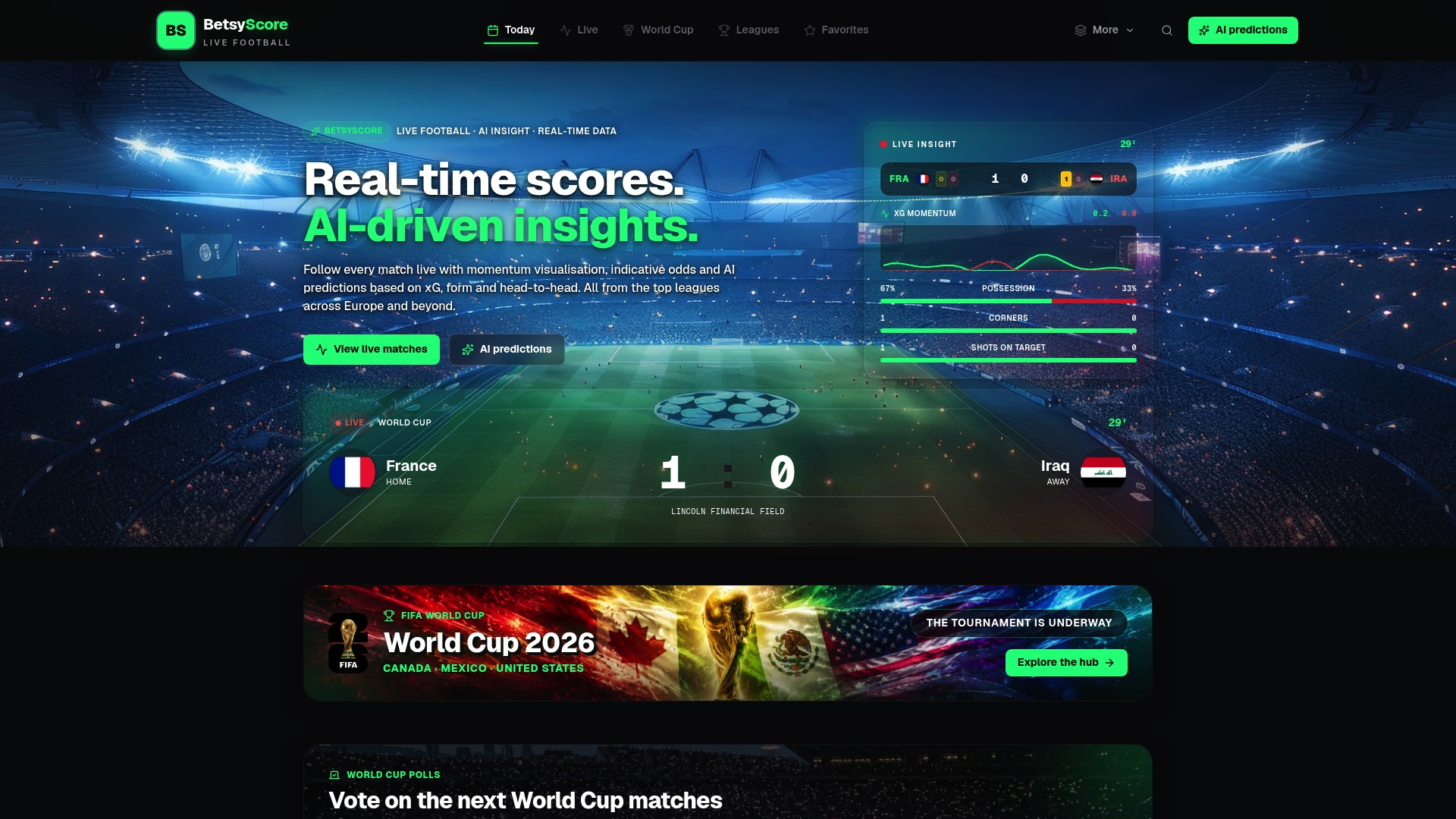
- Live alerts fire the instant a lineup is confirmed, plus a second alert if a late change hits the sheet before kickoff.
- AI signals combine expected goals, recent form, and head-to-head data with the actual confirmed lineup, not just pre-match projections.
Head to Betsyscore Live to see confirmed World Cup 2026 lineups the moment they drop, or check the World Cup 2026 hub for tournament-wide coverage and prediction records.
Sources
- How Confirmed Football Lineups Change the Way Supporters Read a Match
- Football API Endpoints Explained: How Everything Works - Entity Digital Sports
FAQ
How Early Do World Cup Lineups Usually Get Confirmed?
Official lineups for major tournament matches typically post 20 to 40 minutes before kickoff, though last-minute fitness changes can still occur inside that window.
Can Lineup Changes Really Affect Betting Odds?
Yes. A star forward dropping to the bench or a defensive reshuffle can shift goalscorer markets and match totals almost immediately, which is why reaction speed matters for live bettors.
Does a Benched Player Always Mean an Injury?
No. Managers frequently rest players for rotation, workload management, or travel reasons, not just fitness concerns.
Where Can I Track World Cup Lineups Minute by Minute?
Betsyscore Live publishes timestamped World Cup lineups with source attribution alongside AI-prediction overlays built from expected goals and recent form.
What’s the Biggest Mistake Fans Make Reading Lineups?
Acting on an unverified social media report without checking a timestamp or a second source, which often leads to bad fantasy or betting calls based on incomplete information.