Brazil Tops World Cup Winners With Five Titles

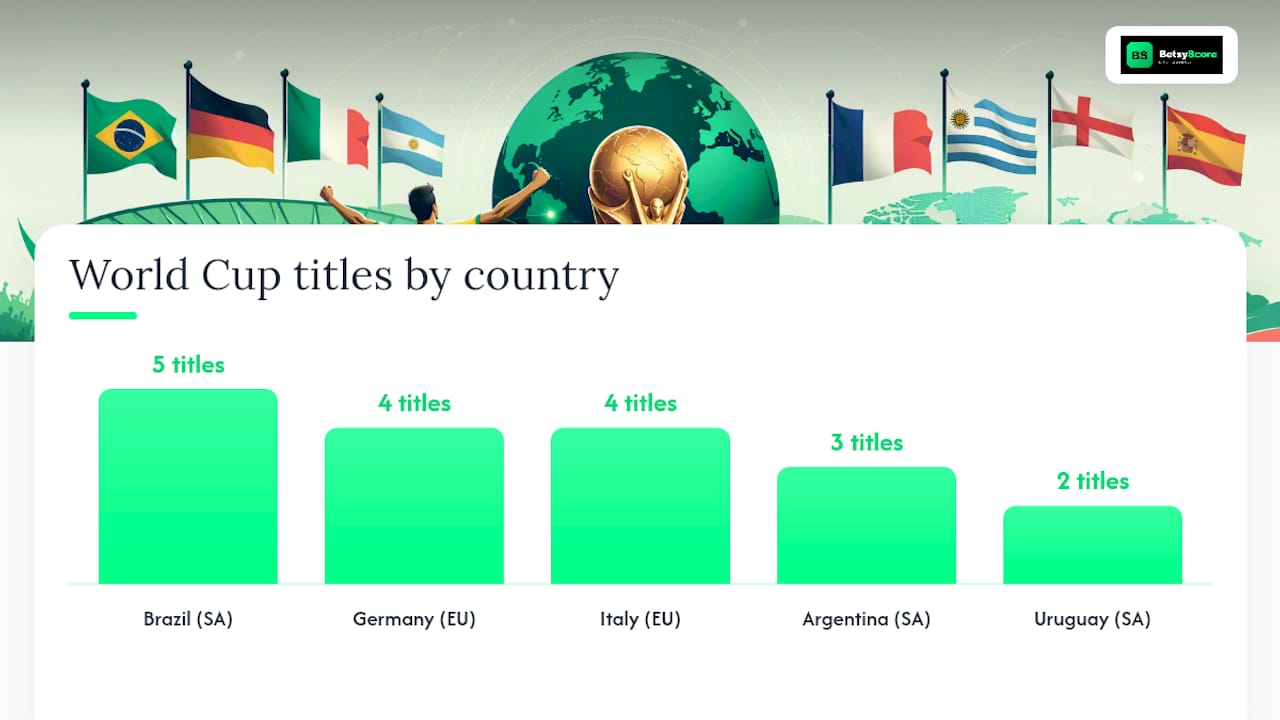
Brazil has won the FIFA World Cup five times, more than any other nation in the tournament’s history. The victories came in 1958, 1962, 1970, 1994, and 2002. Germany and Italy sit tied for second with four titles apiece, and through the 2026 tournament, no other country has closed that gap.
TL;DR:
- Brazil’s five World Cup titles span over four decades, with wins in 1958, 1962, 1970, 1994, and 2002, reflecting long-term squad depth.
- Germany and Italy each hold four titles, but Germany’s record includes titles won as West Germany in 1954, 1974, and 1990, treated as one ongoing record.
- Only eight nations have ever won the World Cup, with European countries holding five of those titles, but South American nations Brazil and Argentina lead in total wins.
- Spain’s 2026 victory increased its total to two titles, tying it with Uruguay and France, but it remains far behind Brazil’s dominant record.
- Brazil’s consistent participation with 23 appearances explains its lead, alongside a reputation for talent pipeline strength and long-term tournament success.
Table of Contents
- Which Country Has Won the Most World Cups? The Full Ranked List
- A Closer Look at Every World Cup Winning Nation
- Why Brazil Sits Alone at the Top
- How FIFA Counts Titles (and Clears Up Common Confusion)
- Why BetsyScore Is a Reliable Source for World Cup Records
- The Takeaway: Brazil Leads, and the Gap Is Real
- Why the Simple Answer Still Gets Overcomplicated
- Sources
- FAQ
Which Country Has Won the Most World Cups? The Full Ranked List
Eight nations have combined to win every men’s FIFA World Cup ever played, and that scarcity is part of what makes the record book so easy to memorize. FIFA’s own tournament records confirm Brazil at the top, with Germany and Italy locked in a permanent tie for second.
Here is the complete list of World Cup winning countries, ranked by title count, with the years each championship was secured:
- Brazil, 5 titles — 1958, 1962, 1970, 1994, 2002
- Germany, 4 titles — 1954, 1974, 1990, 2014 (includes titles won as West Germany)
- Italy, 4 titles — 1934, 1938, 1982, 2006
- Argentina, 3 titles — 1978, 1986, 2022
- Uruguay, 2 titles — 1930, 1950
- France, 2 titles — 1998, 2018
- Spain, 2 titles — 2010, 2026
- England, 1 title — 1966
That last entry is fresh. Spain’s 2026 win moved the country from a single 2010 title into a tie with Uruguay and France, according to Statista’s tracking of World Cup titles by country. It’s a meaningful jump for Spanish soccer, but it doesn’t touch the top of the table. Brazil’s lead over Germany and Italy still sits at a full title, and has held since 2002.
Britannica’s own winners table lines up with these numbers exactly, which matters here because World Cup records occasionally get muddled by sources that count Olympic soccer tournaments or regional championships alongside the FIFA World Cup. Those are different competitions entirely. The list above reflects only the official men’s FIFA World Cup, the tournament that began in 1930 and has run every four years since (aside from wartime cancellations in 1942 and 1946).
If you want to track how these totals might shift in real time during future tournaments, BetsyScore’s World Cup winners page keeps a running tally alongside match-level context for each title run.
One pattern worth noticing before diving into individual countries: five of the eight winners are European, but the two most decorated nations by total titles, Brazil and Argentina combined, come from South America. Geography hasn’t determined dominance so much as depth of talent pipeline and tournament consistency over decades.
A Closer Look at Every World Cup Winning Nation
Each of the eight countries with World Cup titles got there differently, some through sustained generational talent, others through one or two golden windows that never quite repeated. Here’s what separates them.
Brazil: Five Titles Across Five Decades
Brazil’s five championships came in 1958, 1962, 1970, 1994, and 2002, spanning three distinct eras of the sport. The 1958 and 1962 wins built around a teenage Pelé and a squad that redefined attacking soccer for a generation. The 1970 title, often cited as one of the greatest teams ever assembled, cemented Brazil’s identity as the sport’s most aesthetically dominant force. Then came a 24-year gap before the 1994 and 2002 wins, proof that even the most storied program can go through long droughts before breaking through again.
Brazil is also the only country to have played in every World Cup ever held, 23 appearances through 2026, according to Wikipedia’s compiled FIFA World Cup records. That perfect attendance record alone explains part of why Brazil leads the title count: more entries mean more chances to win.
Germany: Four Titles, One Continuous Legacy
Germany’s titles arrived in 1954, 1974, 1990, and 2014. The first three were won under the name West Germany, before German reunification in 1990. FIFA treats these as one continuous national record, so the 1954 and 1990 trophies count toward the same tally as the 2014 win under unified Germany. That continuity is a common point of confusion for fans checking the record books, and it’s worth understanding before comparing Germany’s total to any other country’s.

Italy: Four Titles, Split Across Two Golden Eras
Italy’s four championships came in 1934, 1938, 1982, and 2006. The first two wins happened back to back in the tournament’s early years, before World War II halted global soccer for over a decade. Italy then waited 44 years for its third title in 1982, followed by a 24-year gap before 2006. Like Brazil, Italy’s record shows that World Cup success rarely follows a steady curve. It comes in bursts, often separated by long stretches of near-misses.
Argentina: Three Titles Anchored by Two Icons
Argentina’s titles in 1978, 1986, and 2022 are inseparable from two of the sport’s greatest individual careers. Diego Maradona carried the 1986 squad almost single handedly through the knockout rounds, and Lionel Messi finally added the missing trophy to his résumé in 2022 at age 35, in what many considered his last realistic shot at the title. Argentina’s 1978 win, secured on home soil, remains a source of controversy tied to the political climate of the era.
Uruguay: The Original Champion
Uruguay won the very first World Cup in 1930, played on home turf in Montevideo, and added a second title in 1950 by beating host nation Brazil in the famous “Maracanazo” final. Both wins happened before most of today’s soccer powers had built modern national programs, making Uruguay’s early dominance a genuine historical outlier relative to its small population.
France: Two Titles Twenty Years Apart
France claimed the World Cup in 1998 on home soil, led by Zinedine Zidane, and again in 2018 in Russia behind a young Kylian Mbappé. Both title runs featured teams built on deep, multicultural talent pools that drew from France’s youth academy system, widely regarded as one of the most productive in world soccer.
Spain: Two Titles, Decades Apart
Spain’s first title in 2010 came after a golden generation built around Barcelona’s tiki-taka style finally broke through on the international stage. The 2026 win came 16 years later, giving Spain its second star and tying it with France and Uruguay on the all-time list.
England: One Title, Still Waiting for a Second
England’s only World Cup win came in 1966, on home soil at Wembley Stadium. Nearly six decades later, it remains the country’s single moment at the top of world soccer, and that gap has become one of the sport’s most discussed droughts among a country with one of the deepest domestic leagues in the world.
Why Brazil Sits Alone at the Top
Brazil’s five titles aren’t just a product of talent, they’re a product of volume, consistency, and a soccer culture that has treated the World Cup as a national obsession since 1930. Brazil has played in all 23 World Cups held through 2026, the only country with a perfect attendance record, and that alone creates more opportunities to convert talent into trophies than any rival has had.
Brazil’s five titles were won across genuinely distinct eras and squad generations, from Pelé’s teams of 1958 through 1970 to the later wins in 1994 and 2002, reflecting both long-term program depth and the occasional arrival of a once-in-a-generation core, according to Opta Analyst’s breakdown of World Cup winners.
Brazil’s all-time record includes the most World Cup appearances (23) and the most total matches won of any nation, a statistic that separates title count from tournament dominance. Germany and Italy have both been remarkably consistent contenders, frequently reaching semifinals and finals even in years they didn’t win it all, but neither has matched Brazil’s total volume of victories across the full tournament history.
That gap between “most consistent” and “most decorated” is worth sitting with. Germany’s four titles came alongside a reputation for tournament efficiency, a program that rarely crashes out early. Italy’s four wins reflect a defensive tradition, catenaccio, that has produced champions in wildly different decades. Brazil’s five titles reflect something slightly different: a talent pipeline so deep that even a 24-year drought between 1970 and 1994 didn’t cost the country its spot atop the record books.
Only eight nations have ever lifted the trophy in roughly a century of competition, according to Wikipedia’s FIFA World Cup overview, which says as much about how hard the tournament is to win as it does about who has won it.
How FIFA Counts Titles (and Clears Up Common Confusion)
A few technical questions come up constantly when fans check these totals, and they’re worth settling directly.
Does West Germany’s record count toward Germany’s total? Yes. FIFA and standard historical recordkeeping treat West Germany’s titles from 1954, 1974, and 1990 as part of unified Germany’s ongoing national team record, per Wikipedia’s compiled World Cup statistics. There’s no asterisk or separate ledger. Germany’s four titles are one continuous tally.
Does this list include the Olympics or other tournaments? No. Every count in this article refers strictly to the official men’s FIFA World Cup, the quadrennial tournament that began in 1930. Olympic soccer, regional championships like the Euros or Copa América, and unofficial international tournaments are entirely separate competitions with their own winners and records.
Does the expanded 2026 format change how titles are counted? No. The 2026 tournament expanded to 48 teams, the largest field in World Cup history, but the title still goes to a single champion, and that champion (Spain) gets counted exactly like every winner before it. Format changes affect how many teams compete, not how wins are tallied historically.
Why BetsyScore Is a Reliable Source for World Cup Records
Getting historical soccer statistics right requires more than a quick search, it requires cross-referencing multiple authoritative sources and keeping the data current as new tournaments conclude. Betsyscore approaches World Cup records the same data-first way it handles live match coverage: pulling from verified historical results, cross-checking title counts against primary football statistics, and updating records pages the moment a new champion is crowned.
That approach shows up across a few key resources:
- The World Cup winners page tracks every champion, year, and title count in one place, updated after each tournament.
- The records hub aggregates historical stats across appearances, goals, and match totals for deeper comparisons between nations.
- Coverage of World Cup 2026 includes live match data and tournament context from the event that crowned Spain’s second title.
- Betsyscore’s AI prediction record for the 2026 tournament demonstrates the same data rigor applied to forecasting, not just historical recordkeeping.
Fans who want more than a single fact, who want to see how appearances, win percentages, and squad generations shaped these totals, get a fuller picture through resources built specifically to track the numbers behind the trophy count.
The Takeaway: Brazil Leads, and the Gap Is Real
Brazil has won five World Cups. No other country has more, and only Germany and Italy come close with four each. If you need a quick way to remember it, think in eras: Pelé’s Brazil built the first three titles between 1958 and 1970, then a new generation delivered two more in 1994 and 2002. Five trophies, three decades of talent, one unmatched record.
The gap at the top hasn’t moved since 2002, even as Spain, Argentina, and France added chapters to their own histories in the years since. For live scores, squad news, and match-level detail on how today’s contenders are chasing that record, BetsyScore’s live coverage tracks every match as it happens, and the site’s AI-powered predictions give you a data-backed read on which nation might close the gap next.
Why the Simple Answer Still Gets Overcomplicated
The most common mistake fans make with this question isn’t getting the answer wrong, it’s overthinking it. Brazil’s five titles is about as settled a fact as exists in soccer, yet the internet is full of outdated lists that haven’t caught up with Spain’s 2026 win, or that quietly conflate West Germany’s record with some imagined separate ledger.
What the research actually supports is a straightforward hierarchy: Brazil leads clearly, Germany and Italy are genuinely tied for second, and everyone below that gap earned their titles through distinct, often decades-apart windows of excellence rather than sustained dominance. That’s the nuance most quick-answer sites skip. They’ll give you the top line and stop there.
If you take one thing from this, prioritize the sourcing over the summary. Numbers about international soccer shift after every tournament, and a record that was accurate in 2018 can be stale by 2026. Check the year attached to any claim before you repeat it.
— Aria
Sources
The title counts and years in this article are drawn from FIFA’s official records, which confirms Brazil’s five titles against Germany’s and Italy’s four each. Wikipedia’s FIFA World Cup records page provided appearance totals and the West Germany continuity detail. Statista supplied the updated count reflecting Spain’s 2026 win, while Britannica and Opta Analyst offered independent verification of years and historical context. For coverage of the 2026 tournament’s broader cultural moment, including the closing ceremony headliner announcement, outside reporting adds useful color beyond the numbers. Betsyscore’s own World Cup winners page and records hub serve as internal references for readers who want the data in one continuously updated place.
- FIFA World Cup records and statistics
- Teams with the most World Cup titles
- Number of World Cup titles won by country since 1930
- Which team has won the most World Cup titles — Britannica
- Most World Cup wins by a country | Opta Analyst
FAQ
Has Argentina Won 5 World Cups?
No. Argentina has won three World Cup titles, in 1978, 1986, and 2022, placing it fourth on the all-time list behind Brazil, Germany, and Italy.
Who Has More World Cups, Brazil or Argentina?
Brazil has more, with five titles compared to Argentina’s three. Brazil’s wins came in 1958, 1962, 1970, 1994, and 2002.
Which Country Has Won How Many World Cups?
Brazil leads with five titles, followed by Germany and Italy with four each, Argentina with three, then Uruguay, France, and Spain with two apiece, and England with one.
Who Are the Eight World Cup Winners?
The eight nations that have won the men’s FIFA World Cup are Brazil, Germany, Italy, Argentina, Uruguay, France, Spain, and England.
Why Does Germany’s Title Count Include West Germany’s Wins?
FIFA treats West Germany and unified Germany as one continuous national team for record purposes, so titles won in 1954, 1974, and 1990 count toward Germany’s current total of four.