The Role of Continental Qualifications Leagues Explained
Continental qualification leagues are the mechanisms by which football clubs and national teams earn the right to compete in major international tournaments such as the UEFA Champions League and the FIFA World Cup. The role of continental qualifications leagues extends far beyond simply sorting winners from losers. These systems link domestic league performance to global football hierarchies through multi-year performance coefficients, confederation regulations, and structured qualifying tournaments. For clubs, the financial stakes are enormous. Participation revenue from continental competitions can range from 13% to 200% of a club’s total operating revenue, making qualification one of the most consequential outcomes of any domestic season.
How do continental qualification systems allocate tournament spots?
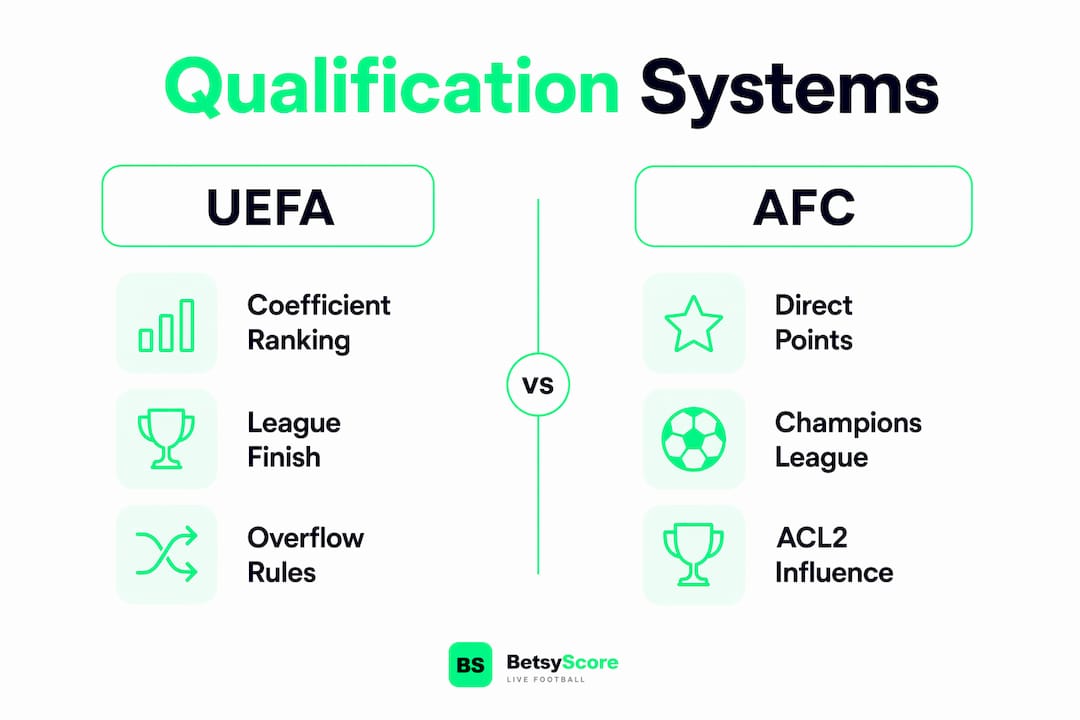
The allocation of qualification spots depends primarily on two factors: a national association’s multi-year coefficient ranking and the domestic league finishing position of individual clubs. The coefficient is a five-year rolling performance metric that aggregates club results across continental competitions to determine how many spots each association receives. Top European leagues, including England, Germany, Italy, and Spain, typically send their top four finishers directly into the UEFA Champions League group stage. Associations with lower coefficients receive fewer automatic berths and must send clubs through qualifying rounds instead.
The system does not stop at domestic finishes. Continental confederation-specific qualifying tournaments serve as a second filter, giving clubs from smaller associations a path into the main draw. The AFC, for example, adjusts qualification slots based on club performances in the AFC Champions League and ACL2, rewarding associations whose clubs perform well over multiple seasons.
Qualification criteria vary by confederation, but the core logic is consistent across UEFA, AFC, CAF, CONMEBOL, and CONCACAF:
- Domestic league rank is the primary qualification determinant for most clubs.
- National association coefficient sets the number of spots available to each league.
- Continental qualifying rounds provide additional entry points for clubs from lower-ranked associations.
- Overflow redistribution shifts spots when a cup winner or title holder already qualifies through the league.
The overflow rule deserves particular attention. Cup final results can shift qualification thresholds from sixth place all the way to ninth place in a domestic league, depending on whether the cup winner has already secured a top-four finish. This redistribution changes the qualification target for mid-table clubs every season, adding a layer of unpredictability to the final weeks of any domestic campaign.
| Confederation | Primary Qualification Method | Secondary Method |
|---|---|---|
| UEFA | Domestic league finish + coefficient | Qualifying rounds, play-offs |
| AFC | Domestic league finish + ACL coefficient | ACL2 qualifying rounds |
| CONMEBOL | Domestic league finish | Copa Libertadores qualifying |
| CAF | Domestic league finish | CAF Champions League qualifying |
| CONCACAF | Domestic league finish | Regional qualifying rounds |
How does qualification affect club finances and squad decisions?
Continental qualification reshapes a club’s entire operating model. The financial windfall from Champions League participation runs into hundreds of millions of euros for elite clubs. For smaller clubs, even a single season in the competition can deliver €36 million, a figure that can equal or exceed their entire annual wage bill.

This revenue gap drives behavior throughout the season. Clubs near the qualification threshold intensify squad rotation, prioritize league points over cup runs, and make targeted transfer decisions in january to protect their position. The transfer market activity visible on platforms like Betsyscore transfers often reflects exactly this calculus, with clubs buying defensively minded players in the second half of the season to secure a top-six finish.
The pressure cuts both ways. Clubs that qualify for lower-tier continental competitions, such as the UEFA Europa Conference League, face a difficult calculation. Additional matches strain squad depth, and UEFA’s 70% wage-to-revenue cap forces some clubs to cut payroll despite the increased fixture load. Premier League clubs qualifying for the Conference League have faced this exact conflict, where the prestige of European football comes with a budget constraint that limits their ability to compete domestically.
Key financial effects of continental qualification on clubs:
- Revenue uplift from prize money, broadcast fees, and matchday income.
- Wage cap pressure under UEFA’s stricter financial regulations compared to domestic rules.
- Recruitment leverage when attracting players who want European football on their résumé.
- Squad depth requirements that force clubs to expand rosters and increase payroll.
Pro Tip: Watch how clubs in the fifth through eighth positions of major leagues manage their squads in march and april. Their transfer activity and lineup choices in that window reveal exactly how much they value continental qualification versus domestic cup runs.
How do qualification systems differ across continents?
The structural differences between confederation qualification pathways are significant, and they produce very different competitive environments. UEFA’s system is the most financially developed. The revamped Swiss model for the Champions League has increased commercial revenue for the confederation but has intensified the financial gap between qualifying and non-qualifying clubs. One club earned €42 million equal to 140% of their operating revenue from a single Champions League campaign. That kind of disparity makes qualification a near-existential priority for clubs in competitive leagues.
The AFC system operates differently. Points earned by clubs in the AFC Champions League and ACL2 directly influence how many spots each national association receives in future seasons. This creates a collective incentive for domestic leagues to support their clubs in continental competition, not just their national teams.
CAF and CONCACAF qualification pathways face structural challenges that UEFA does not. Smaller domestic leagues in Africa and Central America often lack the broadcast revenue to sustain clubs through long qualifying campaigns. The result is a bottleneck effect, where one or two dominant clubs from each association monopolize continental qualification spots year after year, reducing competitive variety in the tournament draw.
CONMEBOL’s Copa Libertadores qualification system sits between these extremes. Brazil and Argentina send multiple clubs based on domestic league performance, while smaller nations like Bolivia and Venezuela send fewer clubs through qualifying rounds. The system maintains geographic diversity without fully resolving the financial imbalance between large and small football markets.
Pro Tip: When analyzing a continental draw, check the coefficient ranking of each association, not just the club’s recent form. A club from a lower-ranked association may have qualified through a weaker domestic league, making their continental pedigree less reliable than their league position suggests.
Qualification systems integrate local domestic performance with global football hierarchies, enforcing a competitive structure that links national competitions to international tournaments. This integration is what gives domestic leagues their meaning beyond the title race.
What do qualification leagues mean for fans and analysts?
Continental qualification transforms the bottom two-thirds of a league table into a genuinely competitive story. The title race may involve three or four clubs, but the qualification race for European football can involve eight to ten clubs simultaneously, each chasing a different threshold. That complexity rewards fans and analysts who track league tables beyond the top positions.
For sports analysts, the qualification race shapes forecasting models in ways that pure form tables do not capture. A club fighting for fourth place will prioritize league points over cup competitions. A club already safe in third will rotate its squad. These behavioral patterns are predictable once you understand the qualification stakes, and they directly affect match outcome probabilities.
The transfer market reflects qualification status in real time. Clubs that secure European football early attract better loan signings and free agents in the summer window. Clubs that miss out often lose key players who want continental experience. Betsyscore tracks live league standings across more than 200 competitions, making it straightforward to monitor which clubs are inside or outside the qualification positions at any point in the season.
Practical ways to use qualification knowledge as a fan or analyst:
- Track the overflow threshold in domestic leagues, since cup results shift the qualification cutoff unpredictably.
- Monitor squad rotation in the final ten matches of the season, as clubs near the qualification line often field full-strength lineups regardless of fixture difficulty.
- Follow coefficient rankings published by UEFA and AFC to understand which associations are gaining or losing spots for the following season.
- Use AI-driven predictions that factor in qualification pressure when assessing match importance and likely lineup intensity.
Key Takeaways
Continental qualification leagues determine club revenue, squad strategy, and competitive balance across every major football market simultaneously.
| Point | Details |
|---|---|
| Coefficient rankings drive spot allocation | A five-year rolling metric decides how many clubs each association sends to continental tournaments. |
| Financial stakes are transformative | Qualification revenue can equal up to 200% of a smaller club’s operating budget in a single season. |
| Overflow rules shift thresholds annually | Cup results can move the qualification cutoff from sixth to ninth place, changing mid-table targets. |
| Wage caps create a qualification dilemma | UEFA’s 70% wage-to-revenue rule forces some clubs to cut payroll despite earning European football. |
| Analyst value extends beyond the title race | Qualification battles involve up to ten clubs and produce predictable behavioral patterns worth tracking. |
Why the qualification story is the most underrated part of the season
Most football coverage focuses on the title race and the relegation battle. The qualification race sits in the middle, and it is consistently the most analytically rich part of any domestic season. I have spent years watching how clubs behave when they are two points outside a Champions League spot in april, and the patterns are remarkably consistent. Squad rotation stops. Transfer targets shift. Managers who rotated freely in february suddenly field their strongest eleven every week.
What concerns me about the current trajectory is the widening financial gap that qualification creates. The Champions League revamp benefits UEFA commercially, but it concentrates revenue among clubs that already qualify regularly. That concentration makes it harder for a mid-table club to close the gap, which reduces long-term competitive variety in domestic leagues. The reform conversation needs to address redistribution, not just expansion.
For fans who want to engage more deeply with the sport, I recommend tracking the World Cup 2026 qualification alongside domestic league races. The two stories intersect constantly. A national team’s World Cup qualification campaign affects player availability, club form, and even transfer valuations. Understanding both layers simultaneously gives you a far more complete picture of why clubs perform the way they do at specific points in the season.
— Aria
Betsyscore and the continental qualification race
Qualification races move fast, and the margin between fourth and fifth place can shift on a single midweek result. Betsyscore delivers live match scores that refresh every few seconds, so you never miss a result that reshapes the qualification table.

Betsyscore’s AI-powered predictions factor in qualification pressure directly, using expected goals, recent form, and head-to-head records to model how much a club’s lineup intensity changes when European football is on the line. The platform covers the Premier League, La Liga, Bundesliga, Serie A, the Champions League, and more than 200 competitions worldwide. AI match predictions are available before every kickoff, giving analysts and fans a data-backed read on which qualification battles are most likely to produce high-stakes performances.
FAQ
What is the role of continental qualifications leagues?
Continental qualification leagues determine which clubs and national teams earn spots in major international tournaments such as the UEFA Champions League and FIFA World Cup. They link domestic league performance to global competition through coefficient rankings, domestic finishing positions, and confederation-specific qualifying rounds.
How are Champions League spots distributed among leagues?
Spot distribution depends on a national association’s five-year coefficient ranking and domestic league finishing positions. Top leagues like England, Germany, Italy, and Spain typically send their top four finishers directly, with additional spots allocated through qualifying rounds.
Can a cup winner change who qualifies from a domestic league?
Yes. Overflow redistribution rules apply when a cup winner has already qualified through the league. The spot shifts to the next eligible league finisher, moving the qualification threshold from sixth to as high as ninth place in some seasons.
Why do some clubs avoid qualifying for the Conference League?
UEFA’s 70% wage-to-revenue cap forces clubs to reduce payroll when they qualify for European competition, even when the prize money increases. For clubs with high wage bills relative to revenue, the Conference League can trigger mandatory budget cuts that weaken their domestic squad.
How does the AFC qualification system differ from UEFA’s?
The AFC adjusts the number of qualification slots each national association receives based on club performances in the AFC Champions League and ACL2 over multiple seasons. This creates a collective incentive for domestic leagues to support their clubs in continental competition, unlike UEFA’s primarily individual club-based coefficient model.