La Liga 2026-27 Season Preview: Barcelona vs Mourinho's Madrid
Barcelona enters the 2026-27 season as the favorite to win a third straight La Liga title, but Real Madrid’s decision to hire José Mourinho has turned this into a tactically unpredictable title race. The rivalry frames everything else about the campaign.
Several clubs realistically matter for the championship:
- Barcelona — two-time defending champion, chasing a third straight crown
- Real Madrid — rebuilding under Mourinho after two trophyless seasons
- Atlético Madrid — the perennial spoiler with the squad to disrupt both
- A trailing pack — Athletic Club, Villarreal and others positioned to steal European spots if the top three stumble
This is a season built on contrast: Barcelona’s continuity against Madrid’s managerial reset, with a World Cup hangover threatening to scramble the opening months for everyone.
Key Takeaways
Barcelona enters as the favorite to win a third straight La Liga title, but Mourinho’s Real Madrid and a compressed post-World Cup calendar make this the least predictable season in years.
| Point | Details |
|---|---|
| Barcelona leads the race | Squad continuity and Lamine Yamal’s rise make them strong contenders. |
| Mourinho reshapes Madrid | His pragmatic, transition-focused approach is the season’s biggest tactical wildcard. |
| World Cup fatigue matters early | Watch for rotation and early substitutions among heavy World Cup minute players in August. |
| Budget gaps define the middle | Academy development and smart recruitment matter more than spending for mid-table survival. |
| Track live form with BetsyScore | Live scores, AI predictions, and player ratings help you follow fatigue and momentum shifts as they happen. |
Table of Contents
- La Liga 2026-27 Season Preview: Dates, Format and Confirmed Clubs
- Who Are the Real Title Contenders This Season?
- Which Teams Could Surprise, and Who’s Fighting Relegation?
- Which Players Should You Watch This Season?
- How Did the Summer Transfer Window Reshape the Race?
- How Will World Cup Fatigue Affect the Opening Weeks?
- What Are the Key Early Fixtures and Where Can You Follow Them?
- Who Wins La Liga in 2026-27? Final Predictions
- How Did Last Season’s Top Teams Perform?
- Are There New Rules for the 2026-27 Season?
- How Do Club Budgets Shape the Competitive Balance?
- Which Young Players Are Breaking Through This Season?
- What Tactical Trends Should You Expect This Season?
- What I’ll Be Watching Every Matchday
- Follow Every La Liga Match With Live Scores and AI Predictions
- Sources
- FAQ
La Liga 2026-27 Season Preview: Dates, Format and Confirmed Clubs
The 96th edition of La Liga kicks off in mid-August 2026, with the opening round landing on or around August 14 and 15. That start date follows directly on the heels of the 2026 FIFA World Cup, leaving clubs with an unusually short close season to rebuild fitness and reintegrate returning internationals.
The essentials for 2026-27:
- Format: 20 clubs, 38 matchdays, home-and-away round robin, same as every season since the current structure began
- Sponsor: the league continues to compete as LaLiga EA Sports, with official fixtures and results published through LaLiga’s own channels
- Newly promoted sides: the clubs that came up from Segunda División bring fresh energy but face the usual gap in squad depth and budget against the established top half
- Notable pre-season shift: several clubs restructured their conditioning programs specifically to account for players returning from World Cup duty
Fixture changes and postponements will be published through LaLiga’s official schedule, which remains the definitive source once the season is underway.
Who Are the Real Title Contenders This Season?
Not every club with a big name deserves a place in the title conversation. Here’s a breakdown of who actually does, and why.
-
Barcelona. Squad continuity is their biggest weapon. Keeping the core of a title-winning group together for a third consecutive campaign is rare in modern football, and it shows in how quickly they start seasons compared to rivals rebuilding on the fly. Lamine Yamal remains the player around whom the entire attacking structure is built, and his growth from breakout teenager to established difference-maker is the single biggest reason Barcelona open as favorites. Expect the same possession-heavy identity, just with sharper edges after another year together.
-
Real Madrid. The Mourinho appointment is the story of the Spanish season. Madrid brought him in specifically to end a two-season trophy drought, and previews across the sport frame this as a deliberate, results-first pivot rather than a stylistic upgrade. That makes Madrid harder to predict than Barcelona. Mourinho’s sides have historically prioritized defensive solidity and game management over expansive football, which could mean a more pragmatic, counter-punching Madrid than fans have seen in recent years. Whether that suits the current squad’s attacking talent is the open question of the season.
-
Atlético Madrid and the chasing pack. Atlético has the tactical discipline to trouble both Catalan and capital rivals, but they need Barcelona or Madrid to slip in at least one derby to have a realistic shot. Athletic Club and Villarreal sit a tier below on squad depth but could climb into the El Clásico conversation if injuries hit the top two hard.
Pro Tip: Watch how Mourinho sets up Madrid in the first two Clásicos specifically. His approach to that fixture, cautious or aggressive, will tell you more about his full-season plan than any pre-season friendly.
Which Teams Could Surprise, and Who’s Fighting Relegation?
Every La Liga season produces at least one club that outperforms its budget, and several that sink faster than their reputation suggests they should. Here’s where to look on both ends.
Dark horses worth tracking:
- Athletic Club — stable coaching staff and a well-drilled academy pipeline give them a floor most mid-table sides lack
- Villarreal — smart recruitment history means their squad often overperforms its wage bill
- Real Betis — continuity in the dugout plus a settled attacking core could push them toward a European spot
Relegation candidates to watch:
- Clubs that changed managers more than once last season tend to carry that instability into the new campaign
- Promoted sides without a proven top-flight goal scorer historically struggle to survive their first year back up
- Teams that lost their best player in the transfer window without reinvesting the fee are the most common relegation story in La Liga, year after year
Squad depth and boardroom patience separate the sides that stabilize from the ones that spiral once results turn.
Which Players Should You Watch This Season?
The title race will be decided as much by individual form as by tactics. These are the names most likely to swing results:
- Lamine Yamal (Barcelona) — the focal point of Barcelona’s attack and the player defenses now build entire game plans around
- Vinícius Júnior (Real Madrid) — his relationship with Mourinho’s system will shape how Madrid attack all season
- Robert Lewandowski (Barcelona) — still the most clinical finisher in the league when fully fit
- Jude Bellingham (Real Madrid) — the midfield engine Mourinho needs functioning at full capacity
- Antoine Griezmann (Atlético Madrid) — the experienced anchor for any Atlético title push
- Breakout candidates from academy systems who could force their way into first-team rotations once World Cup fatigue creates opportunities
BetsyScore’s La Liga player ratings track exactly this kind of form shift match by match, which matters more than usual this year given how compressed the early fixture list is. A player rated poorly in August because of World Cup fatigue can look completely different by October, and the ratings data captures that trajectory better than reputation alone.
How Did the Summer Transfer Window Reshape the Race?
Transfer activity this summer did more to separate contenders from pretenders than any tactical tweak could. Clubs that added rotation-ready depth are the ones best positioned for the compressed post-World Cup calendar.
- Barcelona prioritized squad depth over marquee signings, reinforcing positions that thin out during injury spells rather than chasing headlines
- Real Madrid’s business under Mourinho leaned toward players suited to a more compact, transitional style, a signal of how he intends to set up the team
- Mid-table clubs that lost key players without reinvesting the transfer fee immediately look thinner heading into the season
- Clubs that strengthened bench options rather than starting elevens are the ones best equipped for a season where fixture congestion will punish thin squads harder than usual
The clubs that treated this window as depth-building rather than star-chasing are the ones most likely to still look sharp in April.
How Will World Cup Fatigue Affect the Opening Weeks?
The gap between the World Cup final and La Liga’s kickoff is short enough that fitness, not tactics, may decide the opening month. Clubs with several players who logged heavy World Cup minutes are adapting their pre-season and rotation plans specifically to manage that fatigue.
Watch for these signals:
- Players who played deep into the World Cup often start the season on the bench or come off early, regardless of reputation
- Clubs with several internationals from the same country tend to rotate more aggressively across the first two or three matchdays
- Late pre-season minutes, or the lack of them, are often a better fitness indicator than a player’s name on the team sheet
Pro Tip: When a star player gets subbed off at the 60-minute mark in August, don’t assume it’s tactical. It’s more likely load management, and BetsyScore’s live momentum tracking often shows the team’s rhythm shifting the moment that substitution happens.
What Are the Key Early Fixtures and Where Can You Follow Them?
The opening weeks carry extra weight this season because World Cup fatigue could produce upsets that wouldn’t happen in a normal August. Watch for early meetings between top-four sides, since a shaky Real Madrid or a rotated Barcelona lineup could hand a rival an early psychological edge.
- Opening-weekend fixtures for Barcelona, Real Madrid and Atlético deserve particular attention for lineup selections and player fatigue
- Any early scheduling changes or postponements get published through LaLiga’s official fixture list
- For real-time tracking, BetsyScore Live offers minute-by-minute momentum data that flags shifts in match control before the scoreline changes
Who Wins La Liga in 2026-27? Final Predictions
Barcelona are the pick to win the title, built on continuity and Yamal’s continued rise, but the margin over Madrid looks narrower than it did a year ago.
- Champion: Barcelona, on the strength of squad familiarity and attacking depth that Madrid is still assembling under a new manager
- Likely top four: Barcelona, Real Madrid, Atlético Madrid, and one of Athletic Club or Villarreal rounding out the Champions League places
- Relegation candidates: newly promoted sides without proven top-flight scorers, plus any mid-table club that lost a key player this summer without reinvesting the fee
Three wildcards could flip this forecast: a serious injury to Yamal or Bellingham, a January move that reshapes a title contender’s midfield, or a fixture pileup from Champions League progress that exhausts a thin squad by March.
How Did Last Season’s Top Teams Perform?
Barcelona’s run to back-to-back titles was built on a level of attacking consistency few La Liga champions have matched in recent memory. They rarely went more than a couple of matches without scoring multiple goals, and their away form, historically a weak point for Spanish champions, held up better than expected.

Real Madrid’s previous campaign told a different story. Individual quality carried them through long stretches, but tactical inconsistency under the previous coaching setup cost points against mid-table sides they were expected to beat comfortably. That inconsistency is precisely what the Mourinho hire is meant to correct: fewer dropped points against teams outside the top six, even if it comes at some cost to attacking flair.
Atlético’s trend has been steadier defensively but toothless in the final third against the two giants directly above them. Sample results from recent matchdays, like the November 2025 slate, showed a familiar pattern: Atlético grinding out results against mid-table sides while struggling to convert dominance into goals against elite opposition.
That gap, control without conversion, is the single biggest thing standing between Atlético and a genuine title challenge this season.
Are There New Rules for the 2026-27 Season?
No structural changes affect how the 20-team, 38-match format works this season. The core competition remains a straightforward home-and-away league table, decided on points, with goal difference and head-to-head record as the standard tiebreakers.
Where change shows up is in scheduling logistics rather than competition rules. The condensed calendar following the World Cup has pushed some clubs and broadcasters to discuss adjusted matchday spacing in the opening rounds, giving squads slightly more recovery time between fixtures than a typical August slate allows. Video assistant referee protocols continue under the same framework used in recent seasons, with no major procedural overhaul announced for this campaign.
The more consequential shift is behavioral rather than regulatory: clubs are treating squad rotation as a season-long strategy rather than a late-season necessity, a direct response to the compressed fixture list. Managers who resist rotating early, out of habit or ego, are the ones most likely to see form collapse by matchday ten. This isn’t a rule change on paper, but it’s reshaping how the season gets played in practice.
How Do Club Budgets Shape the Competitive Balance?
Money remains the clearest dividing line in La Liga, and this season is no exception. Barcelona and Real Madrid continue to operate in a financial tier the rest of the league can’t approach, with revenue streams from global sponsorships and stadium redevelopment projects that dwarf anything available to a mid-table club.
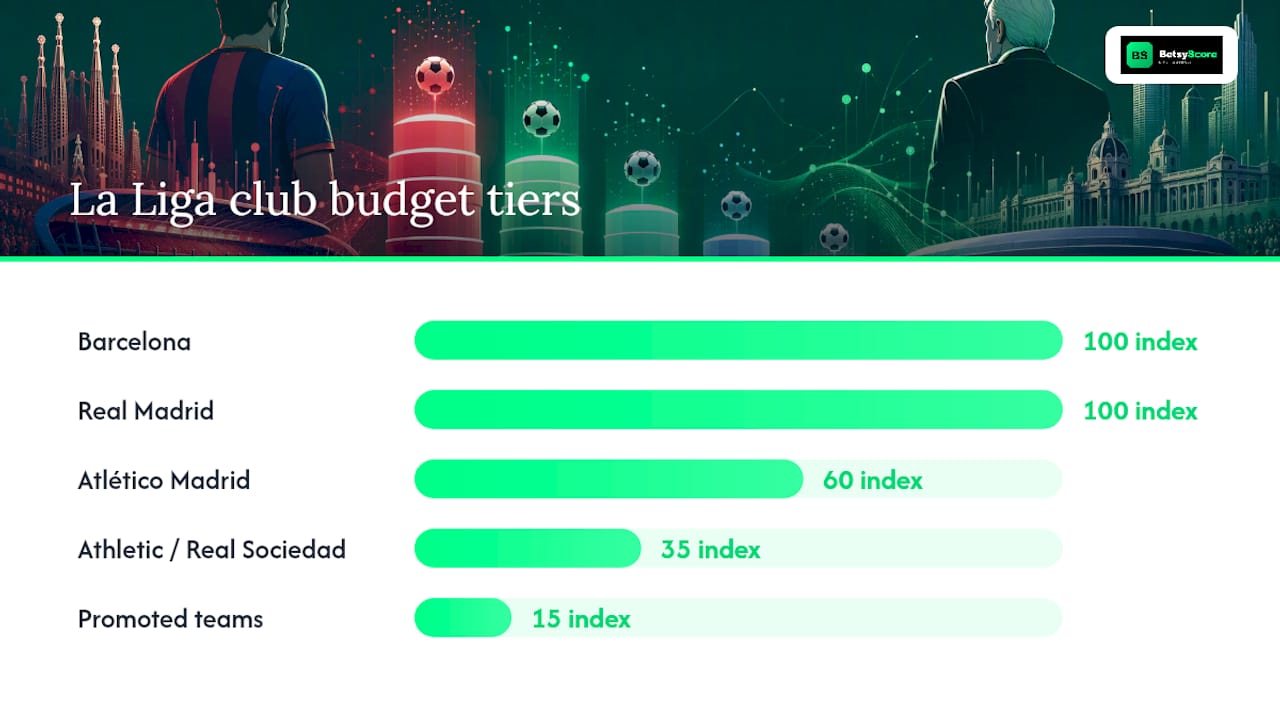
Atlético Madrid sits in a distant but genuine third tier, financially capable of competing for individual signings but not of matching the wage structures at the top two clubs across an entire squad. That gap is exactly why Atlético’s path to the title depends on tactical efficiency rather than outspending rivals.
Below that, the financial cliff is steep. Clubs like Athletic Club and Real Sociedad rely on smart recruitment and academy development rather than transfer spending to stay competitive, which is precisely why their academy pipelines matter more to their season than any single signing. Newly promoted clubs face the widest gap of all: television revenue in La Liga is distributed more evenly than in some European leagues, but it still isn’t enough to close the distance to established top-flight squads within a single transfer window.
That financial reality is also why summer transfer business matters more for mid-table and promoted clubs than for the giants. A single smart signing can lift a mid-table club’s whole season, while Barcelona or Madrid can absorb a transfer misstep without it derailing their campaign.
Which Young Players Are Breaking Through This Season?
Academy production remains one of La Liga’s defining strengths, and this season should showcase it again. Barcelona’s La Masia continues to be the standard-bearer, having already produced Yamal as a generational talent, and the pipeline behind him includes several teenagers pushing for first-team minutes.
Real Madrid’s youth setup has quietly built its own depth of technically gifted midfielders and forwards, several of whom could see expanded roles if the World Cup calendar forces Mourinho to rotate more than he’d prefer in the early months.
Beyond the two giants, Athletic Club’s academy tradition, built entirely around Basque-born or developed players, keeps producing first-team-ready talent at a rate that punches well above the club’s financial weight. Villarreal and Real Sociedad have similarly efficient pipelines that regularly place academy graduates directly into competitive league minutes rather than loaning them out indefinitely.
Watch lower-division loan spells closely this season. Several of the most promising names in Spanish football are currently out on loan at Segunda División clubs, gaining first-team experience that top-flight academies increasingly treat as essential before a permanent promotion. A strong loan season for one of these prospects could accelerate a first-team debut well before next summer.
What Tactical Trends Should You Expect This Season?
Mourinho’s return to Madrid is the single biggest tactical variable in the league. His track record favors compact defensive structures and rapid transitions over sustained possession, a philosophy that stands in direct contrast to Barcelona’s positional, ball-dominant approach. That contrast is what makes this rivalry so compelling tactically, not just competitively.

Expect more clubs across the league to copy elements of a low-block, counter-attacking approach against the top two, since that’s historically been the most effective way to take points off possession-heavy sides. Atlético has run this playbook for years and other mid-table clubs are increasingly borrowing pieces of it.
At the other end, Barcelona’s continued success with a possession-based, high-press identity will likely keep that style as the aspirational model for ambitious mid-table clubs, even if few have the personnel to execute it consistently across 38 matches. The compressed post-World Cup calendar adds another layer: expect more in-game tactical substitutions built around managing fatigue rather than chasing goals, particularly in the first ten matchdays.
What I’ll Be Watching Every Matchday
The most compelling storyline isn’t who wins the title. It’s whether Mourinho’s pragmatism can actually coexist with Real Madrid’s attacking talent, or whether it creates friction that costs them points against sides they should beat. Every matchday, I check lineups for World Cup returnees and watch BetsyScore’s momentum data during the opening 20 minutes. It tells you who’s actually in control faster than the scoreline does. Share your own predictions as the season unfolds.
Follow Every La Liga Match With Live Scores and AI Predictions
A World Cup hangover season like this one rewards fans who watch closely, not just fans who check final scores. Betsyscore gives you the tools to actually follow the fatigue factor, the rotation calls, and the momentum swings that decide these early matchdays, in real time, for free.

What you get during La Liga 2026-27:
- Live scores that update every few seconds, so you catch substitutions and momentum shifts as they happen
- AI-powered win probabilities built from expected goals, recent form, and head-to-head history for every fixture
- Minute-by-minute momentum tracking that shows which side is actually controlling a match, not just who’s ahead
- Detailed La Liga player ratings that track form across the season, useful for spotting a World Cup fatigue dip before it shows up in the box score
Check live scores now or head to the predictions page before the next Clásico kicks off and see where the win probabilities stand.
Sources
- 2026–27 La Liga — Wikipedia
- La Liga 2026-27 preview: Madrid look to Mourinho in bid to dethrone Barcelona — The Guardian
- How LaLiga clubs have adapted their routines for the World Cup — TSN
FAQ
When Does the 2026-27 La Liga Season Start?
The season kicks off in mid-August 2026, with the opening round landing on or around August 14 and 15, shortly after the 2026 FIFA World Cup concludes.
Which Teams Are Confirmed for La Liga in 2026-27?
The league runs with its standard 20-club format, made up of clubs that survived relegation last season plus the sides promoted from Segunda División. Full club-by-club confirmation is published through LaLiga’s official fixture list.
What Is the La Liga Fixture Schedule for 2026-27?
The season follows the standard 38-matchday, home-and-away format across 20 clubs. Official fixtures, including any early postponements tied to World Cup recovery, are published on LaLiga’s website.
How Far in Advance Are La Liga Fixtures Confirmed?
LaLiga typically releases the full 38-matchday schedule a few months before kickoff, though early-season fixtures can shift slightly due to broadcasting demands or, this year, World Cup recovery scheduling.
Who Is Favored to Win La Liga in 2026-27?
Barcelona enters as the favorite to win a third consecutive title, with Real Madrid under José Mourinho seen as the primary challenger. You can track live win probabilities for every matchday through BetsyScore’s predictions page.