Best Competitions Across 200 Leagues: 2026 Global Rankings
The best competitions across 200 leagues are defined by three measurable criteria: squad market value, average player ratings, and consistent competitive depth across an entire season. The English Premier League leads all global competitions with over €12.56 billion in squad market value and generates €7.1–7.5 billion annually. That figure alone separates elite league football from single-event tournaments like the FIFA World Cup Final, which draws massive viewership but runs for only 90 minutes. Betsyscore tracks all of these competitions, from the Premier League to more than 200 leagues worldwide, giving fans real-time data to measure quality beyond reputation alone.
1. What are the top-ranked soccer competitions globally?
The globally recognized elite leagues are the English Premier League, La Liga, Serie A, Bundesliga, and Ligue 1. These five competitions, collectively called the “Big Five,” dominate squad market values, player rating averages, and broadcasting revenues. Brazil’s Série A ranks 6th globally, sitting just 1.3 points behind the lowest-ranked Big Five league by TransferRoom’s methodology.

| League | Global Rank | Squad Market Value | Avg. Attendance | Avg. Player Rating |
|---|---|---|---|---|
| Premier League | 1 | €12.56 billion | 40,474 | 83.5 |
| La Liga | 2 | Not publicly listed | Not publicly listed | Not publicly listed |
| Serie A | 3 | Not publicly listed | Not publicly listed | Not publicly listed |
| Bundesliga | 4 | Not publicly listed | Not publicly listed | Not publicly listed |
| Ligue 1 | 5 | Not publicly listed | Not publicly listed | Not publicly listed |
| Brazil Série A | 6 | Not publicly listed | Not publicly listed | Not publicly listed |
The Premier League’s average stadium attendance of 40,474 per match reflects both fan demand and commercial infrastructure. No other league combines that attendance figure with a squad market value above €12 billion.
- Premier League: Highest squad value, revenue, and global broadcast reach.
- La Liga: Home to FC Barcelona and Real Madrid, with consistent UEFA Champions League representation.
- Serie A: Strong tactical tradition and rising squad investment post-2022.
- Bundesliga: Highest average attendance in Europe, known for fan-owned club models.
- Ligue 1: Paris Saint-Germain drives international profile; rest of league rebuilding depth.
- Brazil Série A: Best non-European league by ranking, with clubs reaching FIFA Club World Cup quarterfinals.
Pro Tip: If you follow La Liga for tactical depth, pair it with Serie A viewing to compare two distinct defensive philosophies at the elite level.
2. Which emerging leagues are reshaping global soccer?
The Saudi Pro League climbed to 13th globally by TransferRoom’s 2026 rankings, driven by high-profile signings from European leagues. That ranking reflects individual star quality more than overall league depth, a distinction that matters when evaluating long-term competitiveness. Opta’s analysis confirms that league depth, not star power, determines true league strength.
Major League Soccer reached 18th globally in january 2026, a direct result of Lionel Messi’s signing with Inter Miami and the club’s subsequent MLS Cup performance. That rise is significant because MLS had historically ranked outside the top 25. The league now attracts scouts and broadcasters who previously ignored it.
Other leagues showing upward trajectories include:
- Liga Portugal: Consistent UEFA competition qualifiers; Sporting CP and Benfica export talent regularly to Big Five clubs.
- Eredivisie: Ajax and PSV maintain strong continental records despite a recent Opta ranking slide.
- Czech Liga: Clubs like Slavia Prague qualify for UEFA group stages with regularity, signaling genuine depth.
- Liga I (Romania): An example of a developing European league building continental ambitions through youth development.
Pro Tip: Track transfer activity in Liga Portugal and the Eredivisie. These leagues consistently produce players who move to Big Five clubs within two seasons, making them reliable talent pipelines for fantasy sports and scouting.
3. How do player ratings and competitive balance define the best leagues?
Different ranking systems use varied approaches: aggregate team power, player rating averages, or historical performance. That variation causes league ranks to shift depending on which methodology you apply. Understanding the framework behind a ranking tells you as much as the ranking itself.
TransferRoom’s player rating system measures average quality across all clubs in a league, not just the top two or three. Opta’s Power Rankings apply a similar principle, weighting overall club strength over individual signings. Both systems agree on one point: a league where the bottom half of clubs performs at a high level outranks a league built around two dominant clubs.
England’s Championship, a second-tier league, carries an average player rating of 75.4 and ranks in the global top 10 by that metric. That result means England’s second division outperforms the top flight of most countries worldwide. It is the clearest evidence that league depth, not prestige, drives genuine competitive quality.
The 2. Bundesliga in Germany follows a similar pattern. Clubs like Hamburger SV and Schalke 04 maintain squad values and player ratings that would place them comfortably in the top half of several European top flights. Second-tier strength is the hidden metric most fans overlook when ranking global competitions.
| Metric | What It Measures | Why It Matters |
|---|---|---|
| Average player rating | Quality across all clubs | Reveals true league depth |
| Squad market value | Financial investment in talent | Signals long-term competitiveness |
| Competitive balance index | Points gap between 1st and last | Shows how many clubs can win |
| UEFA/FIFA coefficient | Continental performance history | Confirms sustained quality |
4. What makes some leagues stand out to fans and the global audience?
Fan engagement is a separate metric from competitive quality, and the two do not always align. The Premier League’s 40,474 average attendance per match is the highest among the Big Five leagues. That figure reflects decades of stadium investment, safe standing reforms, and a broadcast product that reaches 188 countries.
Brazil’s Série A generates some of the most intense fan atmospheres in world football. Fixtures like Flamengo vs. Palmeiras regularly fill 70,000-seat stadiums and carry cultural weight that no European league can replicate in South America. The football derbies and rivalries within Brazilian football are among the most historically charged in the sport.
Broadcasting rights and global reach amplify a league’s status beyond its borders. The Premier League’s international rights deals mean a fan in Jakarta or Lagos watches the same product as a fan in Manchester. That global distribution creates a feedback loop: more viewers attract more sponsors, which funds better squads, which raises the quality of competition.
Key factors that drive global audience engagement:
- Historic club rivalries that carry generational significance (El Clásico, Derby della Madonnina, Der Klassiker).
- Star player presence that draws casual fans into weekly viewing habits.
- Broadcast accessibility across free-to-air and streaming platforms in multiple regions.
- Consistent title races where three or more clubs compete into the final weeks of the season.
Top global soccer competitions balance high quality, consistent competitive matches, and global audience reach rather than relying on single-event viewership metrics like a World Cup final.
5. How to choose which soccer competitions to follow
Choosing which leagues to follow depends on what you want from the sport. Fans who prioritize tactical quality and squad depth should start with the Premier League and Serie A. Both leagues feature high defensive organization, pressing systems, and weekly matches where the quality gap between clubs is narrow enough to produce genuine upsets.
Fans interested in player development and transfer markets should watch Liga Portugal and the Eredivisie. These leagues consistently produce players who transfer to Big Five clubs, making them ideal for fantasy sports managers and scouts tracking emerging talent. Checking transfer activity alongside league results gives a fuller picture of a league’s trajectory.
For fans focused on entertainment value and atmosphere, Brazil’s Série A and the Bundesliga offer the best combination of passionate crowds and open, attacking football. The Bundesliga’s fan-owned club model keeps ticket prices accessible, which directly contributes to its attendance figures being the highest in Europe.
- For tactical depth: Premier League, Serie A, La Liga.
- For talent scouting and fantasy sports: Liga Portugal, Eredivisie, Czech Liga.
- For atmosphere and entertainment: Bundesliga, Brazil Série A.
- For emerging market interest: Saudi Pro League, MLS, Liga I.
- For international competition context: Track FIFA World Rankings alongside club league results.
Pro Tip: Use Betsyscore’s AI predictions to compare win-probability percentages across leagues. Leagues where predictions are harder to call accurately tend to have stronger competitive balance, which is itself a quality indicator.
Key Takeaways
The best global soccer competitions are ranked by squad market value, average player ratings, and competitive depth across all clubs, not by star signings alone.
| Point | Details |
|---|---|
| Premier League leads globally | €12.56 billion squad value and 40,474 average attendance set the benchmark for elite competition. |
| Big Five plus Brazil | The six strongest leagues worldwide are the Big Five European competitions plus Brazil’s Série A at 6th. |
| Depth beats star power | Opta and TransferRoom both rank leagues by average club quality, not individual signings. |
| Second tiers matter | England’s Championship ranks top 10 globally by player rating, outperforming many countries’ top flights. |
| Emerging leagues are rising | MLS (18th) and Saudi Pro League (13th) are climbing, but sustained depth will determine long-term rank. |
My read on where global soccer competitions are actually heading
The conversation about the best leagues in the world has shifted in the past three years. For most of my time covering football, the Big Five were treated as a closed hierarchy. That assumption no longer holds.
What strikes me most is not the Saudi Pro League’s ranking. It is the methodology debate underneath it. When Opta and TransferRoom both flag that high-profile signings do not translate into league strength, that is a meaningful signal. The league strength analysis from 2026 shows the Saudi league climbed to 13th but still faces a depth problem that money alone cannot solve quickly. Building a competitive league requires years of infrastructure, youth development, and coaching quality at every club, not just the top three.
MLS is the more interesting case. Its rise to 18th is partly Messi-driven, but the underlying club investment across the league is real. The expansion model, where new franchises enter with significant capital, creates a floor of quality that older leagues built slowly over decades. I expect MLS to reach the top 15 within three years if that investment continues.
The insight fans should carry into 2026 is this: a league’s rank tells you about its floor, not its ceiling. The Big Five financial hierarchy) is challenged increasingly by Brazil, Portugal, and the Netherlands through talent development and export. Those leagues may never match Premier League revenue, but their competitive quality is closer than the financial gap suggests.
— Aria
Betsyscore covers all 200-plus competitions in one place
Betsyscore tracks every competition discussed in this article, from the Premier League and La Liga to MLS, the Saudi Pro League, and more than 200 other leagues worldwide. The platform updates live scores every few seconds and layers in AI-powered win-probability percentages built from expected goals, recent form, and head-to-head records.
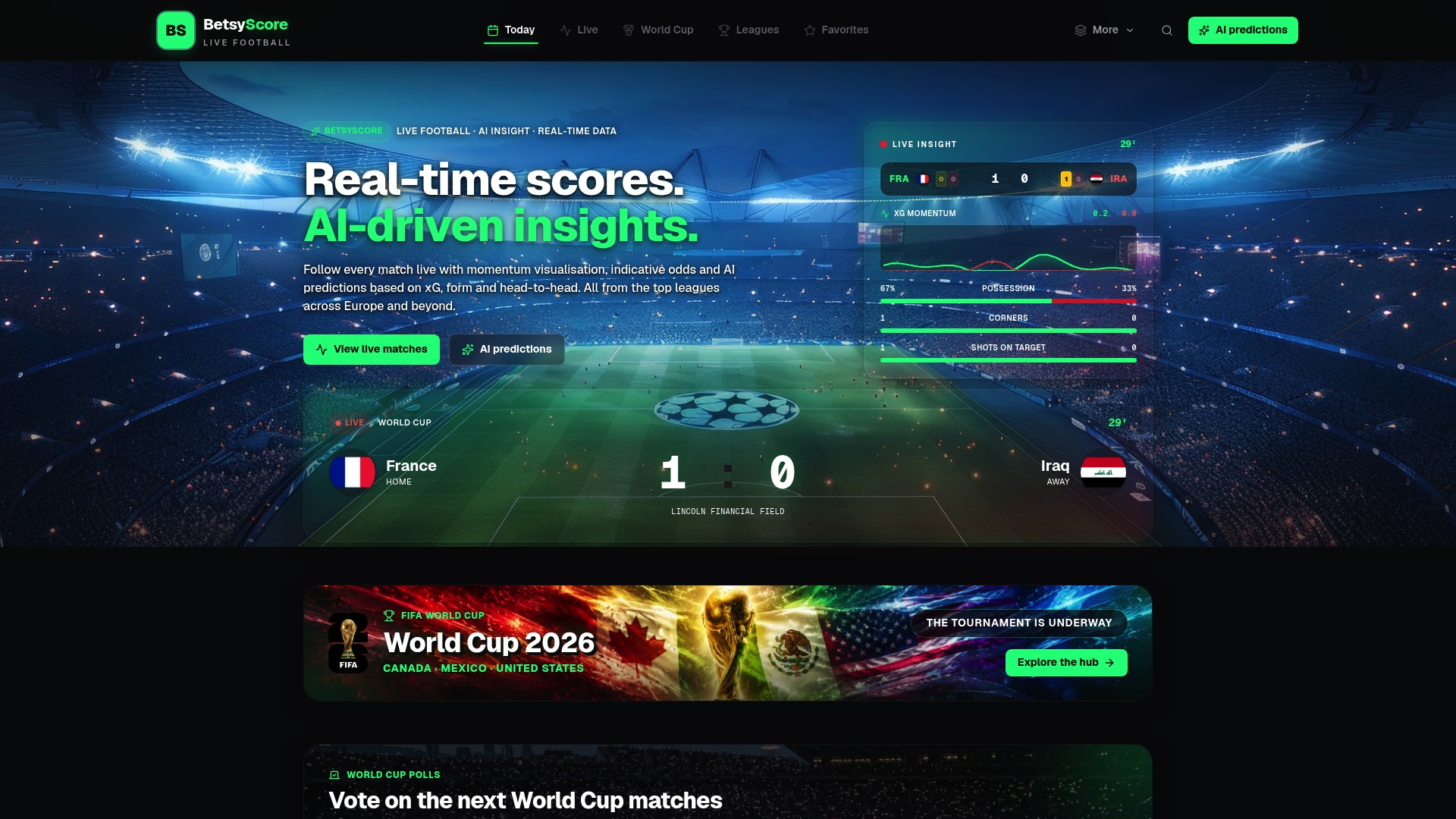
Fans who want to go deeper can access detailed league pages with standings, player profiles, and tournament leaderboards for each competition. For match-by-match tracking, Betsyscore’s live scores feed covers every kickoff across all covered competitions in real time. The World Cup 2026 section is already live with host city data, group stage previews, and fan prediction tools.
FAQ
What league ranks first globally in 2026?
The English Premier League ranks first globally in 2026, with a squad market value exceeding €12.56 billion and an average stadium attendance of 40,474 per match.
How is league strength measured beyond win-loss records?
League strength is measured by average player ratings across all clubs, squad market values, and performance in UEFA or FIFA continental competitions. Opta and TransferRoom both weight overall club depth more heavily than individual star signings.
Which non-European league ranks highest in 2026?
Brazil’s Série A ranks 6th globally in 2026, sitting just 1.3 points behind the lowest-ranked Big Five league by TransferRoom’s methodology. Recent FIFA Club World Cup quarterfinal appearances by Brazilian clubs support that ranking.
Why does England’s Championship rank so high globally?
England’s Championship carries an average player rating of 75.4, placing it in the global top 10 by that metric. That result reflects the depth of English football’s second tier, where relegated Premier League clubs and well-funded Championship sides maintain squad quality above most countries’ top flights.
How can I follow all these competitions in one place?
Betsyscore covers more than 200 competitions worldwide, including the Premier League, La Liga, Bundesliga, Serie A, MLS, and the Saudi Pro League, with live scores, AI predictions, and detailed league statistics updated in real time.