UEFA Rankings and the Champions League: A Fan's Guide

UEFA rankings are a points-based system that determines how many clubs from each country qualify for the Champions League and at what stage they enter the competition. The formal term for this system is the UEFA coefficient, and it operates at two levels: the club coefficient and the association coefficient. Understanding the role of UEFA rankings in the Champions League is not just trivia for die-hard fans. It directly shapes which clubs get a guaranteed seat at Europe’s top table and which ones must fight through qualifying rounds just to get there.
How are UEFA club and association coefficients calculated?
UEFA coefficients are built from match results across five consecutive seasons of UEFA competition. Points accumulate for wins, draws, progression through rounds, and reaching specific qualification stages. That five-season window means a single bad year does not destroy a club’s standing, but sustained underperformance will eventually drag a coefficient down.
The two coefficient types work differently:
- Club coefficient: Calculated directly from a specific club’s results in the Champions League, Europa League, and Europa Conference League over five seasons. Wins and draws earn points. Advancing through rounds adds bonus points.
- Association coefficient: Calculated as the average of the five best club coefficients from clubs representing that country in UEFA competitions during a given season. A country with multiple clubs performing well in Europe will carry a higher association coefficient.
- Timing lag: Association rankings apply with roughly a two-season lag. For example, 2024/25 performance data feeds into the access structure for 2026/27. This lag exists to give leagues and clubs time to plan around their qualification allocations.
- Weighting: More recent seasons carry proportionally more weight in the calculation, so clubs that have improved recently benefit faster than the raw average might suggest.
The association coefficient is the number that matters most for qualification volume. A country ranked higher in the association table sends more clubs directly into the Champions League league phase, while lower-ranked associations must send their clubs through qualifying rounds.
How do UEFA rankings affect Champions League qualification?

The impact of UEFA rankings on Champions League access is direct and structural. Association rankings set how many clubs from each country receive automatic entry into the league phase versus how many must enter through the qualifying path. The top-ranked associations in Europe, historically England, Spain, Germany, Italy, and France, receive the most direct league phase spots. Lower-ranked associations may only guarantee their domestic champion a place in the qualifying rounds.
The key distinctions in how rankings shape access:
- Direct league phase entry: Clubs from top-ranked associations enter the league phase without playing a single qualifying match. This is a significant competitive and financial advantage.
- Qualifying path entry: Clubs from lower-ranked associations enter earlier rounds, facing elimination risk before the main competition even begins.
- Titleholder rebalancing: When the Champions League titleholder also qualifies domestically, a vacancy opens. The highest club coefficient among eligible clubs on the champions path fills that vacancy. This means a club’s coefficient can earn it a direct league phase spot even without a top domestic finish.
- Access list adjustments: UEFA publishes an access list each cycle that maps out exactly how many spots each association receives. That list is built directly from the association coefficient table.
Pro Tip: If you follow a club from a mid-table European association, check where that association sits in the UEFA coefficient rankings. A rise of just a few places can mean the difference between entering in the first qualifying round and entering in the playoff round.
What are European Performance Spots and how do they work?
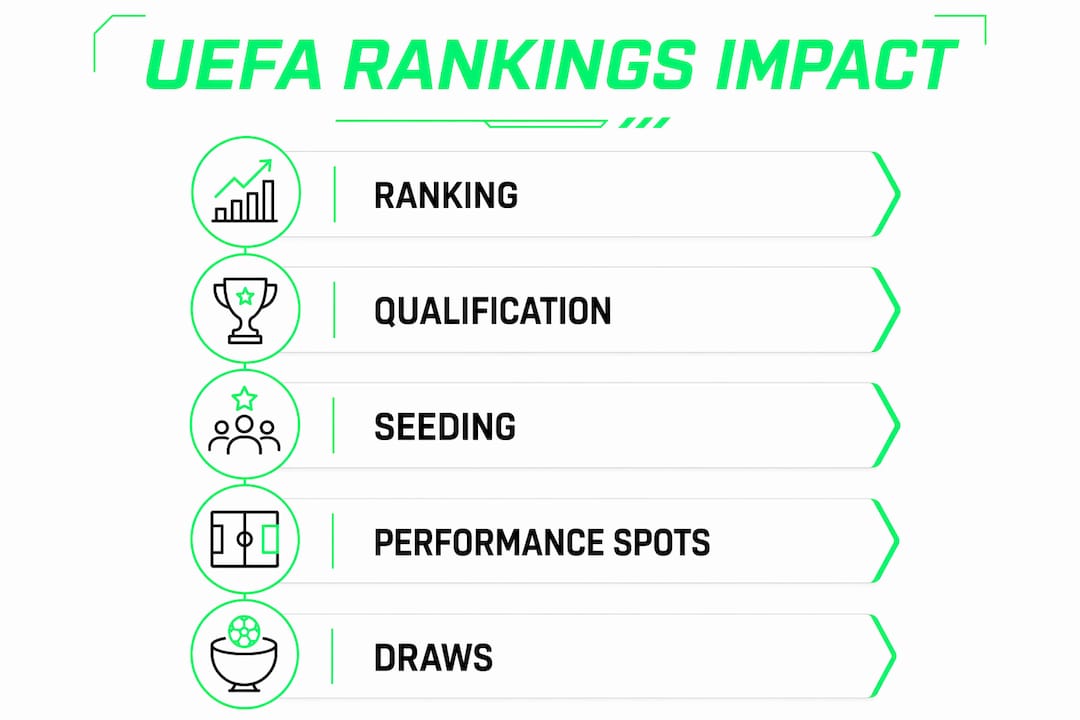
European Performance Spots are one of the newer additions to the Champions League format, and they reward associations whose clubs collectively performed best in UEFA competitions the previous season. Two associations with the best collective club performance in a given season each receive an extra league phase spot for the following season. That extra spot goes to the next-best domestic club that did not already qualify through the standard league finish.
The 2026/27 season provides the clearest example of how this works in practice:
- England and Spain finished as the top two associations in the 2025/26 UEFA club coefficient standings.
- Liverpool and Real Betis each secured extra league phase places via these spots after finishing fifth in their respective domestic leagues.
- The benefit goes to the club ranked next-best domestically behind those who already qualified through standard routes. A fifth-place finish in the Premier League or La Liga would normally fall short of Champions League qualification. With a European Performance Spot, it does not.
Pro Tip: European Performance Spots mean that fans of clubs finishing just outside the top four in England or Spain should watch the association coefficient race closely. A strong collective European campaign by other clubs in the same country can open a backdoor into the Champions League.
European Performance Spots convert association-level strength into practical qualification advantages for individual clubs. This mechanism rewards countries that consistently produce competitive clubs across multiple UEFA competitions, not just the Champions League.
How do UEFA rankings influence Champions League seeding and draws?
The Champions League seeding process relies directly on club coefficients. When UEFA conducts the draw for the league phase, clubs are placed into seeding pots based on their individual club coefficients. Higher coefficients produce better seedings. Better seedings mean a club avoids the strongest opponents in the early stages of the competition.
The practical effects of seeding on the draw include:
- Pot 1 clubs receive the most favorable draw conditions, facing opponents from lower pots in the league phase matchups.
- Lower-pot clubs face a harder schedule by design, as the draw is structured to create competitive balance across the league phase.
- Association coefficient influence: While the draw uses club coefficients directly, association rankings indirectly affect seeding by determining which clubs enter the competition at all. A club that enters through qualifying and exits early accumulates fewer coefficient points, which weakens its seeding in future seasons.
The UEFA club coefficient significance extends beyond a single season. A club that consistently reaches the knockout rounds of the Champions League builds a coefficient that protects its seeding for years. Real Madrid, Bayern Munich, and Manchester City have all benefited from this compounding effect, maintaining top-pot status across multiple seasons through sustained European performance.
Common misconceptions about UEFA rankings and match outcomes
UEFA rankings do not predict or influence what happens on the pitch. A club’s quality, tactics, and squad determine on-pitch success, entirely separate from coefficient rankings. This distinction matters because fans sometimes treat a high coefficient as a measure of current form or squad strength. It is neither.
“Coefficient rankings serve dual roles: they govern competition entry logistics and influence draw seeding but do not dictate competitive strength on the pitch.” — UEFA Champions League regulations
A club with a high coefficient built over five seasons may be in decline right now. A club with a low coefficient may have recently assembled a squad capable of reaching the final. The coefficient reflects historical European performance, not present-day ability. Leicester City’s 2015/16 Premier League title and subsequent Champions League campaign is a clear example. Leicester entered European competition with a low coefficient but performed at a level far above what that number suggested.
The UEFA club coefficient significance is therefore administrative and structural. It shapes access and draw conditions. It does not shape tactics, squad depth, or the result of any individual match.
Key takeaways
UEFA rankings determine Champions League access, seeding, and European Performance Spot allocation based on multi-season club and association performance, not current form or squad strength.
| Point | Details |
|---|---|
| Coefficients drive access | Association rankings set how many clubs from each country enter the league phase directly versus through qualifying. |
| Five-season calculation | Club and association coefficients aggregate results over five UEFA competition seasons, with recent seasons weighted more heavily. |
| European Performance Spots | The two top-ranked associations each season earn an extra league phase spot for their next-best domestic club. |
| Seeding uses club coefficients | Draw pots are assigned by individual club coefficients, giving higher-ranked clubs more favorable early matchups. |
| Rankings do not predict results | Coefficients govern logistics and access. On-pitch performance depends on squad quality, management, and form. |
Why the coefficient system matters more than most fans realize
The UEFA coefficient system is one of the most consequential structures in European football, and most fans engage with it only when their club benefits or misses out. What gets overlooked is how the system compounds over time. A club that consistently reaches the Champions League knockout rounds builds a coefficient that protects its seeding and guarantees direct entry for years. That protection has real financial value. Direct league phase entry means more guaranteed matches, more broadcast revenue, and more time to focus on domestic competition rather than burning energy in qualifying rounds.
The European Performance Spot mechanism is the part of the system I find most interesting for mid-table clubs. It creates a genuine incentive for clubs like Liverpool or Real Betis to push hard in European competition even when the domestic title race is over. A fifth-place finish that earns a Champions League spot is a result that changes a club’s financial trajectory. Fans of clubs in England and Spain should treat the association coefficient race as a secondary competition running alongside the domestic season. Most do not, and that is a missed opportunity to understand what is actually at stake in late-season Europa League and Conference League matches.
The evolving UEFA rules around rebalancing and vacancy filling also deserve more attention. When a titleholder qualifies domestically and a vacancy opens, the club that fills it based on coefficient is often from a country fans would not expect. Shakhtar Donetsk earning an automatic 2026/27 league phase place through coefficient is a direct example of how the system rewards sustained European performance regardless of domestic league context.
— Aria
Betsyscore keeps you current on every UEFA competition
Tracking UEFA rankings and Champions League developments across multiple competitions is exactly what Betsyscore is built for. The platform delivers live match scores that update every few seconds, covering the Champions League, Europa League, and over 200 competitions worldwide.

Betsyscore also offers AI-powered match predictions built from expected goals, recent form, and head-to-head records. Whether you are following the association coefficient race or tracking how a club’s European campaign might affect its seeding next season, Betsyscore gives you the data to follow every development. Check the full league coverage to find every UEFA competition in one place.
FAQ
What is a UEFA club coefficient?
A UEFA club coefficient is a points total built from a club’s results in UEFA competitions over five seasons. It determines draw seeding and, in some cases, direct entry into the Champions League league phase.
How do UEFA rankings affect Champions League qualification?
Association coefficients set how many clubs from each country receive direct league phase entry. Higher-ranked associations send more clubs directly into the competition without qualifying rounds.
What is a European Performance Spot?
A European Performance Spot is an extra Champions League league phase place awarded to the top two associations by collective club performance in the previous season. The spot goes to the next-best domestic club that did not qualify through standard routes.
Do UEFA rankings predict Champions League results?
No. UEFA rankings govern access and draw seeding only. On-pitch performance depends on squad quality, tactics, and form, not coefficient standings.
How often are UEFA association coefficients updated?
UEFA updates association coefficients annually after each European competition season concludes. The updated rankings then feed into access list calculations for the following cycle, with roughly a two-season lag before they affect qualification allocations.